

From Grand Prix to Global Phenomenon An F1 History Guide
The history of Formula 1 is an incredible story of speed, skill, and sheer human drama. It all kicked off with the first official world championship race back in 1950. From the raw, dangerous days of early Grand Prix racing to the high-tech global spectacle we know today, the sport has been on a wild ride, constantly shaped by its legendary drivers, iconic cars, and game-changing technology.
The Dawn of Grand Prix Racing
Picture this: a world rebuilding after years of conflict, hungry for excitement and the pure thrill of competition. This is where the story of Formula 1 truly begins. On 13 May 1950, the sleepy airfield of Silverstone in the UK roared to life, hosting the first-ever official FIA Formula 1 World Championship race. This wasn't just another race; it was the birth of a sport that would go on to capture the hearts of millions.
The starting grid was a sight to behold—a collection of raw power and unbelievable courage. Early pioneers like Alfa Romeo, with their dominant "Alfetta" 158 cars, and a young, ambitious team called Ferrari, set the stage for a rivalry that would span decades. These front-engined beasts were monstrously powerful but offered their drivers next to nothing in terms of safety.
The Original Rules of Engagement
Compared to today's massive rulebook, the initial regulations were refreshingly simple. The championship was decided by a points system awarded to the top five finishers, with an extra point thrown in for the fastest lap. This straightforward approach encouraged drivers to push their machines to the absolute limit on every single lap, creating a spirit of pure, unfiltered racing.
At its core, early F1 was a contest of bravery and mechanical sympathy. Drivers weren't just athletes; they were daredevils, wrestling powerful machines on circuits that were often little more than public roads lined with trees and hay bales.
These early years were dominated by legends who defined what it meant to be a racing driver. Men like Giuseppe Farina, the sport's very first World Champion, and the masterful Juan Manuel Fangio, who would go on to win five titles in the 1950s, laid the foundations of F1 history. Their incredible feats in these formative years are often celebrated in classic track prints that capture the raw energy of the era.
This timeline shows just how quickly the sport began to take shape in those first few years.
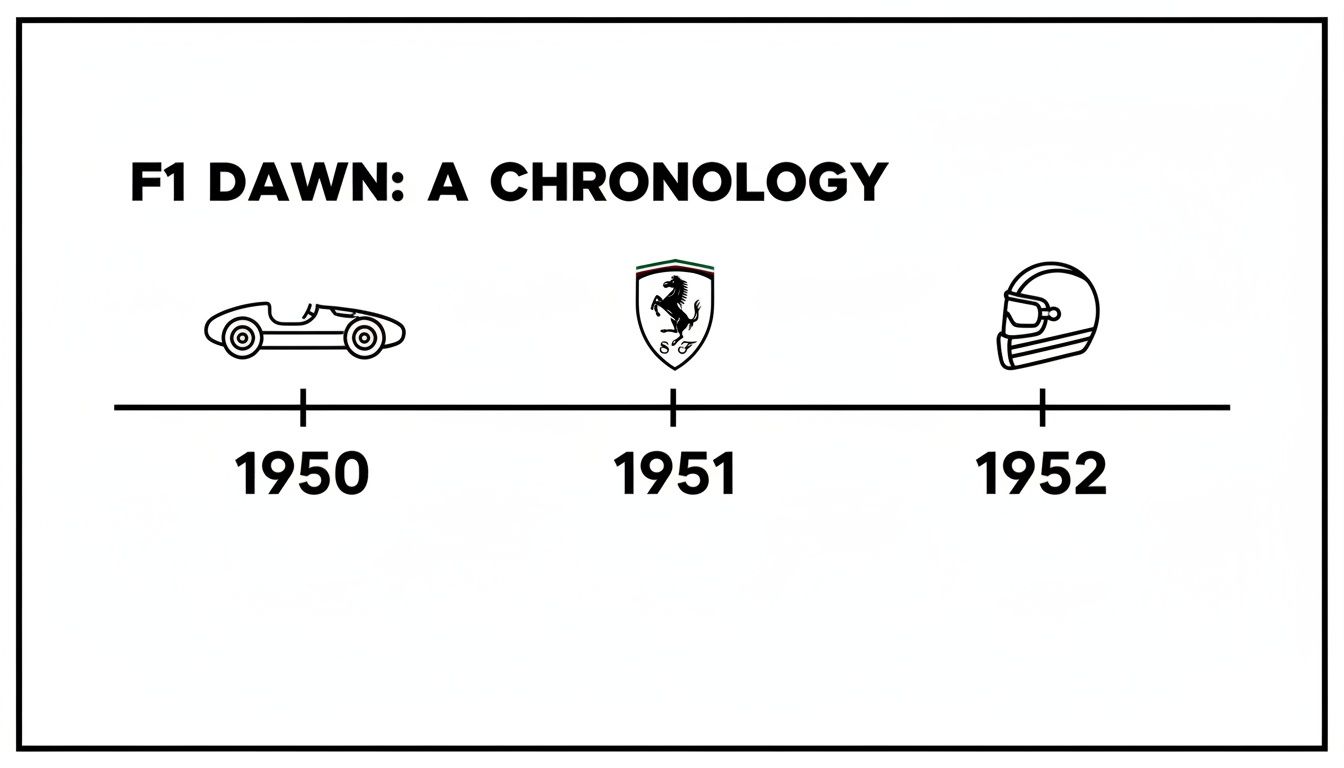
The rapid jump from the inaugural race in 1950 to Ferrari's first victory in 1951 shows just how fast the competitive landscape was evolving. It was a sign of the incredible innovation and intense rivalries that were to come.
Forging Legends in F1's Formative Years
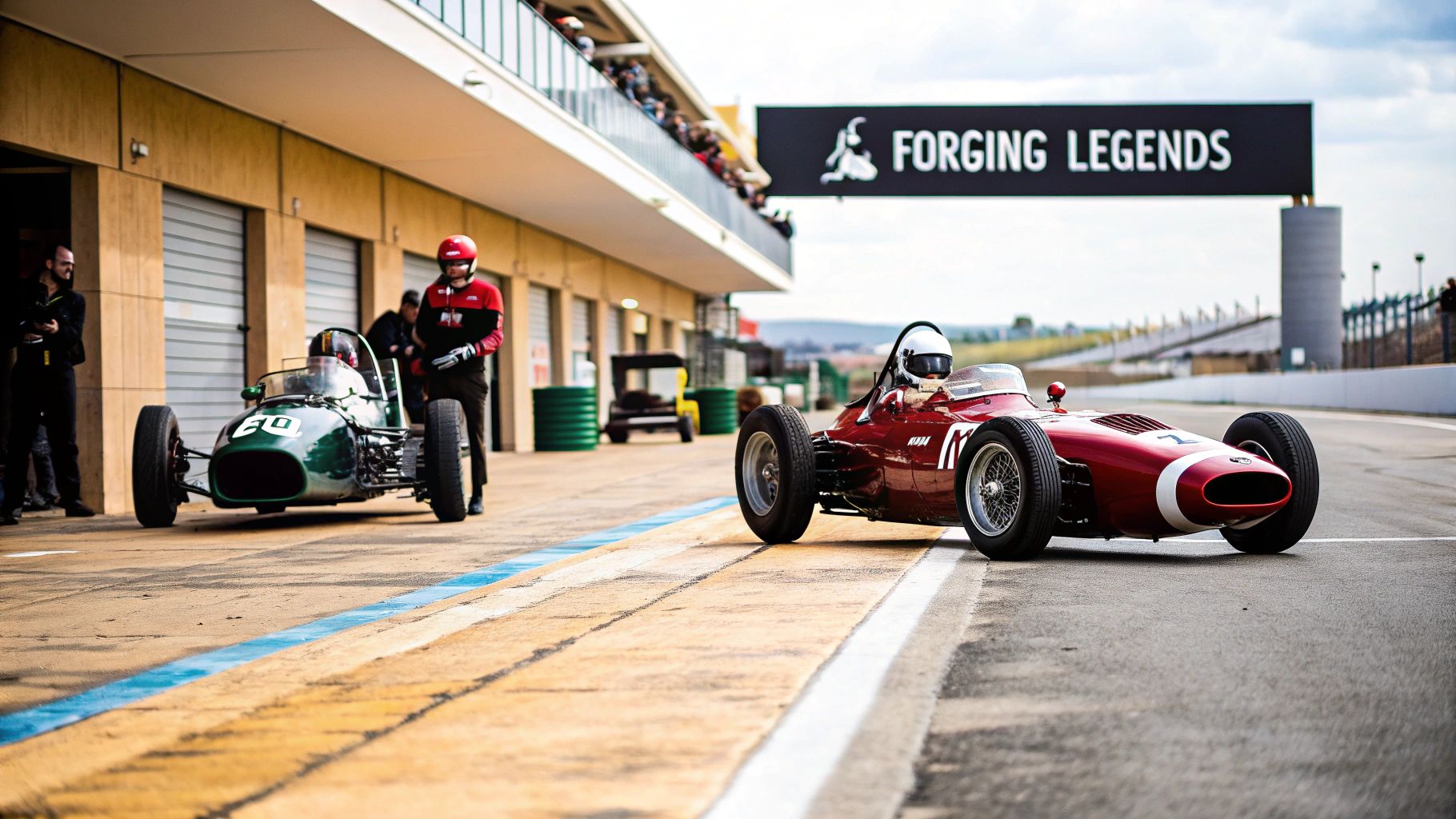
The first decade of Formula 1 was an era of thunderous, front-engined behemoths. These were machines of brute force, demanding an incredible mix of raw courage and delicate finesse from their drivers.
Nobody exemplified this better than the Argentinian maestro, Juan Manuel Fangio. His five world championships in the 1950s set a record that would stand for nearly half a century, cementing his status as one of the sport's original titans.
Fangio wasn't just quick; he was a strategic genius who instinctively understood the mechanical limits of his cars. He drove for Alfa Romeo, Maserati, Mercedes, and Ferrari, winning championships with all four—a feat that has never been repeated. His sheer dominance forged the heroic, larger-than-life image of the F1 driver in the public’s imagination.
But the fundamental design of these cars was about to be completely upended. For years, the gospel was that the engine belonged at the front, pulling the car along. A small British outfit called Cooper Car Company, however, had other ideas.
The Mid-Engine Revolution Changes Everything
In 1958, Cooper's lightweight, rear-engined T45 sent shockwaves through the paddock by winning the Argentine Grand Prix. Shifting the engine behind the driver delivered far superior balance, traction, and handling. It was a deceptively simple concept that made the cars infinitely more nimble through the corners.
The establishment giants, like Ferrari, initially scoffed at the design. But you can't argue with the results. By 1959, Jack Brabham had piloted a Cooper to the World Championship, proving once and for all that the mid-engine layout was the future. It was a watershed moment that rendered front-engined cars obsolete almost overnight, kicking off an era of inspired innovation.
The Cooper revolution was like realising you could steer a boat much more effectively with a rudder at the back instead of trying to pull it from the front. It fundamentally altered the physics of a racing car and opened the door for decades of British engineering dominance.
This period also gave rise to drivers who became household names. To celebrate these icons, many fans collect beautifully crafted driver framed prints that capture the character and grit of these early legends. The mid-engine layout didn't just change how cars were built; it demanded a new style of driving and set the stage for the next generation of heroes.
Swinging Sixties: British Dominance
The 1960s belonged to Britain. Teams like Lotus, BRM, and Brabham unleashed a wave of engineering creativity that left the rest of the world playing catch-up. Lotus, led by the brilliant Colin Chapman, introduced the monocoque chassis—a groundbreaking design where the car's body and frame were a single, stressed skin. This made cars dramatically lighter and stiffer, a massive leap forward in both performance and safety.
This era was defined by drivers whose talent seemed almost otherworldly.
- Jim Clark: A quiet Scottish farmer often hailed as the most naturally gifted driver of all time. He claimed two championships in 1963 and 1965 with Lotus, showcasing a level of car control that simply mesmerised his rivals.
- Graham Hill: The quintessential English gentleman racer, Hill won two titles and remains the only driver in history to clinch the "Triple Crown of Motorsport" (Monaco Grand Prix, Indianapolis 500, and 24 Hours of Le Mans).
- Jackie Stewart: Another Scot who emerged late in the decade, Stewart brought a new level of professionalism to the grid, alongside a fierce and determined crusade to improve the sport's frankly appalling safety standards.
The Visceral and Dangerous Seventies
As F1 roared into the 1970s, the cars grew wider, lower, and visually more aggressive. Aerodynamics became the new frontier, with massive wings sprouting from the front and rear to generate downforce, literally sucking the cars to the track. The introduction of slick tyres provided astonishing levels of grip, resulting in mind-bending cornering speeds.
But this raw power came at a terrible cost, making the 1970s one of F1’s most dangerous decades. The visceral thrill of the sport was perfectly captured in the legendary 1976 rivalry between the calculated, methodical Niki Lauda and the charismatic playboy James Hunt. Their titanic championship battle, which saw Lauda make a miraculous return from a near-fatal crash, showcased the intense human drama at the very heart of Formula 1.
Navigating the Turbo Era and Tech Wars
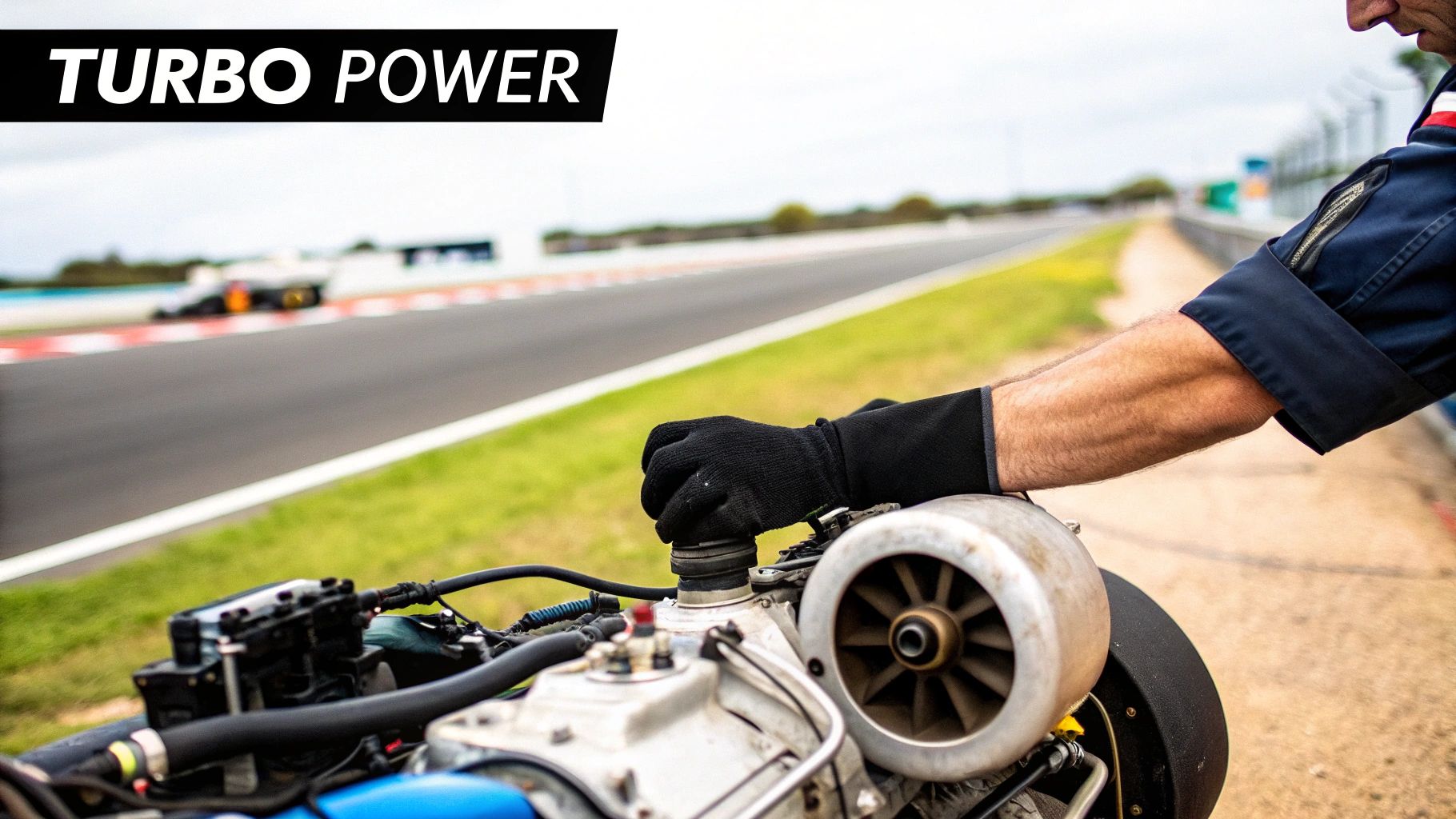
As the 1970s bled into the 1980s, a new sound began to scream from the pit lane—the high-pitched shriek of the turbocharger. This wasn't a gentle evolution; it was a raw, brutal display of engineering might. The Turbo Era had well and truly arrived, completely rewriting the F1 history books with its mind-bending power.
Teams like Renault, Ferrari, and BMW threw everything they had at pushing the limits of what was possible. They somehow managed to coax insane performance from tiny 1.5-litre engines. These power units were almost docile during a race, but for qualifying, they could be cranked up to eleven. The result? A staggering 1,400 horsepower for one single, blistering lap.
These cars were notoriously difficult to tame, often described as light switches—they were either off or on, with absolutely nothing in between. The sheer ferocity of these machines demanded drivers with immense skill, bravery, and a little bit of madness. It was in this crucible of fire-spitting engines that one of the sport's greatest rivalries was forged.
Prost vs Senna: A Defining Rivalry
The duel between Alain Prost and Ayrton Senna was far more than just a contest on the track. It was a psychological war that captivated the entire world. Prost, nicknamed "The Professor," was a calculating, impossibly smooth, and strategic driver. Senna, on the other hand, was pure, raw passion—an artist who pushed himself and his car to the absolute limit with an almost spiritual intensity.
Their rivalry exploded when they became teammates at McLaren in 1988. Behind the wheel of the Honda-powered MP4/4, one of the most dominant cars in F1 history, they won an unbelievable 15 of the 16 races that season. But their partnership was volatile, ultimately imploding in controversial championship-deciding collisions in both 1989 and 1990 that fans still debate today.
This intense personal and professional feud defined the late Turbo Era, creating a gripping story that drew millions of new fans to Formula 1. These legendary battles are a huge theme for motorsport enthusiasts decorating their space, with many choosing to celebrate the era through compelling Formula 1 race car framed prints that capture the drama.
The Rise of Electronic Aids
When turbos were outlawed at the end of 1988 over safety and cost concerns, a new battleground emerged in the 1990s: technology. The "tech wars" were on, and clever engineering became the key to victory. Teams like Williams, led by technical geniuses Adrian Newey and Patrick Head, mastered a suite of electronic driver aids that gave them a colossal advantage.
Key breakthroughs of this period included:
- Active Suspension: A game-changer. This system used computers to constantly adjust the car's ride height, keeping it perfectly level through corners to maximise its aerodynamic performance.
- Traction Control: This prevented wheelspin under acceleration, letting drivers slam the power down earlier and more aggressively when exiting a corner.
- Semi-Automatic Gearboxes: First introduced by Ferrari in 1989, paddle-shifters allowed for lightning-fast gear changes without the driver ever needing to take their hands off the wheel.
Williams perfected this technological cocktail, creating cars so advanced they seemed almost unbeatable. The 1992 Williams FW14B is often considered one of the most sophisticated cars in F1 history—a machine that, in some ways, practically drove itself.
This technological arms race powered Nigel Mansell to a dominant championship in 1992 and Alain Prost to his fourth and final title in 1993. However, it also sparked a fierce debate about whether the driver was becoming less important than the computer.
A New Legend and Lasting Changes
Against this high-tech backdrop, a new superstar announced his arrival. A fiercely determined German driver named Michael Schumacher claimed his first two championships with Benetton in 1994 and 1995. He showcased a unique blend of supreme talent and a relentless work ethic that would later power Ferrari's spectacular return to glory.
Tragically, this era was also marked by a dark weekend in 1994 at the San Marino Grand Prix, where the deaths of Roland Ratzenberger and Ayrton Senna shook the sport to its very core. This profound loss triggered an urgent and sweeping safety revolution. The result was stronger cars, redesigned circuits, and new rules that would make Formula 1 a much safer sport for generations to come, setting the stage for the modern era.
Modern Dominance and Global Expansion
As the new millennium dawned, one partnership was about to redefine dominance in Formula 1. It wasn't just a strong team; it was an unbreakable bond between a legendary driver and an iconic manufacturer. Michael Schumacher and Ferrari didn't just enter the 2000s as contenders—they arrived as an unstoppable force.
From 2000 to 2004, the combination of Schumacher's relentless talent and Ferrari's engineering perfection delivered five straight drivers' and constructors' championships. The run was simply staggering. It set a new benchmark for what was possible in the sport and cemented Schumacher's legacy with a then-record seven world titles.
The Screaming V8s and New Champions
By the mid-2000s, the rulebook got another shake-up, ushering in the era of high-revving 2.4-litre V8 engines. These naturally aspirated monsters produced a deafeningly beautiful scream that became the soundtrack for a fresh wave of competition.
The Ferrari dynasty finally crumbled, making way for a new generation of superstars. A young, fiercely competitive Spaniard named Fernando Alonso stormed onto the scene, clinching back-to-back world championships for Renault in 2005 and 2006. He was soon joined by another incredible talent, Lewis Hamilton, who nearly won the title in his rookie year before grabbing his first championship in the most dramatic fashion possible in 2008.
The V8 era was a period of intense competition. It wasn't just about one team running away with it all; multiple drivers and teams were constantly in the fight, creating a thrilling and unpredictable spectacle for fans around the globe.
This was also a golden age for Australian motorsport. Our nation has produced some serious talent over the decades, and drivers like Mark Webber were frequently battling at the very front of the grid during this period. You can explore the stats and stories of all Australian F1 drivers to see just how deep our racing heritage runs.
A New Formula and the Hybrid Revolution
The next seismic shift in F1's history landed in 2014, and it was one of the biggest technical overhauls the sport had ever witnessed. The screaming V8s were gone, replaced by mind-bogglingly complex 1.6-litre V6 turbo-hybrid power units.
This wasn't just a new engine; it was a completely new philosophy. The formula pivoted to energy efficiency, integrating advanced Energy Recovery Systems (ERS) that captured waste heat and kinetic energy. These power units were engineering masterpieces, achieving over 50% thermal efficiency—a number that road cars can only dream of.
The Mercedes-AMG Petronas team mastered this new technology on a level nobody else could touch. Their power unit was miles ahead of the competition, kicking off a period of dominance that made even Ferrari's earlier run look tame. From 2014 to 2020, Mercedes swept every single drivers' and constructors' title. Lewis Hamilton added six more championships to his name, equalling Michael Schumacher's record of seven and setting an entirely new standard for modern excellence.
The New Era and a Growing Global Audience
Looking to reset the pecking order and spark closer racing, Formula 1 rolled out another massive set of regulation changes for the 2022 season. The focus snapped back to ground-effect aerodynamics, a concept borrowed from the late 1970s and reimagined for today's cars. The goal was simple: let cars follow each other more closely and create more wheel-to-wheel action.
This new chapter ignited one of the fiercest rivalries in recent memory between Lewis Hamilton and the prodigious Max Verstappen. Their incredible battle for the 2021 championship, which went right down to the final lap of the final race, captivated an entirely new generation of fans.
This recent explosion in popularity has been turbocharged by new media. The runaway success of the docuseries Drive to Survive introduced the sport's human drama to a massive global audience, especially in the United States. You can see this growth at circuits worldwide, including at the famously packed Australian Grand Prix. F1's smart embrace of social media has turned it from a niche motorsport into a mainstream entertainment juggernaut, cementing its place in the global spotlight.
The Evolution of Formula 1 Battlegrounds
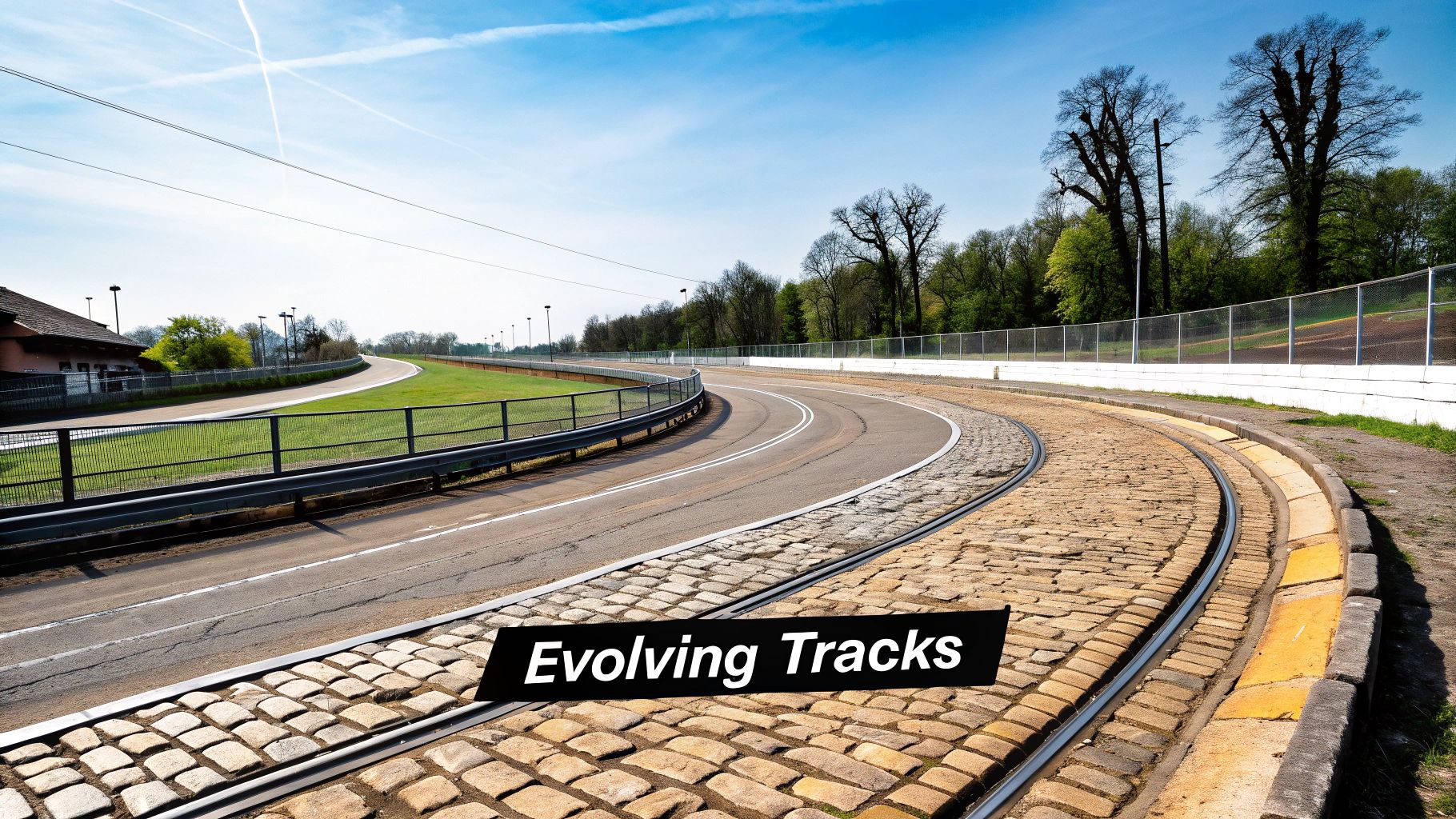
The story of Formula 1 is written not just by its drivers and cars, but on the very ground they race on. In the early days, the circuits were less like purpose-built racetracks and more like public highways temporarily borrowed for a high-speed showdown. These were the ultimate tests of raw courage.
Venues like the original Spa-Francorchamps in Belgium and Germany’s monstrous Nürburgring Nordschleife were breathtakingly fast and utterly terrifying. Lined with trees, ditches, and farmhouses instead of modern runoff areas, they offered absolutely zero room for error. The Nordschleife, aptly nicknamed "The Green Hell" by Jackie Stewart, was a twisting, 22.8-kilometre ribbon of tarmac that punished the smallest mistake with savage consequences.
These legendary circuits are woven into the fabric of F1 history, but their unforgiving nature came at a steep price, contributing to the sport's tragically dangerous reputation in its formative decades.
A Necessary Shift Towards Safety
The turning point came in the late 1960s and early 1970s. A growing chorus of drivers, fed up with accepting death as an occupational hazard, began to demand change. Led by the fiercely vocal safety advocate Jackie Stewart, the Grand Prix Drivers' Association started using its collective power to force urgent improvements to the circuits.
This driver-led movement sparked a revolution in circuit design. The old road courses were either abandoned or heavily modified to tame their deadliest elements. A new generation of purpose-built racetracks started to appear, designed from the ground up with driver safety as the priority.
Key safety innovations that we now take for granted were introduced:
- Wider Runoff Areas: Replacing trees and walls with gravel traps and grass gave drivers a fighting chance to slow down safely after losing control.
- Armco Barriers: Steel barriers were installed to absorb the energy of a crash and keep cars from flying into the crowd or surrounding obstacles.
- Improved Medical Facilities: On-site medical centres became mandatory, slashing the time it took to give life-saving treatment to injured drivers.
This was a fundamental shift in philosophy. It marked the end of one era and the beginning of a safer, more professional one, ensuring the sport's survival by finally putting its athletes first.
The shift to purpose-built circuits was less about taming the cars and more about respecting the drivers. It was an acknowledgement that the spectacle of speed should not have to come at the cost of human life.
The Modern Era of Tilkedromes and Street Circuits
Fast forward to the late 1990s and 2000s, and we see the rise of circuits designed by German architect Hermann Tilke. These "Tilkedromes," built in emerging markets like Malaysia, China, and Bahrain, became known for their long straights, tight hairpins, and world-class facilities. While praised for their impeccable safety and spectator amenities, they've often been criticised for producing less exciting, more predictable racing than the classic venues.
Partly in response, recent years have brought a celebrated return to the thrill of city racing, but this time with modern safety standards baked in. Street circuits like Baku and Singapore blend the close-quarters challenge of old-school tracks with the security of today’s technology, creating a spectacular modern twist on a classic F1 concept.
The Australian Grand Prix’s move from Adelaide's tight street circuit to Melbourne's Albert Park in 1996 is a perfect example of striking this balance. The semi-permanent Albert Park track has become a massive fan favourite and a commercial powerhouse. The inaugural Melbourne event drew a staggering 401,000 fans, setting a new benchmark for organisation. That success has only grown, with recent attendance soaring past 444,000, cementing its place as a cornerstone of the F1 calendar. You can explore more of its history in these Australian F1 Grand Prix race facts.
Commonly Asked Questions About F1 History
Once you start exploring the incredible history of Formula 1, you’ll find it’s full of passionate debates and tricky questions. It's all part of the fun. Let’s dive into some of the big ones that every fan has chewed over at some point.
Here, we’ll cut through the noise and give you clear answers on the drivers, the rules, and the moments that defined this amazing sport.
Who Is the Greatest F1 Driver of All Time?
Ah, the ultimate motorsport debate. The short answer? There isn't one.
If you’re just looking at the numbers, the conversation has to start with Lewis Hamilton, who holds the record for the most wins (105), and Michael Schumacher. They both sit on an incredible seven world championships. Their eras of dominance are simply staggering.
But for the purists, it’s not always about the stats. Many will argue for Juan Manuel Fangio, whose win rate in the lethal 1950s was almost unbelievable. Others will point to the blinding, raw speed of Ayrton Senna in qualifying, or the pure, effortless talent of a driver like Jim Clark. The "greatest" really depends on what you value most—statistics, natural car control, or sheer dominance in a particular era.
The greatest driver isn't just a name on a trophy. It's a combination of talent, timing, and the machine they command. The debate is what keeps F1 history alive and exciting for every generation of fans.
What Was the Most Dangerous Era in F1?
Without a doubt, the period from the 1950s through to the late 1970s was the most perilous time in the sport's history. The cars were brutally powerful, but the drivers had almost no protection. Modern survival cells and effective fire suppression systems were things of the future.
To make matters worse, many circuits were just public roads lined with trees, buildings, and ditches, with absolutely no runoff areas. It’s a sobering thought, but fatalities were tragically common until drivers like Jackie Stewart led a charge for safety. His tireless campaigning forced the sport to finally prioritise driver survival, which led to much safer cars and the purpose-built tracks we see today.
What Is the Biggest Technological Leap in F1 History?
This is a tough one, but two innovations really stand out as complete game-changers for the sport.
The first was the arrival of aerodynamics and wings in the late 1960s. This completely revolutionised how cars generated grip and could fly through corners at speeds previously thought impossible. It changed the entire philosophy of car design.
The second, more recent leap was the monumental shift to V6 turbo-hybrid power units in 2014. These aren't just engines; they're masterpieces of engineering. Combining a traditional engine with sophisticated energy recovery systems, they achieve over 50% thermal efficiency—making them the most efficient racing engines ever constructed. This move defined the modern technological soul of F1. You can celebrate these engineering marvels with stunning Formula 1 posters that put incredible car design front and centre.
At TrackNation, we bring the passion of motorsport into your home. Our premium wall art celebrates the legendary circuits, iconic cars, and heroic drivers that make F1 history unforgettable. Find the perfect piece to honour your favourite era at https://tracknation.au.