

A Collector's Guide to Formula One Memorabilia
Formula One memorabilia isn't just about collecting things; it’s about owning a tangible connection to the sport’s most electric moments, legendary drivers, and mind-bending engineering. These pieces, from striking art prints to battle-scarred, race-used car parts, let you bring a piece of motorsport history right into your own home.
Starting Your Journey into F1 Collecting
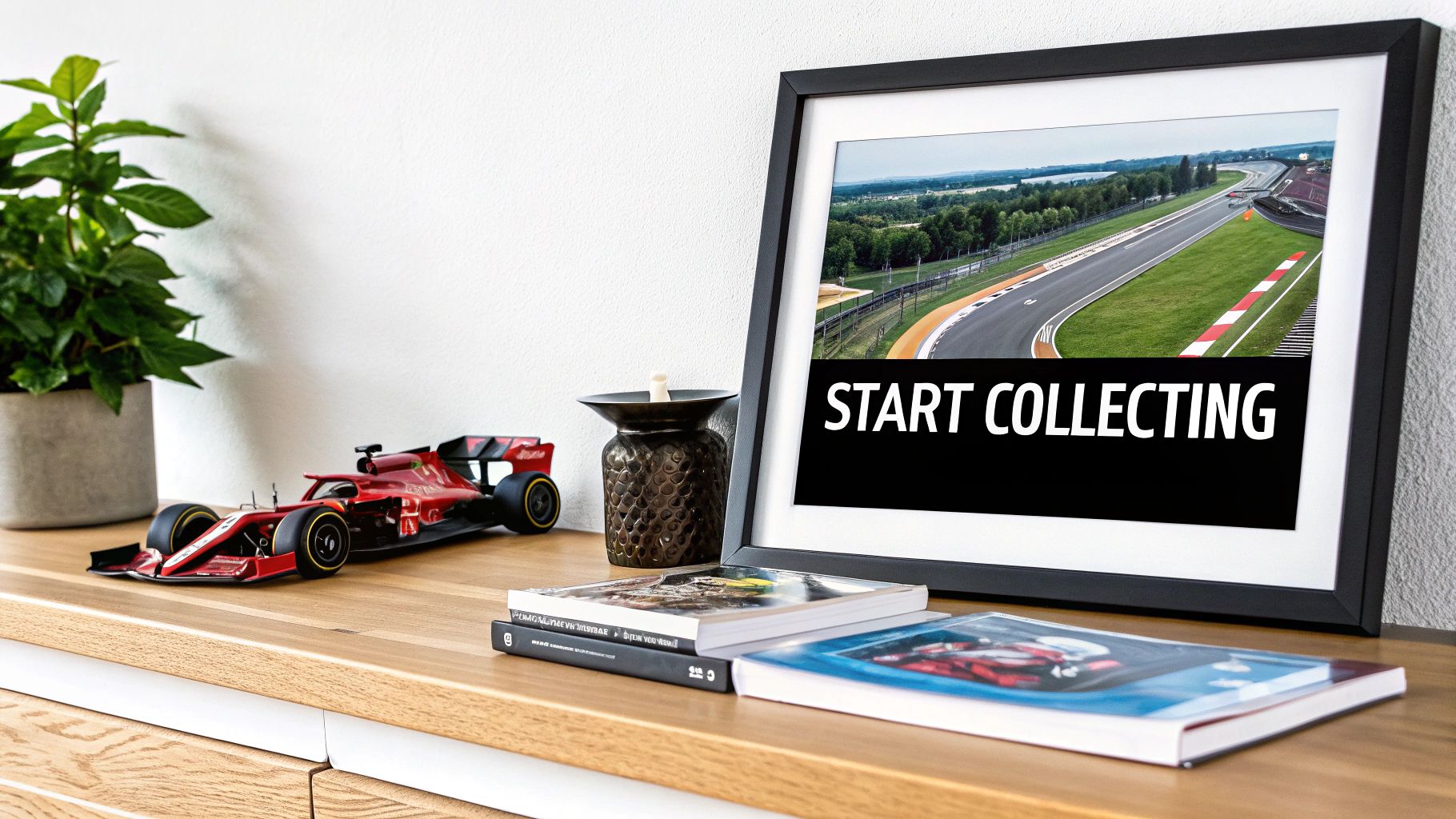
The deafening roar of an engine, the blur of a car screaming down a straight, that heart-stopping last-lap overtake—these are the moments that truly define Formula 1. They forge memories that fans hold onto forever. This guide is your map to owning a physical piece of that incredible history. We’ll explore the world of Formula One memorabilia not as simple objects, but as powerful links to the heroes, the machines, and the unforgettable races that make F1 the absolute pinnacle of motorsport.
Collecting is a passion that’s open to every kind of fan. Whether you’re after a single, stunning piece of wall art to celebrate your favourite circuit or you dream of acquiring a component from a race-winning car, there’s an entry point just for you. The journey really begins with understanding what makes an item special and how it fits into the grand story of the sport.
What Makes F1 Memorabilia So Special
At its heart, collecting F1 memorabilia is about storytelling. Every single item holds a narrative, connecting you directly to a specific point in time.
Think of it this way: a history book can tell you about a great battle, but holding a soldier's helmet from that very battle makes the story feel real. In the same way, a framed print of Senna at Monaco doesn't just decorate a wall; it captures the very spirit of a legend in his element.
An F1 collectible is more than just an item; it’s a frozen moment of speed, strategy, and human achievement. It transforms your passion for the sport into something you can see and touch every day, making the history of F1 a part of your personal space.
This powerful connection is what drives the desire to collect. It’s all about preserving the legacy of the drivers, the brilliance of the engineers, and the pure drama of the races. For a deeper dive into the sport's incredible past, you can explore the pivotal moments that define F1 history and see how these events have shaped the kinds of collectibles available today.
Building a Meaningful Collection
Starting a collection doesn't require a huge budget or a lifetime of expertise. It simply starts with figuring out what truly resonates with you. The most rewarding collections are always built on passion, not just potential value. Here’s how you can get started:
- Identify Your Passion: Are you drawn to a specific driver like Michael Schumacher or Lewis Hamilton? A particular team like Ferrari or McLaren? Or maybe it’s the technical beauty of the cars themselves that gets your engine running.
- Start with Accessible Pieces: High-quality wall art, detailed model cars, or official team apparel are fantastic starting points. They are visually stunning, widely available, and let you showcase your fandom right away.
- Focus on Story, Not Just Rarity: An item from a race you actually attended or a print of your favourite track can hold far more personal meaning than a rare but impersonal piece.
Ultimately, your collection should be a reflection of your unique connection to Formula 1. This guide will give you the foundational knowledge you need to navigate this exciting world and build a collection you’ll cherish for years to come.
What Kinds of F1 Collectibles Are Out There?
From a sleek print capturing a car’s perfect lines to a battle-scarred piston that’s seen thousands of RPMs, the world of Formula One memorabilia is incredibly deep and diverse. Getting your head around the main categories is the first step toward finding pieces that really connect with your passion for the sport—and fit your budget.
Let’s break down the five main types of F1 collectibles. Each one offers a totally unique way to own a piece of motorsport history, and knowing the difference will help you build a collection that tells a brilliant story.
High-Quality Wall Art and Prints
For most of us, art is the gateway into the world of collecting. High-quality prints and canvases perfectly capture the visual drama of Formula 1—the beautiful engineering of a car, the iconic corners of a legendary track, or a portrait of a driver who defined an era. This is the ideal way to bring your passion into your home or office without it feeling out of place.
These aren't just your average posters; they’re curated works of art celebrating the sport's incredible design and heritage. They let you own a piece of the F1 aesthetic without the eye-watering price tag or the complex authentication process that comes with other types of memorabilia. Imagine a minimalist print of the Spa-Francorchamps circuit hanging in your office—it's a subtle but powerful nod to the sport you love. If you're looking to kickstart your collection with something visually stunning, exploring different styles of Formula 1 posters is a fantastic starting point.
Signed Memorabilia
An autograph instantly transforms an everyday object into a direct link to a hero of the sport. Signed memorabilia is easily one of the most personal and sought-after categories, covering everything from driver cards and photos to helmets, gloves, and caps. There's just something special about holding an item personally signed by a legend like Ayrton Senna or a modern champion like Max Verstappen.
The real value here comes down to the signature's authenticity and rarity. Of course, a signature on a race-worn helmet is going to be leagues more valuable than one on a promotional postcard, but they both serve the same core purpose: closing the gap between fan and icon.
A genuine signature is like a handshake across time. It certifies that the driver once held that very item, infusing it with a personal touch that can't be replicated. This direct connection is what makes signed formula one memorabilia so special to collectors.
Race-Used Components
If you're fascinated by the pure engineering genius of F1, then nothing beats owning a piece of a car that’s actually seen action on the track. Race-used components are parts taken directly from a Formula 1 car after a race or a full season. These pieces carry the physical story of their time on the circuit—every scuff, every bit of carbon fibre wear, and every hint of heat discolouration tells a tale.
This category has an incredible range of options for every budget:
- Small Components: Things like wheel nuts, spark plugs, or tiny winglet endplates are pretty accessible and make for fascinating display pieces.
- Larger Parts: More significant bits like sidepods, rear wings, or engine covers are major statement pieces that really show off the incredible craftsmanship of an F1 machine.
- Mechanical Internals: Pistons, gears, and brake discs give you a look inside the heart of the beast, appealing to the more technically-minded collectors.
Owning a race-used part is like owning a relic from a high-speed battle. It’s a tangible piece of engineering history that has been pushed to its absolute limits.
Official Team Apparel and Merchandise
Showing your allegiance to a team is a massive part of being an F1 fan. Official team apparel, from race suits worn by the pit crew to limited-edition team jackets, is the perfect way to do it. While a current-season team polo is just merchandise, a rare, vintage team jacket from a past era? That’s a true collectible.
The key difference is rarity and significance. A standard team cap is a great souvenir, but a cap from a championship-winning year, especially one that's no longer made, elevates it to proper memorabilia status. This category is perfect for fans who want to wear their passion and collect items that represent specific, golden eras of their favourite constructor.
Historical Ephemera
Finally, we have historical ephemera—items that capture a specific moment in time. This is a broad category that includes things like race day programmes, event tickets, old pit passes, and promotional flyers from bygone eras. They might not be as glamorous as a signed helmet, but these paper goods are vital historical documents.
Think about it: a race programme from the 1970 Monaco Grand Prix gives you a perfect snapshot of the sport at that exact moment. You see the drivers who were competing, the sponsors of the day, and the articles written at the time. These items are often surprisingly affordable and let you build a rich, detailed collection that chronicles the evolution of Formula 1 through the decades. They're the footnotes and annotations that truly bring the sport's incredible history to life.
Here's a quick look at how these categories stack up.
Types of Formula One Memorabilia at a Glance
| Category | Examples | Primary Appeal |
|---|---|---|
| Wall Art & Prints | Circuit maps, driver portraits, car canvases | Aesthetic appeal, easy to display, accessible price point |
| Signed Memorabilia | Autographed photos, helmets, caps, driver cards | Personal connection to a driver, high sentimental value |
| Race-Used Parts | Wing endplates, wheel nuts, pistons, bodywork | Tangible piece of F1 engineering, connection to on-track action |
| Team Apparel | Vintage team jackets, race-worn crew shirts | Showing team loyalty, nostalgia for specific eras |
| Historical Ephemera | Race programmes, tickets, pit passes | Historical documentation, affordability, storytelling potential |
Ultimately, each category offers a different way to connect with the sport, whether you're drawn to the art, the heroes, the tech, or the history.
How to Authenticate F1 Memorabilia
In the world of collecting, authenticity isn't just a nice-to-have—it's everything. It’s what separates a genuine piece of motorsport history from a mere souvenir. So, let's walk through how you can verify the legitimacy of your Formula One memorabilia and make sure every item in your collection has a real story to tell.
The absolute cornerstone of authenticity is provenance. Think of it like an item's logbook. Just as a car's service history details its owners and repairs, an item's provenance traces its journey from the moment it left the track or a driver’s hands, right to your own. Great provenance could be anything from photos of the item being signed to official team paperwork.
The Power of a Certificate of Authenticity
The most common form of provenance you’ll come across is a Certificate of Authenticity (COA). This is a document that certifies an item—like a signature or a race-used part—is the real deal. But here’s the crucial part: not all COAs are created equal. The credibility of a COA is only as good as the reputation of who issued it.
A COA from a globally recognised authenticator or directly from an F1 team carries serious weight. On the flip side, a certificate printed at home by a random seller is basically worthless. Always do your homework on the COA's issuer before you put any trust in it.
This quick overview shows you where authenticity matters most.
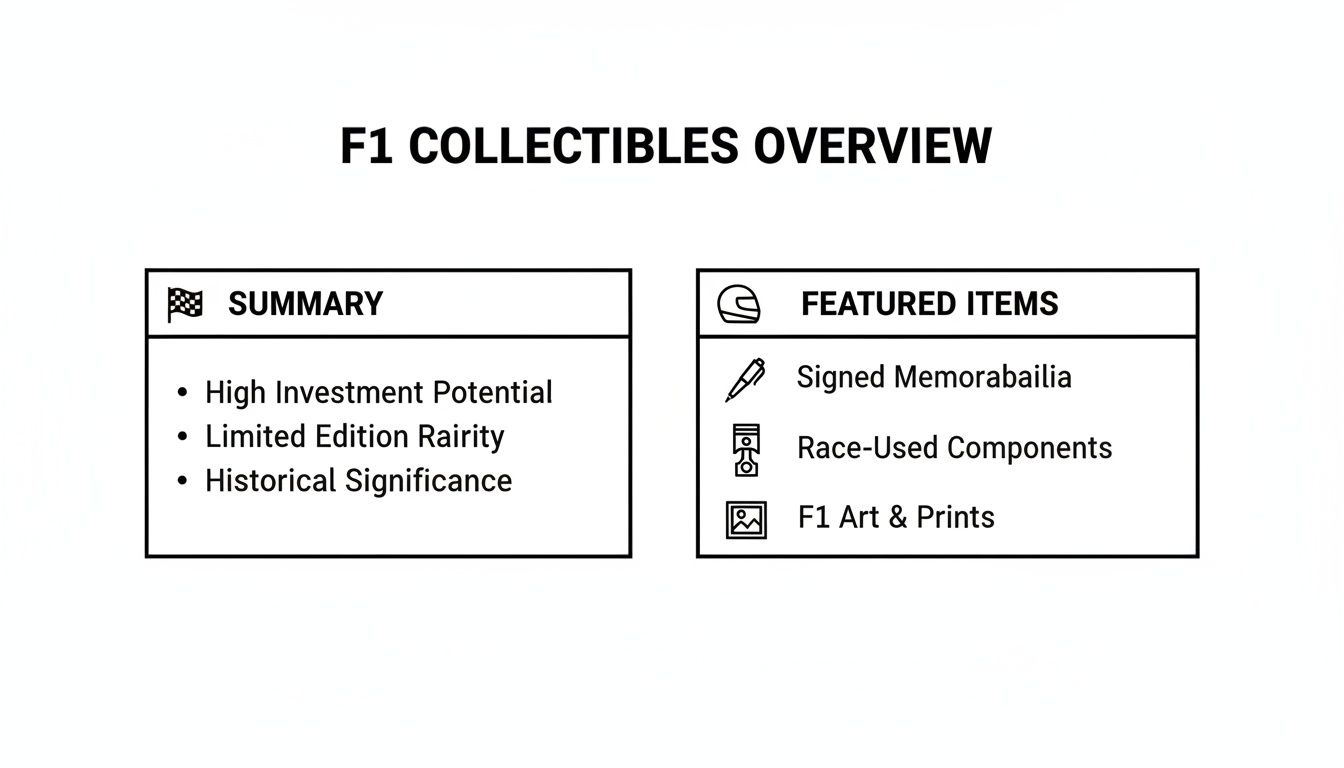
As you can see, while the value of art lies in its aesthetics, signed and race-used items are completely dependent on verified authenticity to hold their worth.
Identifying Reputable Dealers and Sources
The safest way to get your hands on genuine Formula One memorabilia is to stick with established specialists. Reputable dealers spend years, sometimes decades, building a reputation for sourcing and verifying authentic items. Their entire business is built on trust, so they have every reason to get it right.
Here are a few signs of a trustworthy seller:
- Detailed History: They provide a full background for each piece, explaining its origin and story.
- Transparent Policies: They have clear return policies and stand behind their items with guarantees of authenticity.
- Strong Reputation: They’ve got positive reviews, a professional online presence, and are often respected by other collectors.
The passion for rare F1 gear has exploded in Australia, with prices often mirroring the big global auctions. Official channels like F1 Authentics, which launched in 2019, now offer a direct pipeline to verified race-worn suits and signed kit. Smart collectors know this level of certainty is priceless, and it’s what builds long-term trust.
Common Red Flags to Watch Out For
Just as important as knowing what to look for is knowing what to run from. When you're browsing for a new piece, especially on big online marketplaces, keep your eyes peeled for red flags that should make you hit the brakes.
If a deal seems too good to be true, it almost certainly is. A race-used helmet from a world champion will never sell for a couple of hundred dollars. Trust your gut and always treat unbelievable bargains with a healthy dose of scepticism.
Be wary of vague descriptions that skip key details like the race, year, or driver. Low-quality photos that hide parts of the item or sellers who dodge questions about its history are also huge warning signs. And of course, a lack of verifiable provenance or a dodgy-looking COA should be an instant deal-breaker.
A piece of apparel like a driver-signed cap can be a fantastic collectible, but its value is completely tied to that proof. For more on this, check out our guide to collecting Formula One caps. By staying vigilant and sticking to authenticated sources, you can build a collection that’s not only valuable but truly connected to the sport you love.
Understanding What Your Collection is Really Worth
So, what makes a driver's glove from the Monaco Grand Prix worth a whole lot more than a wheel nut from the very same car? Getting your head around the value of Formula One memorabilia is about much more than just a price tag. It's about learning to read the story behind each item and knowing the key ingredients that turn a cool souvenir into a seriously prized collectible.
Think of it like this: two diamonds might look pretty similar, but their real value comes down to the four Cs—cut, colour, clarity, and carat. F1 memorabilia plays by a similar set of rules, with its own criteria that separate the good from the great. Once you get a handle on these, you'll be making smarter calls, whether you're buying a gift, looking for an investment, or just building a personal collection that truly means something.
The Driver and the Moment
The absolute biggest factor? The name attached to the item. It’s that simple. Memorabilia tied to a world champion or a true legend—think Ayrton Senna, Michael Schumacher, or Lewis Hamilton—will almost always be in a different league compared to an item from a driver who didn't quite make the same mark. Their status in the sport’s history acts as a massive value multiplier.
But it’s not just who it belonged to; it’s also about when. The significance of the event is a massive piece of the puzzle. An item from a race where a driver clinched a world championship is worlds apart in value from something used in a pre-season test. The story of that specific moment—a record-shattering lap, a nail-biting victory, or a driver's final race—is baked right into the item, giving it layers of historical weight.
Rarity and Condition
Just like any other collecting hobby, scarcity is king. A one-of-a-kind, race-worn helmet is naturally going to be rarer than a mass-produced signed photo. Teams go through thousands of wheel nuts in a season, but a driver only wears a handful of helmets. This basic principle of supply and demand is a huge driver in the Formula One memorabilia market.
An item’s condition is right up there in importance, too. A race suit in pristine condition will fetch a much higher price than one with serious damage—unless, of course, that wear and tear is part of its story, like battle scars from a famous on-track clash.
An item’s value is a delicate dance between its history and its physical state. A perfectly preserved piece tells a story of care, while a race-used part’s scuffs and marks tell a story of action. Both can be valuable, but mint condition usually takes the prize.
Provenance and What’s Hot Right Now
As we've touched on, strong provenance—that is, the verifiable history of an item—is the foundation of its value. A piece that comes with a rock-solid Certificate of Authenticity and a clear history of ownership straight from the team or driver is always going to be more sought-after than one with a murky backstory. Without proof, it's just a cool object with a nice story.
Finally, don't underestimate the power of a cultural moment. The "Drive to Survive" effect has pulled a whole new generation of fans into the sport, sparking massive interest in memorabilia from today's popular drivers and teams. When a driver has a killer season, you can bet the value of their gear will spike. Keeping an eye on these market trends is key to understanding why certain pieces suddenly become hot property. All these factors come together to create a lively market where history, rarity, and hype all have a say in an item’s final worth.
How to Display and Preserve Your Memorabilia
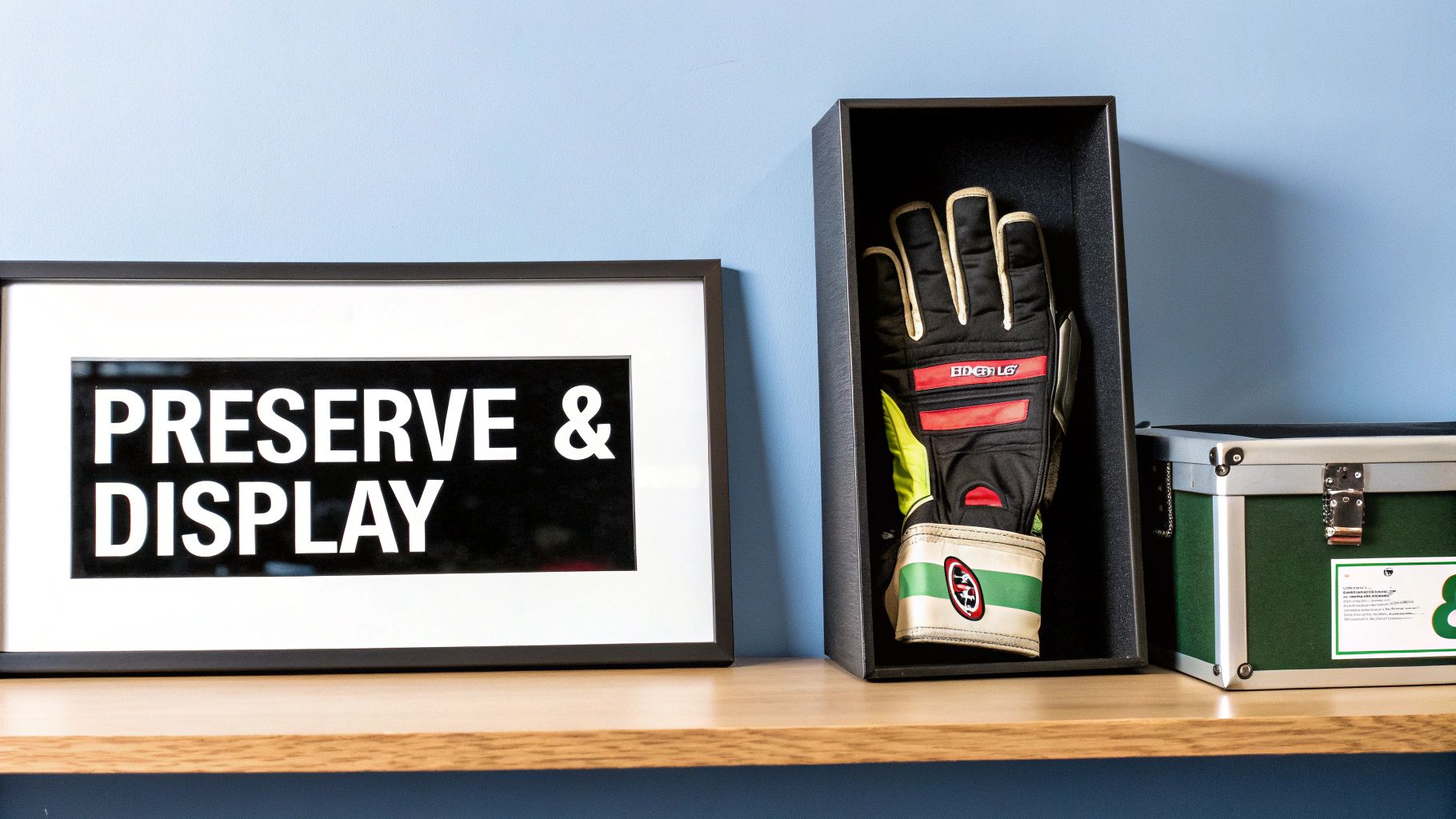
Getting your hands on a prized piece of Formula 1 memorabilia is an incredible feeling, but that’s only half the battle. The other half is giving it a home where it can be admired without falling victim to the ravages of time.
Think of your collection like a classic F1 car; it needs the right conditions to stay in pristine shape. The biggest threats are often the ones you can’t see: ultraviolet (UV) light, humidity, and wild temperature swings. These silent assassins can fade signatures, discolour materials, and make paper brittle.
Your mission is to create a stable, controlled environment. Keep your items out of direct sunlight, away from damp basements, and clear of heat sources like radiators. A consistent, cool, and dry space is the gold standard.
Framing and Displaying with Care
When it comes to prints and signed photos, a frame is much more than a decorative border—it's a suit of armour. Investing in proper framing is one of the most important things you can do to protect your visual pieces.
Here’s what you need for archival-quality framing:
- UV-Protective Glass or Acrylic: This is non-negotiable. It acts like sunscreen for your art, blocking up to 99% of the harmful UV rays that cause fading.
- Acid-Free Mounts and Backing: Standard cardboard can leach acids over time, causing "mat burn"—a permanent yellow or brown stain. Always insist on acid-free materials.
- Spacers for 3D Objects: If you’re framing something with a bit of depth, like a signed cap or glove, use spacers. This stops the item from pressing against the glass, which can trap moisture and cause damage.
This careful approach turns your collectibles into a personal exhibit. For those looking to start or expand their visual collection, our guide to stunning Formula One wall art is packed with inspiration on how to make a real statement.
Creating Your Personal F1 Exhibit
Beyond just framing, think about how you weave your passion into your decor. A thoughtfully arranged display tells a story, turning your space into a personal gallery of motorsport history. You could group items by driver, team, or a specific era to create a cohesive theme.
This enthusiasm for F1 decor is booming, especially here in Australia, which ranked third globally for F1 merchandise sales in 2022. This shows a massive appetite for premium items, from high-quality canvas prints of Albert Park to framed maps celebrating our Aussie heroes. It’s exactly why curated collections, like those featuring stylish cotton canvases, are perfect for turning an office or garage into a sophisticated fan space.
A great display does more than just show off your items; it communicates your passion. It balances visibility with protection, allowing you to enjoy your collection every day while ensuring it lasts a lifetime.
Whether it’s a single statement piece or a full wall dedicated to the sport, a well-preserved collection becomes a focal point and a constant source of inspiration, connecting you daily to the high-octane world of Formula 1.
Where to Safely Buy and Sell F1 Memorabilia
Navigating the world of Formula 1 memorabilia can feel like trying to thread a needle at 300 km/h. Knowing where to look is everything if you want to build a genuine collection without hitting any unexpected barriers. The landscape has a few different channels, and each comes with its own set of rules and rewards for the smart collector.
Your safest bet is always to start with official sources. Think team-run stores and licensed partners like F1 Authentics, which give you a direct-from-the-source guarantee. Specialised online retailers are another fantastic choice, as their entire reputation is built on the quality and legitimacy of what they sell. These people live and breathe motorsport, and it shows in their curated collections.
The Best Places to Source Your Collection
Once you're ready to cast a wider net, you’ll find several trusted avenues. Each platform really caters to a different type of collector, from the casual fan to the serious investor. Getting your head around these differences is the key to finding the right piece at the right price.
Reputable auction houses are where the truly rare and significant pieces of Formula One memorabilia tend to surface. These institutions have specialists on staff who verify the story behind every item, giving buyers a high level of confidence. They’re the place to go for high-value gear like race-worn helmets or significant car parts, but be ready for some fierce competition and a buyer's premium on top.
Private dealers offer a much more personal touch. A good dealer builds relationships and can often track down specific items you’re hunting for. Their business relies on their reputation, so a well-regarded dealer is usually a very safe bet for picking up properly authenticated pieces.
The smartest collectors treat their sources like a race team treats its suppliers—they find trusted partners with a proven track record and stick with them. That relationship with a reputable dealer or retailer is one of the most valuable assets you can have.
Weighing Your Options and Avoiding the Potholes
Now, while marketplaces like eBay might look tempting with their endless listings, you have to be extremely careful. The risk of stumbling across fakes or items with a dodgy history is so much higher. If you do decide to dip your toe in, vet the sellers like your life depends on it. Check their feedback, ask detailed questions about provenance, and never, ever buy something that doesn't have a credible Certificate of Authenticity.
It's also worth being a bit wary when buying merchandise at live events. The buzz of a Grand Prix weekend has a way of inflating prices for standard apparel. For example, during the Melbourne GP, fans reported seeing trackside markups of 20-70%, with a hat costing $100 when you could get it for $30 online. You can read more about this trend in this piece on F1 merchandise sales.
This is exactly why dedicated online stores often offer far better value and a more thoughtful selection. Instead of an impulse buy at the track, you can put your money towards a premium piece that truly celebrates the sport. For instance, focusing your budget on high-quality artwork, like beautifully crafted driver framed prints, is a more lasting and sophisticated way to show your passion. By choosing your marketplace wisely, you protect your investment and make sure your collection is built on a foundation of authenticity and real value.
Got Questions About F1 Memorabilia? We’ve Got Answers.
As you get pulled deeper into the incredible world of Formula One memorabilia, questions are bound to pop up. It’s a fascinating hobby with its own language and rules, so let’s clear the air on some of the things new and even seasoned collectors often ask. Getting these fundamentals right will give you the confidence to build a truly special collection.
Think of it this way: understanding these points helps you build a collection that doesn't just look amazing but is also built on a solid foundation. It’s all about making smart moves that connect with your passion for the sport.
What's the Best Starting Point for a New F1 Collector?
Honestly, for anyone just dipping their toes in, you can't go wrong with a high-quality art print of a favourite car or circuit. It’s a brilliant, accessible way to get started. You get to express your passion visually without immediately diving into the deep end of authenticating signed or race-used items.
These pieces are the perfect foundation for any collection. You can hang them up and enjoy them straight away while figuring out what your personal taste is before you hunt down more specialised Formula One memorabilia. A stunning print is a daily celebration of the sport's incredible aesthetic.
Starting with art is like learning a circuit on a simulator before the real race. You get a feel for what you love and what you want to invest more in, all without the high stakes of verifying a rare, one-of-a-kind piece.
How Can I Be Sure an F1 Signature Is Real?
This is a big one. The only dead-certain way to know a signature is genuine is to buy from a reputable dealer who provides a Certificate of Authenticity (COA). Provenance is everything here. Look for items with a documented history—things like photos of the driver actually signing the piece are gold.
Always be wary of deals on general marketplaces that feel too good to be true and lack any verifiable proof. A real signature adds huge personal and financial value, but only if its authenticity is rock-solid. Without that proof, you’re just buying a good story.
Is F1 Memorabilia a Smart Financial Investment?
Look, while some rare items with bulletproof provenance can definitely go up in value, collecting should always start with passion. The market can be unpredictable, and an item's value is tied to all sorts of things, like a driver's popularity, race wins, and current market trends.
My advice? Focus on collecting pieces you genuinely love and feel a connection to. If they happen to increase in financial value over time, think of it as a fantastic bonus to the joy they already bring you. The real return on investment is having a piece of motorsport history hanging on your wall.
Ready to bring the thrill of the track into your home? At TrackNation, we've curated a collection of premium motorsport wall art and accessories designed for true fans like you. Explore our collection and find the perfect piece to celebrate your passion at https://tracknation.au.