

Your Ultimate Guide to the Formula One Monaco Grand Prix
When you think of Formula 1, what’s the first race that comes to mind? For millions, it’s the Formula One Monaco Grand Prix. It’s widely seen as the most prestigious and glamorous race in all of motorsport, a unique spectacle where high-speed racing meets high society on the narrow, unforgiving streets of Monte Carlo. This is one-third of the legendary Triple Crown of Motorsport, and for good reason.
The Crown Jewel of Formula 1
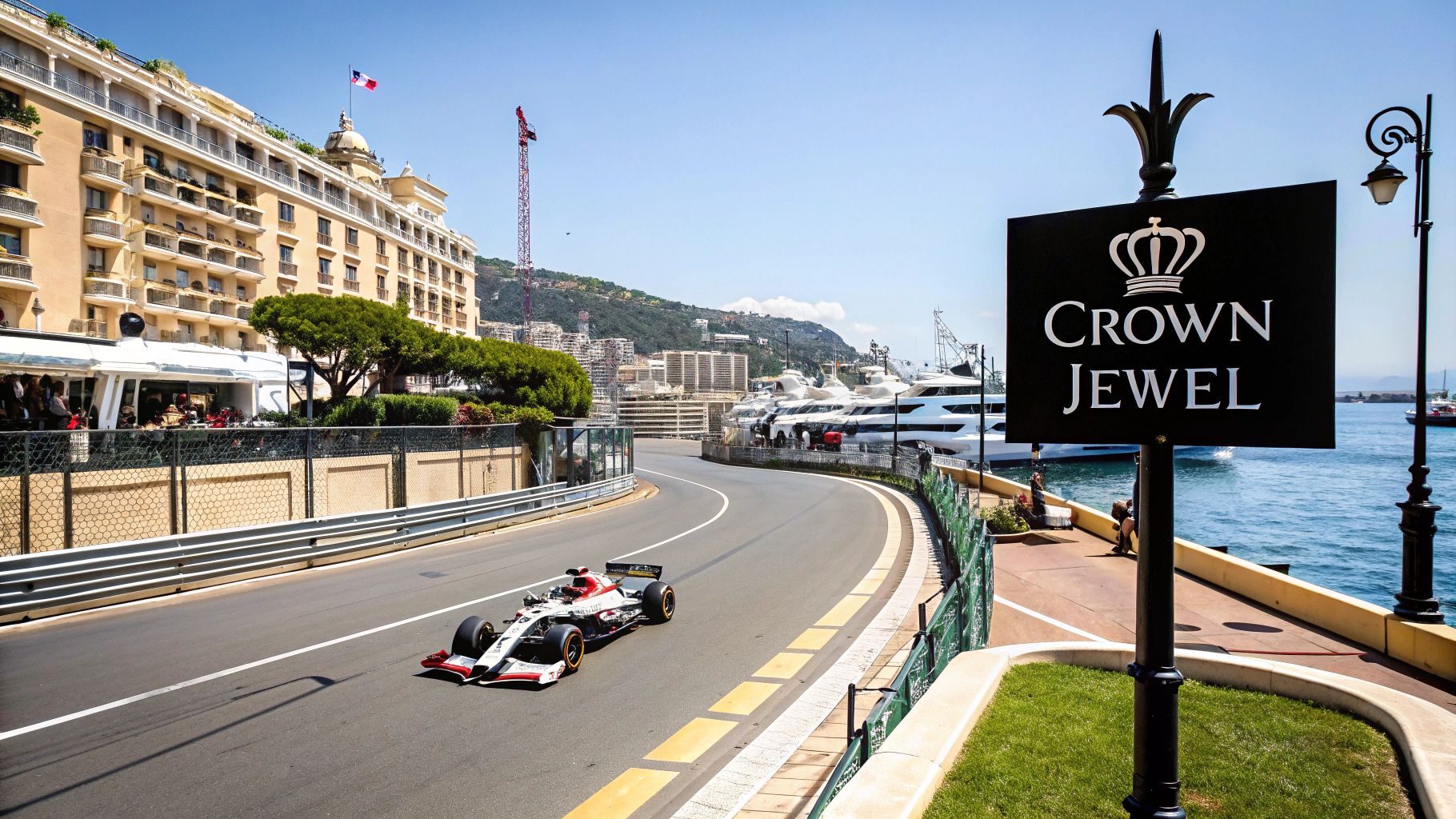
There are plenty of incredible races on the Formula 1 calendar, but none capture the world's imagination quite like Monaco. It's so much more than a competition; it’s a global event steeped in history, prestige, and pure theatre. For one weekend each year, the usually tranquil streets of the Principality of Monaco transform into a breathtakingly fast and impossibly challenging street circuit.
This race is a one-of-a-kind fusion of sport and culture. The scream of F1 engines echoes between luxury apartment buildings and historic casinos, while superyachts pack the iconic Port Hercule, creating a backdrop you won't find anywhere else. It’s a place where the rich history of motorsport is alive on every single corner. If you want to dive deeper into the sport's origins, you can explore the fascinating history of Formula 1 in our detailed article.
Why Monaco Is A Unique Challenge
What truly sets the Formula One Monaco Grand Prix apart is the sheer difficulty of the circuit itself. Unlike purpose-built racetracks with wide, forgiving run-off areas, Monaco’s circuit is a temporary labyrinth of public roads. The track is defined by its famously tight corners, dramatic elevation changes, and unforgiving Armco barriers that sit mere centimetres from the cars.
A win here is often considered as valuable as a World Championship. There is zero margin for error; one tiny mistake and a driver’s race is over in an instant. This high-stakes environment demands absolute precision and courage.
Drivers have to thread their high-tech machines through the eye of a needle at speeds approaching 300 km/h. It's an intense challenge that highlights raw driving talent above all else. This combination of a brutally demanding layout and a glamorous setting creates an electric atmosphere that defines this legendary race.
This guide is for everyone—from new fans just discovering the magic of Monaco to seasoned enthusiasts looking to deepen their appreciation for this cornerstone of motorsport. We'll explore everything that makes this event so special, covering:
- The Circuit Layout: A turn-by-turn analysis of its most iconic sections.
- Legendary Moments: Reliving the triumphs and heartbreaks that have defined its history.
- Driving Challenges: Understanding the specific skills required to conquer these streets.
- Viewing and Attendance: Practical tips for experiencing the race weekend.
Join us as we unpack the technical skill, cultural significance, and enduring appeal of the race every single driver dreams of winning.
A History Forged on the Streets of Monte Carlo
Unlike most modern circuits, the story of the Monaco Grand Prix isn’t written on pristine, purpose-built asphalt. It's etched right into the city streets of Monte Carlo. The whole thing goes back to 1929, long before Formula 1 was even a concept. It was the audacious idea of Antony Noghès, a man who simply wanted to put the Automobile Club de Monaco on the global motorsport map.
The concept itself was wild: a full-blown race through the city’s impossibly narrow roads, past the iconic Casino, and around its stunning harbour. This wasn't some temporary track in a park; the city was the circuit. The first-ever race was won by William Grover-Williams in a Bugatti, and right from day one, it established a legacy of immense bravery and pinpoint precision.
When the official Formula 1 World Championship kicked off in 1950, Monaco rightfully took its place on the inaugural calendar. The legendary Juan Manuel Fangio, a true titan of the sport, claimed victory that year. After a short break, it came back for good in 1955 and has been an unshakeable fixture ever since, a genuine cornerstone of Formula 1's identity.
The Reign of Mr Monaco
As F1 evolved through the 1950s and 60s, one driver’s name became completely synonymous with taming these treacherous streets: Graham Hill. The British driver had an almost supernatural feel for the circuit, winning an incredible five times between 1963 and 1969.
His amazing consistency and sheer dominance earned him the legendary nickname, 'Mr. Monaco'. Hill’s ability to thread the needle through the punishingly tight corners with such grace and speed set a new benchmark for every generation of driver who dreamt of conquering the Principality. His success here was also a crucial part of his unique achievement of winning the Triple Crown of Motorsport.
What’s remarkable is how consistent the challenge has remained, even as the cars have changed beyond recognition. Sure, safety has improved with better barriers and tweaked chicanes, but the soul of the track—its narrowness, its bumps, and its terrifying lack of run-off—is still there. This is exactly why a victory at the Formula One Monaco Grand Prix is so revered; it forges a direct link between modern champions and the heroes of the sport's golden age.
A Global Spectacle with Deep Roots
Today, the event is so much more than just a race. It's a global phenomenon that captivates millions, and that includes a massive following among Aussie F1 fans. Its popularity just keeps soaring, recently smashing a television record in the U.S. with an average live audience of 1.965 million viewers. The F1 fanbase has exploded worldwide, and Monaco remains its glittering jewel, historically drawing 200,000 spectators to its shores over the race weekend. You can read more about Monaco's record-breaking viewership to see just how massive its appeal has become.
But this immense modern appeal is built on decades of unforgettable history.
From Fangio’s inaugural F1 win to the modern era, the circuit has tested the best of the best. Drivers like Ayrton Senna, who won a record six times, and Michael Schumacher have all cemented their legendary status with victories here.
The history of the Monaco Grand Prix is a living story, told every single time a car threads the needle through Casino Square or blasts through the famous tunnel. It is this rich heritage of challenge, glamour, and courage that inspires our detailed circuit art, letting fans bring a piece of motorsport's most celebrated history into their own space.
Deconstructing a Lap of the Circuit de Monaco
Driving a Formula 1 car around any circuit is a monumental challenge, but a lap of the Circuit de Monaco is something else entirely. It’s less a racetrack and more a high-speed, high-stakes ballet between unforgiving concrete walls. To truly appreciate the genius of the drivers at the Formula One Monaco Grand Prix, let's take a virtual tour and break down the iconic sequence of corners that make this the most demanding 78 laps in motorsport.
The lap kicks off with a short, frantic burst towards Turn 1, Sainte Dévote. This tight, uphill right-hander is a notorious first-lap bottleneck and often the scene of race-ending chaos. Drivers have to brake brutally hard and turn in with absolute precision, using every millimetre of the road without snagging the inside barrier, which will instantly shatter their suspension.
From there, it's a steep, curving climb up Beau Rivage. This isn't a straight; it's a relentless, winding ascent where the cars get incredibly light over the crests, leading drivers into the glamorous heart of the circuit.
Navigating Casino Square and the World's Most Famous Hairpin
The approach to Masanet and the world-famous Casino Square is one of the fastest parts of the track. Drivers sweep left and then right through this iconic section, with the legendary Monte Carlo Casino serving as a stunning backdrop. The real challenge here is the change in camber and the bumpy road surface, which can easily unsettle a car on the edge.
Immediately after, the track plunges downhill through the bumpy Mirabeau Haute. This is a critical braking zone that feeds into one of the most famous corners in all of motorsport: the Grand Hotel Hairpin (formerly the Fairmont Hairpin). Taken at just 50 km/h, it is the slowest corner on the entire F1 calendar.
Drivers must use maximum steering lock, almost turning the car on a sixpence. It’s like trying to navigate a U-turn in a shopping centre car park, but with a multi-million dollar race car surrounded by steel barriers.
This sequence from Casino Square to the Hairpin demands incredible versatility, forcing a driver to shift from high-speed commitment to slow, technical precision in a matter of seconds.
From its humble beginnings in 1929 to its celebrated place in modern F1, the circuit's fundamental character has remained beautifully intact.
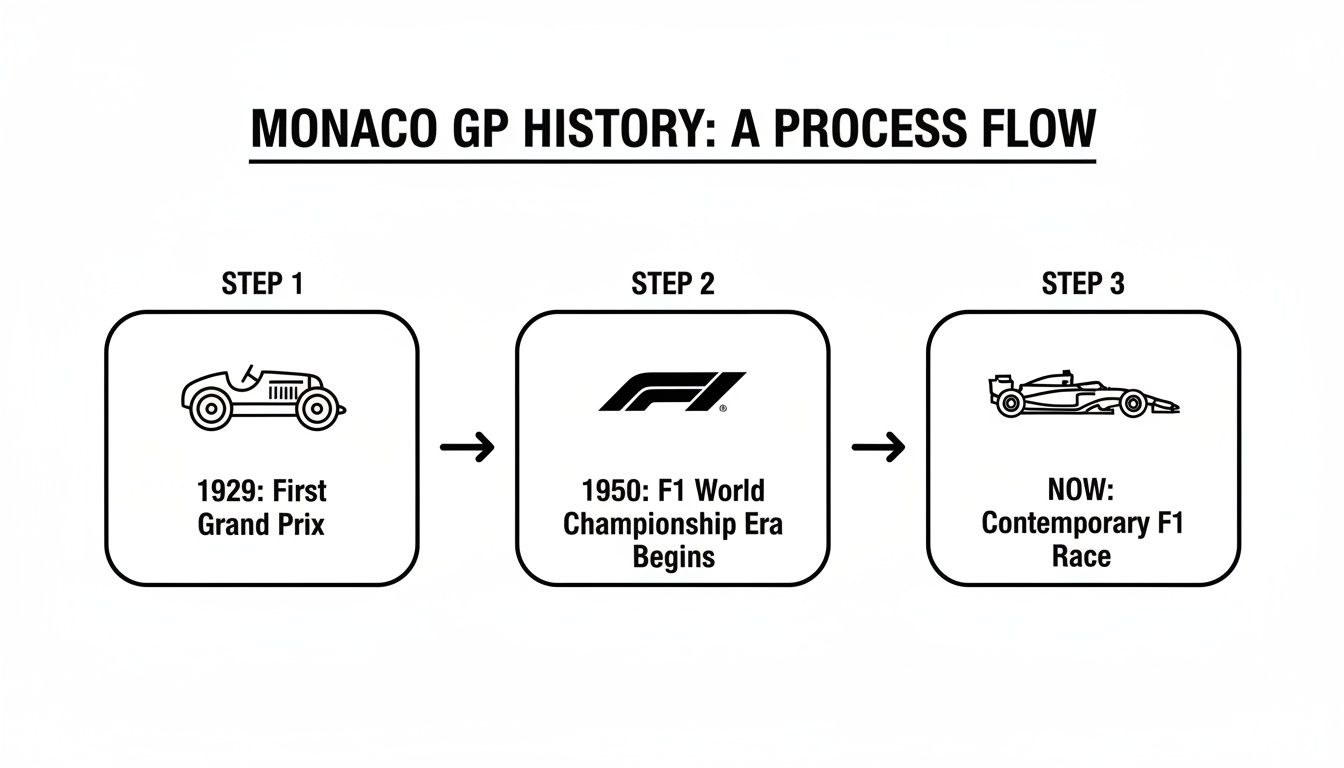
This visual journey shows just how the essence of the challenge has been preserved through motorsport's greatest eras.
Through the Darkness and Skimming the Water's Edge
Exiting the hairpin, drivers navigate two right-handers, Mirabeau Bas and Portier, the latter being the infamous corner where Ayrton Senna famously crashed out of a dominant lead in 1988. This turn leads directly into the iconic Tunnel section—the only one of its kind in Formula 1.
The drivers rocket from bright sunlight into relative darkness and back out again at nearly 300 km/h. Their eyes have to rapidly adjust while dealing with a slight curve inside the tunnel, making it one of the most unique sensory challenges in sport.
Emerging from the darkness, they are immediately hard on the brakes for the Nouvelle Chicane. This is the track's most significant overtaking opportunity, though "opportunity" is a generous term here. It’s a heavy braking zone into a tight left-right flick that requires immense bravery to even attempt a pass.
Following the chicane is a short straight leading to Tabac, a deceptively fast left-hander that sweeps drivers into the final complex. This corner demands absolute commitment, as any hesitation will cost crucial time. Visualising this incredible layout is key to understanding its difficulty, and a high-quality Circuit de Monaco framed canvas print can serve as the perfect centrepiece for any fan wanting to appreciate its intricate design.
The final part of the lap is the incredibly technical Swimming Pool section (Piscine). It’s a rapid-fire sequence of chicanes where drivers flick the car left, then right, then left again, kissing the barriers on both sides. Precision is everything; there is absolutely no room for error. The final corner, La Rascasse, is another tight hairpin, followed by the Antony Noghès corner, which slingshots the car back onto the main straight to complete a punishing, exhilarating lap.
To really appreciate the challenge, it helps to break down these legendary corners.
Iconic Corners of the Monaco Grand Prix Circuit
Each turn at Monaco has its own personality and presents a distinct test of skill and nerve. Here’s a closer look at the corners that have made and broken the dreams of countless racing legends.
| Corner Name | Turn Number | Key Challenge | Approximate Speed |
|---|---|---|---|
| Sainte Dévote | Turn 1 | A tight, chaotic first corner with a high risk of contact. | 90 km/h |
| Casino Square | Turn 4 | A fast, sweeping right-hander with deceptive bumps and camber changes. | 130 km/h |
| Grand Hotel Hairpin | Turn 6 | The slowest corner in F1, requiring maximum steering lock. | 50 km/h |
| Tunnel | Turn 9 | A high-speed flat-out curve in near darkness, a unique sensory challenge. | 290 km/h |
| Nouvelle Chicane | Turn 10-11 | Heavy braking out of the tunnel into a tight chicane; a key (but risky) overtaking spot. | 70 km/h |
| Tabac | Turn 12 | A deceptively quick, blind left-hander right on the harbour's edge. | 160 km/h |
| Swimming Pool (Piscine) | Turn 13-16 | A rapid-fire sequence of chicanes demanding immense precision. | 200 km/h |
| La Rascasse | Turn 18 | A tight, tricky hairpin that sets up the final sprint to the line. | 60 km/h |
From the blind faith required at Tabac to the delicate dance through the Swimming Pool, every section of the track demands perfection. One tiny miscalculation, and a driver’s race is over in a flash of carbon fibre.
Legendary Drivers and Unforgettable Moments
The Circuit de Monaco is so much more than just asphalt and barriers. It’s a stage where the human drama of motorsport plays out in its most raw and intense form. Over the decades, its unforgiving nature has forged legends, shattered dreams, and created stories that are now etched into the very soul of Formula 1.
These are the moments that elevate the Formula One Monaco Grand Prix from just another race into a timeless saga of skill, courage, and sometimes, sheer luck.
Talk about Monaco legends, and one name immediately comes to mind: Ayrton Senna. The Brazilian driver had a connection with this circuit that felt almost mystical. His record of six victories still stands as the benchmark, a powerful testament to his incredible precision and unwavering focus. His 1988 qualifying lap is often called the greatest in F1 history; he was an astonishing 1.4 seconds faster than his teammate Alain Prost and later described the experience as driving on pure instinct.
Mr Monaco and the Underdog Story for the Ages
Long before Senna, another driver owned these streets. Graham Hill, with his famously smooth and calculated style, conquered Monaco five times in the 1960s. This incredible feat earned him the enduring title of 'Mr. Monaco' and cemented his place as one of the sport's true greats, forming a cornerstone of his legendary Triple Crown achievement.
But Monaco isn't just about the titans; it’s a place where unbelievable underdog stories can unfold. The 1996 Grand Prix is the perfect example. Held in treacherous wet conditions, the race was pure chaos from the very start. Olivier Panis, starting from a lowly 14th on the grid for the Ligier team, drove the race of his life.
As leaders and front-runners spun out or retired one by one, Panis kept his cool. He made decisive overtakes and navigated the treacherous circuit with flawless skill, crossing the line to take a victory so improbable it remains one of the greatest shocks in the sport's history. Only three cars actually finished that chaotic race.
That remarkable win proved that on its day, Monaco can defy all odds, rewarding drivers who combine immense talent with unwavering composure.
Dramatic Moments That Defined an Era
The circuit's brutal layout has also produced some of motorsport's most heart-stopping moments. In 1955, Alberto Ascari famously misjudged the chicane after the tunnel and plunged his Lancia straight into the harbour. Incredibly, he escaped with only minor injuries, creating one of the most iconic images from F1's pioneering days.
These days, races are often decided not by raw speed, but by daring strategy. A perfectly timed pit stop during a Safety Car period or a gamble on tyre choice can be the difference between victory and defeat. These high-stakes decisions, made in fractions of a second, add a whole other layer of chess-like tension to the race. Even today, the new generation of drivers, like Australia's own rising star, are making their mark on challenging circuits, and you can learn more about the journey of Oscar Piastri in our detailed profile.
From Senna's qualifying perfection to Panis's fairytale win, these legendary drivers and unforgettable moments are what make the Monaco Grand Prix the true jewel in F1's crown. They are the stories of human brilliance and drama that transform a simple street race into an enduring legend.
Experiencing the Monaco Grand Prix Like a Pro
There’s nothing else on the F1 calendar quite like the Monaco Grand Prix. It's a pure assault on the senses, whether you're lucky enough to be soaking up the atmosphere in person or catching the action from your couch.
For anyone making the pilgrimage to the Principality, a bit of planning is essential to get the most out of the spectacle. And if you're watching from afar, knowing what to look for can completely transform how you see the race unfold. This guide is packed with insider tips to make you feel like you're right in the thick of it, no matter where you are.
Monaco is a true bucket-list event for motorsport fans, and plenty of Aussies make the trip every year. Its popularity is off the charts. A recent race weekend saw a staggering 250,000 visitors descend on the tiny country, completely smashing attendance records. Travel data showed 2,400 helicopter trips and a massive spike in train arrivals, blowing pre-pandemic numbers out of the water. You can discover more insights about Monaco's massive attendance figures.
Tips for Attending in Person
Being there is a sensory overload in the best possible way, but a little prep goes a long way. You’ve got options, from grandstands to mind-blowing yacht parties, and each gives you a totally different slice of the action.
- Grandstand K: Tucked in by the harbour, this spot gives you an incredible view of the cars flicking through the Tabac corner and the Swimming Pool complex. You really get a sense of their incredible agility here.
- Casino Square: If you want pure glamour, this is it. It's a ticketed area, but you get to see the cars navigating one of the most famous backdrops in all of motorsport.
- Yacht Viewing: This is the ultimate luxury experience. Watching from a superyacht in Port Hercule puts you right in the heart of the party, with an atmosphere that's simply unbeatable.
Getting around the city itself is a workout. Wear comfortable shoes—seriously. You'll be walking up and down steep hills all day. Public transport, especially the trains, is your best friend for getting in and out of the Principality without the stress.
Maximising Your Viewing from Home
Don't have a ticket? No problem. Watching from home has its own perks, especially when you know what to watch for. Monaco is a race of pure precision and nail-biting strategy, which makes for captivating viewing.
The most important session of the entire weekend? It’s not the race. It’s Saturday's qualifying. On a track where overtaking is next to impossible, where you start on the grid is everything. Grabbing pole position here is often seen as 90% of the job done.
When you're watching the broadcast, keep your eyes glued to the onboard cameras. They give you a driver's-eye view of just how ridiculously narrow the circuit is and the millimetre-perfect precision needed to keep it out of the barriers, lap after lap. Also, listen in on the team radios. They offer a direct line into the strategy calls, where a perfectly timed pit stop or tyre change can win or lose the race.
And to really get in the mood, you've got to look the part. Our guide to the best Formula 1 clothing will help you find the perfect gear to show some love for your favourite team or driver while you take it all in.
Bringing the Spirit of Monaco Into Your Home
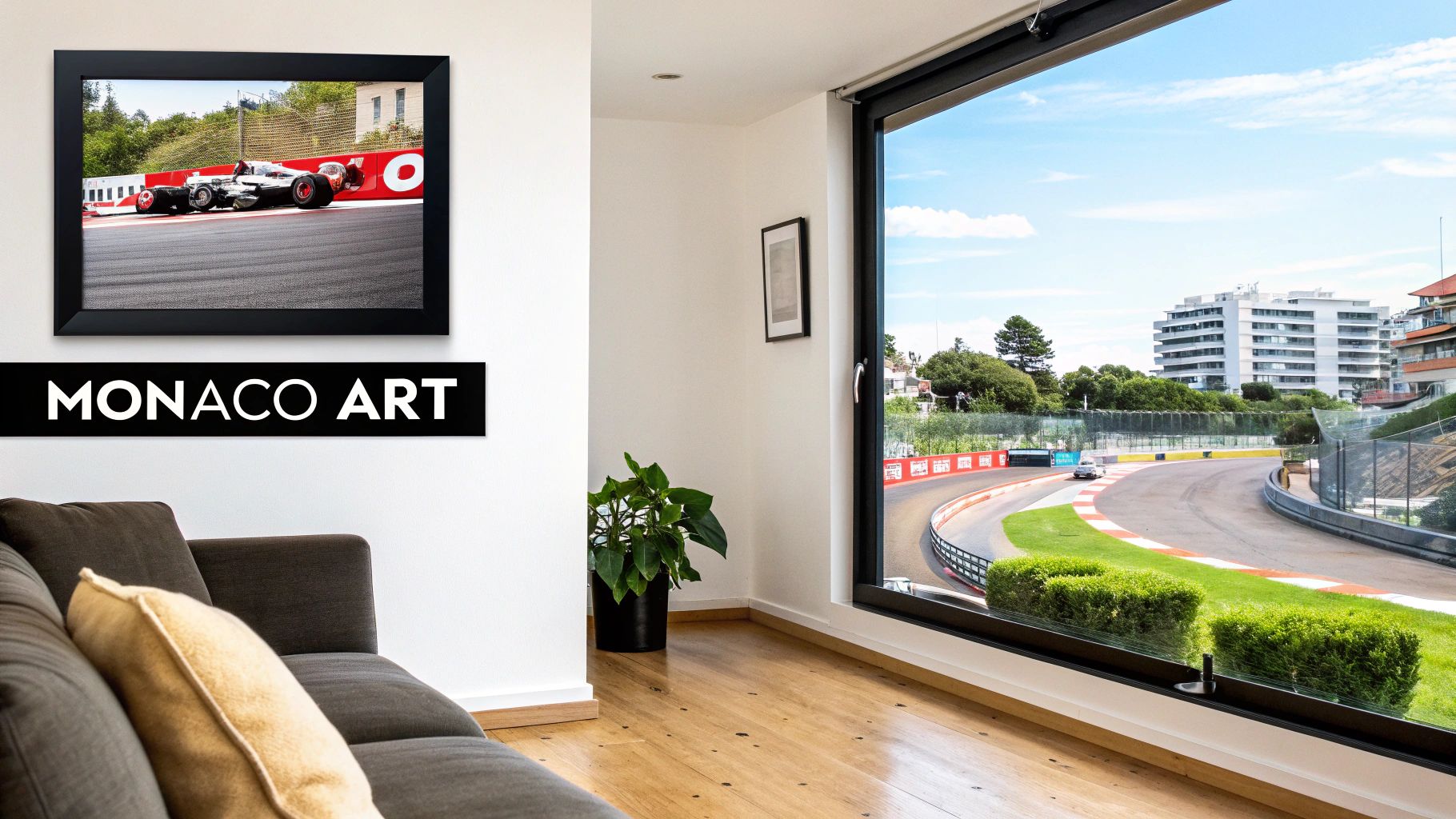
The electric atmosphere of the Monaco Grand Prix doesn't have to stay in Monte Carlo. You can bring that same passion, precision, and rich history right into your own space, turning it into a personal tribute to the pinnacle of motorsport.
More than just decoration, high-quality wall art is a celebration of the sport you love. It becomes an instant focal point, sparking conversations about legendary drivers, iconic corners, and unforgettable moments. A piece dedicated to Monaco is a nod to the ultimate test of driving skill and racing heritage.
Choosing Your Perfect Tribute
Finding the right piece comes down to your personal style and the room you're decorating. The real key is to pick something that captures what you find most compelling about the Monaco Grand Prix.
Think about which of these popular styles would be the perfect match for you:
- Minimalist Circuit Layouts: Clean, modern, and perfect for an office or living room. These designs focus on the pure, elegant form of the track itself, making a sophisticated statement without overwhelming the space.
- Detailed Map-Style Canvases: Ideal for a dedicated fan cave or games room. These pieces often feature corner names, track stats, and other key data, offering a deeper dive into the circuit's technical challenges.
- Retro-Inspired Designs: Want to capture the golden age of motorsport? Artwork that evokes the spirit of past decades is perfect for adding a touch of classic character to your home.
Choosing artwork is all about connecting with the story behind the image. Whether it’s the clean lines of the circuit or a design celebrating a past hero, the right piece keeps the spirit of racing alive every day.
Ultimately, the goal is to find something that truly resonates with your passion for F1. From a subtle nod to a bold centrepiece, the right art brings the energy of the grid right into your home.
If you're looking for a bit of inspiration, exploring a curated collection of Formula 1 posters is a great place to start. It can help you pinpoint the ideal style for your own space or find a thoughtful gift for the ultimate F1 enthusiast in your life.
Your Monaco Grand Prix Questions, Answered
Even for die-hard fans, the Monaco Grand Prix has a few quirks that always seem to spark questions. It’s just that kind of race. So, let's clear up some of the most common queries and get a better feel for what makes this event such a standout on the F1 calendar.
From its bizarre logistics to its legendary status in motorsport history, these little details are exactly what gives the world's most famous street race its incredible character.
Why Is Qualifying So Important in Monaco?
Put simply, qualifying is everything in Monaco. The circuit is so tight, narrow, and twisting that trying to overtake another car during the race is next to impossible. Nailing a high grid position—especially pole—gives a driver a strategic advantage that’s far bigger than at any other track on the calendar.
Most circuits have long straights or wide corners where a pass is always on the cards. Monaco has none of that. This means a driver's starting spot on Sunday is often a pretty solid predictor of where they'll finish, which is why Saturday's qualifying session often feels even more tense and thrilling than the race itself.
What Is the Triple Crown of Motorsport?
The Triple Crown of Motorsport isn't an official championship, but it's one of the most respected achievements in racing. It's a badge of honour for any driver who can win three of the most prestigious and challenging motor races in the world.
To earn this legendary status, a driver has to conquer:
- The Formula One Monaco Grand Prix
- The Indianapolis 500 in IndyCar
- The 24 Hours of Le Mans endurance race
To this day, the legendary Graham Hill is the only driver in history to have won all three. It’s an incredible achievement that speaks volumes about his versatility and skill across completely different styles of racing, cementing his place as an all-time great.
Do People Actually Live on the Monaco Grand Prix Circuit?
They sure do, and it’s one of the things that makes the Monaco Grand Prix so unique. The entire circuit is pieced together from public roads that are lined with apartments, hotels, and local businesses. Come race weekend, the residents living along the track have some of the most unbelievable views in all of sport.
Many locals even rent out their balconies and terraces to spectators for a premium price, turning their homes into private grandstands. As soon as the race weekend is over, the barriers, fences, and stands are all taken down, and the streets are handed back to everyday traffic until next year.
How Long Does It Take to Build the Monaco Circuit?
Turning the glamorous streets of Monte Carlo into a world-class, Grade 1 FIA circuit is a massive job. The construction crews get to work a full six weeks before the first car even hits the track.
Once the final chequered flag falls, it takes another three weeks to dismantle everything and return the Principality's roads to normal. It’s a huge, meticulous process that showcases the incredible effort behind the world's most famous street race.
At TrackNation, we capture the essence of legendary circuits like Monaco in stunning wall art. Celebrate motorsport's greatest challenges and bring the passion of the track into your home. Explore our full collection of premium F1-inspired prints and find the perfect piece for your space.