

McLaren F1 The Ultimate Guide To A Racing Legend
When you hear the name McLaren F1, you’re not just thinking of a racing team. You’re thinking of a powerhouse, a name synonymous with relentless innovation, championship glory, and a legacy forged in pure speed. From its scrappy beginnings to becoming a titan of the grid, McLaren has consistently set the bar for what it means to compete at the very top.
The Enduring Legacy of McLaren F1
The McLaren story is one of raw ambition, engineering wizardry, and incredible human drama. It all started with the vision of a young driver from New Zealand, Bruce McLaren, who had a simple dream: to build and race his own cars. What began in a tiny workshop back in 1963 quickly evolved into a force that would challenge the established giants of Formula 1. This wasn't just about winning; it was about smashing the boundaries of automotive tech and aerodynamics.
McLaren's mark on the sport is everywhere you look. The team has always been a trailblazer, introducing game-changing concepts like the first-ever carbon fibre monocoque chassis with the MP4/1 in 1981. This design completely redefined safety and performance and is now the standard across the entire grid. That kind of forward-thinking became the core of the team's DNA.
McLaren's culture is built on a simple yet powerful idea voiced by its founder: "Life is measured in achievement, not in years alone." This philosophy continues to drive the team's relentless pursuit of excellence, both on and off the track.
This incredible legacy was carried on the shoulders of the legendary drivers who have gripped the wheel of a McLaren. Names like Ayrton Senna, Alain Prost, Mika Häkkinen, and Lewis Hamilton aren't just champions; they are icons whose nail-biting battles and triumphs are etched into the very fabric of F1 history. Their stories of fierce rivalries and last-lap heroics have created unforgettable moments for millions of fans worldwide. It's fascinating to see how a team like this, much like its rivals, has shaped the sport—as you can see in our deep dive into the history of Scuderia Ferrari F1.
Today, that vibrant papaya orange livery is an instant nod to this rich heritage, connecting the team’s modern-day contenders to its very roots. Every single race weekend adds another chapter to a story that continues to captivate and inspire motorsport fans everywhere.
A Journey Through McLaren's Storied History
Every great Formula 1 team has a story, but McLaren's reads like a Hollywood script filled with ambition, innovation, and pure, unfiltered dominance. It all kicked off in the 1960s with a brilliant Kiwi driver and engineer named Bruce McLaren. His vision wasn't just to compete; it was to build a powerhouse that would one day define entire eras of motorsport.
From those foundational years, McLaren steadily grew into a force to be reckoned with. The 1980s, however, is where the legend was truly forged. The team became home to one of the most electric rivalries in all of sport: the intense, often bitter battle between teammates Alain Prost and Ayrton Senna. They pushed each other, and the team, to unimaginable heights, securing multiple world championships and cementing the McLaren name in F1 folklore forever.
The Modern Championship Eras
After the fiery Prost-Senna years, a new kind of dominance emerged in the late 1990s. It was cool, calculated, and personified by Mika Häkkinen. Known as "The Flying Finn," his incredible speed and calm demeanour brought McLaren back-to-back World Championships in 1998 and 1999, writing a completely new chapter of success for the Woking team.
That legacy of finding and nurturing world-class talent rolled right into the 21st century. In 2008, a young Lewis Hamilton, in a McLaren, snatched his very first Drivers' Championship on the final corner of the final lap of the season. It remains one of the most heart-stopping, dramatic moments in the sport's history and proved, yet again, that McLaren knew how to build a championship-winning car.
McLaren’s history isn’t just a highlight reel of wins. It’s a masterclass in resilience. The team has navigated tough periods, fallen down the order, and fought its way back to the front, proving its competitive spirit is simply unbreakable.
This timeline gives you a great visual snapshot of McLaren's journey, from its foundational roots to its key moments of innovation and championship glory.
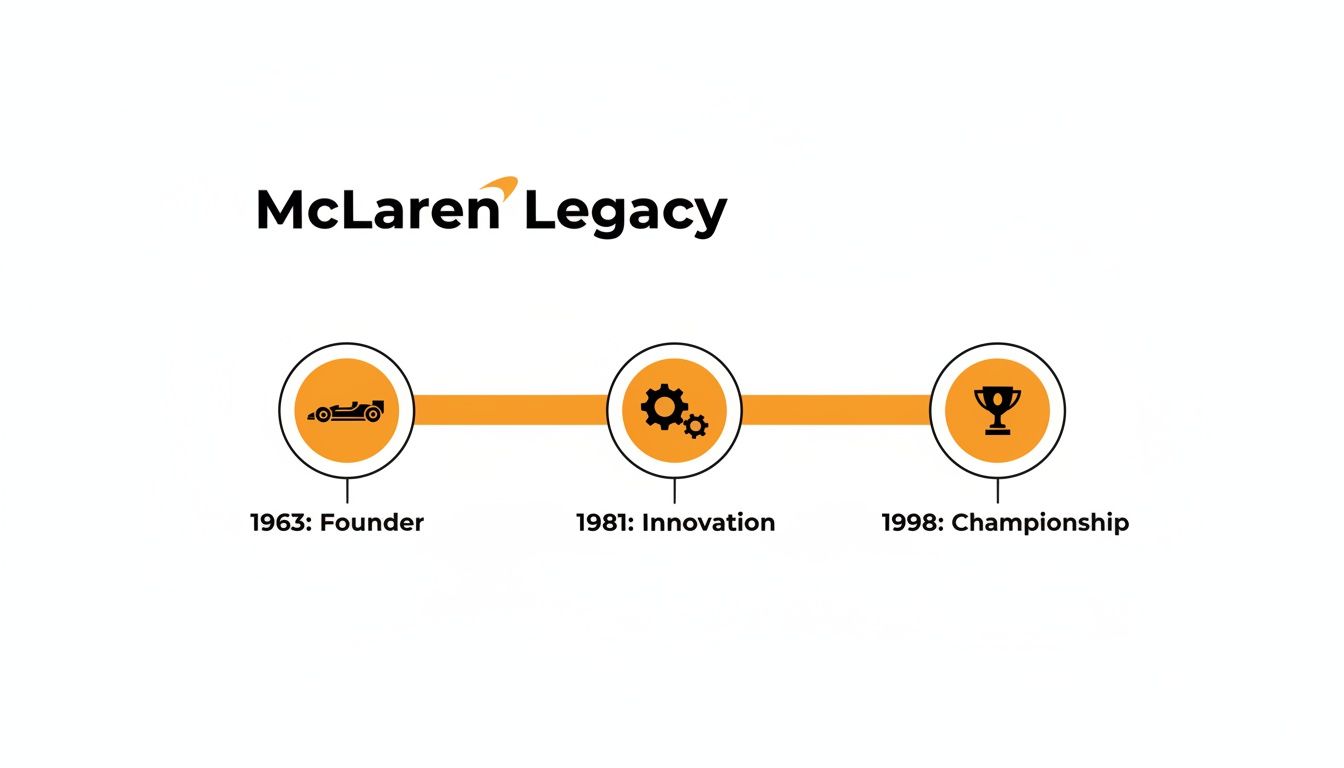
You can see a clear line from Bruce McLaren's founding principles right through to the team's groundbreaking technical leaps and, ultimately, their championship trophies.
Resurgence and Future Glory
Like all legendary teams, McLaren has had its share of slumps. After a tough period away from the top step of the podium, the team went through a massive rebuild from the ground up. All that hard work has paid off, leading to a huge resurgence in recent years that has seen them consistently fighting for podiums and wins once more. This up-and-down journey is a common story in the sport, as you can see in our look at the history of F1 teams.
Today, with a fresh driver lineup and a renewed hunger, the McLaren F1 team is firing on all cylinders. They're not just resting on their laurels; they're actively building on that incredible history, dead set on adding a few more championships to the trophy cabinet.
Iconic Cars And Unforgettable Liveries
A Formula 1 car is more than just a beast of an engine on wheels; it’s a moving canvas that tells the story of an era. For McLaren, certain cars and their liveries have become the stuff of legend, symbolising moments of pure dominance, technical genius, and a deep-seated heritage. These designs are burned into the memories of fans everywhere.
The story for many starts with the unmistakable red and white of the Marlboro sponsorship. This look is most famously plastered on the McLaren MP4/4, a car that put together one of the most dominant seasons in the history of F1. In 1988, with the fiery duo of Ayrton Senna and Alain Prost behind the wheel, the MP4/4 won a staggering 15 out of 16 races. Its sleek, low-slung profile combined with that bold chevron livery became a symbol of near-invincibility.
But it wasn't just a looker. The MP4/4 was an engineering masterpiece, a perfect harmony of power and aerodynamics. The blend of its visual punch and its on-track demolition derby makes it one of the most revered machines the sport has ever seen.
From Silver Arrows to a Papaya Revival
As McLaren roared into the late 1990s and 2000s, a new partnership brought a fresh identity. The link-up with Mercedes-Benz ushered in the sleek, sophisticated silver and black of the West livery. These "Silver Arrows" were piloted to glory by Mika Häkkinen, who clinched back-to-back world championships in 1998 and 1999.
That chrome-like finish screamed modern and high-tech, projecting an image of cool, calculated precision. Cars like the MP4/13 weren't just ridiculously fast; they were visually stunning, defining the look of the grid for more than a decade and becoming a huge fan favourite.
The livery of a McLaren F1 car is never just paint. It’s a visual handshake with the team's history, whether it’s the dominant red and white of the Senna era or the modern return to its papaya roots.
Let's take a look at some of the cars that truly defined the team's visual and competitive legacy. The table below highlights the machines that not only won races but also won the hearts of fans with their iconic designs.
McLaren's Most Iconic F1 Cars
| Car Model | Era | Key Achievement | Iconic Livery |
|---|---|---|---|
| MP4/4 | 1988 | Won 15 of 16 races | Marlboro Red & White |
| MP4/13 | 1998 | Häkkinen's first championship | West Silver & Black |
| MP4-23 | 2008 | Hamilton's first championship | Vodafone Chrome & Red |
| MCL33 | 2018 | Return to Papaya | Papaya Orange |
These cars represent more than just metal and carbon fibre; they are chapters in McLaren's incredible story, each with a unique identity that fans still celebrate today.
In recent years, McLaren has gone back to its roots by embracing a vibrant Papaya Orange. This colour wasn't just pulled out of a hat; it was the original colour founder Bruce McLaren used back in the 1960s. He chose it for a simple, brilliant reason: it stood out on the black-and-white TV screens of the day.
The modern papaya livery is a direct nod to that pioneering spirit. It’s a bridge connecting the current crop of drivers and fans to the team's founding ethos of innovation and guts. This return to its origins has hit home with the fanbase, showing a team proud of its past as it scraps for future glory. It’s this powerful visual identity that makes so many fans want to celebrate these cars with high-quality Formula 1 posters.
Each of these distinct looks represents a chapter in the McLaren saga, showcasing a legacy built on both groundbreaking tech and unforgettable style.
The Heroes Behind The Wheel
A racing car, no matter how perfectly engineered, is only as good as the driver in its cockpit. The history of the McLaren F1 team is truly defined by the legends who pushed its machines to the absolute limit. These weren't just drivers; they were titans of the sport whose personalities, rivalries, and defining moments are woven into the very fabric of Formula 1.
The most iconic chapter is undoubtedly the fierce, often explosive, rivalry between Ayrton Senna and Alain Prost in the late 1980s. They were polar opposites: Senna, the passionate, instinctive Brazilian genius, and Prost, "The Professor," a calculating and cerebral French tactician. Putting them in the same team created a perfect storm of talent and tension, pushing each other to greatness while delivering a string of championships for McLaren.
Legends of Every Era
Following that fiery period, a new kind of hero emerged. Mika Häkkinen, the "Flying Finn," brought a cool, unflappable presence to the team in the late 1990s. His incredibly smooth driving style and calm demeanour were the perfect match for the sleek "Silver Arrows" of the McLaren-Mercedes partnership, earning him back-to-back World Championships in 1998 and 1999. He was just pure, unadulterated speed.
Years later, a young British sensation named Lewis Hamilton would create one of the most dramatic moments in F1 history. In 2008, he secured his first-ever World Championship for McLaren on the final corner of the very last lap of the season—a heart-stopping conclusion that announced the arrival of a future all-time great.
Each driver brought something unique to the team. Senna brought raw passion, Prost brought tactical brilliance, Häkkinen brought ice-cool speed, and Hamilton brought a fearless, attacking spirit. It's this human element that transforms a race into a saga.
This rich driver history includes a special connection for Australian fans. McLaren's storied 11 Australian Grand Prix triumphs is a statistic that crowns them the most successful team at this iconic season opener. From the gritty Adelaide street circuit to Melbourne's Albert Park, McLaren has mastered both, securing victories across eras with drivers like Jenson Button, who commanded an impressive 150 laps Down Under, eclipsing even Hamilton's count. You can discover more insights about their Australian dominance over at GPRacingStats.com.
The Modern Generation
Today, that legacy continues with a new generation of talent. Drivers like Lando Norris and homegrown talent Oscar Piastri in our detailed profile are now the faces of the team, capturing the hearts of a new legion of fans with their skill, personality, and fierce determination to return McLaren to the top step of the podium. They aren't just driving for a team; they are carrying the weight of legends on their shoulders, adding their own chapters to the incredible McLaren story.
Dominance Down Under: McLaren's Australian Success
For Aussie Formula 1 fans, the connection to McLaren runs deep, and for good reason. The team from Woking isn't just another popular contender down here; they are, statistically speaking, the undisputed kings of the Australian Grand Prix. Their incredible and long-standing success on our soil has forged a powerful bond with the local supporters who flock to Albert Park year after year.
This relationship is built on a mountain of on-track victories. McLaren holds the record for the most wins at the Australian Grand Prix, with an impressive 11 victories since the event landed on the F1 calendar back in 1985. That number comfortably puts them ahead of rivals like Ferrari and shows a consistent knack for mastering the unique challenges of both the Adelaide and Melbourne circuits. You can dig into the full breakdown of their Australian Grand Prix achievements over at Formula1.com.
Memorable Melbourne Moments
The streets of Adelaide and the sweeping corners of Albert Park have been the backdrop for some of McLaren's most iconic wins. Who could forget Ayrton Senna's final ever F1 victory at the 1993 Australian Grand Prix in Adelaide? It was an emotional, historic moment for the entire sport—a true masterclass from the Brazilian legend as he closed a chapter with one last triumphant performance.
Then there was 1997, when David Coulthard took the chequered flag at Albert Park. This win was massive for the team. It shattered a painful winless streak that had stretched for 50 long races, reigniting McLaren's competitive fire and setting them up for future championship glory. It was a clear signal to the paddock: McLaren was back in business.
McLaren’s success in Australia isn't just about the numbers. It’s about the stories behind the wins—the last-ever victory for a legend, the end of a long drought, and the controversial team orders that had fans talking for weeks.
The team's history here is also packed with drama. The 1998 race saw a controversial 1-2 finish where David Coulthard honoured a pre-race pact to let his teammate Mika Häkkinen pass him for the win. It’s a moment fans still debate today, and a perfect example of the intense team dynamics at play.
This rich tapestry of triumphs, controversies, and emotional victories has cemented McLaren's status as a fan favourite Down Under. Their consistent ability to put on a show makes them a central part of the Australian Grand Prix experience each and every year.
Bringing The McLaren Legend Home
Celebrating McLaren's legacy doesn't have to stop when the chequered flag drops. Bringing your passion for the papaya legends into your home or office is the perfect way to keep that racing spirit alive all week long. The trick is to pick wall art that doesn't just show off your fandom but actually looks great in your space.
Think of it like setting up a car for a specific track—you wouldn't run a Monza setup at Monaco. In the same way, the right artwork depends entirely on its surroundings. A minimalist, monochrome print of the Silverstone circuit layout could bring a touch of sophisticated speed to a home office. On the other hand, a vibrant, retro-style poster of Senna in the MP4/4 might be the perfect statement piece for a proper fan cave.
Choosing Your Tribute Style
What is it you love most about the team? Is it the engineering genius? The iconic drivers? Or just the sheer beauty of the cars themselves? Your choice of art should echo that.
- For the Purist: Detailed canvases of icons like the MP4/4 or the modern MCL38 let you soak in every curve and aerodynamic detail.
- For the Historian: Retro posters celebrating legends like Mika Häkkinen or famous Grand Prix wins offer a nostalgic trip back to the team's golden eras.
- For the Strategist: Stylised track maps from circuits where McLaren has dominated, like Albert Park, are a subtle nod to their greatest on-track victories.
When it comes to styling these pieces, think about scale and placement. A big, framed canvas of Lando Norris carving through a corner can be a powerful focal point above a sofa. Alternatively, a curated gallery wall of smaller prints—maybe showing off different liveries through the years—can create a dynamic story in a hallway or study.
Don't just hang a picture; create an atmosphere. The right framing, lighting, and placement can turn a simple print into an immersive piece that captures the energy and emotion of Formula 1.
For a cohesive look, try matching the frame to your existing decor. A sleek black frame gives a clean, modern finish that lets the artwork do the talking, while a natural wood frame can add a bit of warmth. By being thoughtful about how you choose and style your McLaren F1 art, you can create a personal tribute that’s both tasteful and genuinely meaningful.
Your McLaren F1 Questions Answered
Even the most dedicated fans have questions about McLaren's long and storied history. We get it. There's a lot to unpack. So, let's clear up a few of the most common queries and round out your knowledge of this legendary team.
Who Is The Most Successful McLaren F1 Driver?
While plenty of icons have sat in a McLaren cockpit, Ayrton Senna is almost always the name that comes to mind. He's often hailed as the team's most emblematic driver, clinching three World Championships with them in 1988, 1990, and 1991, along with 35 Grand Prix victories.
That said, you can't talk about McLaren success without mentioning Alain Prost. He also won three titles with the team (1985, 1986, 1989), making him statistically just as much of a legend. And of course, more recently, a young Lewis Hamilton nabbed his nail-biting first championship with McLaren in 2008, adding another giant of the sport to their honour roll.
Why Did McLaren Go Back To Papaya Orange?
McLaren’s return to its iconic papaya orange livery was a brilliant nod to its deep-rooted heritage. The vibrant colour wasn't just a random choice back in the day; founder Bruce McLaren first used it in the late 1960s because it stood out on the black-and-white television broadcasts of the era. Simple, but clever.
The modern return to papaya is more than just a paint job; it's a powerful statement connecting the team's current ambitions to the innovative, can-do spirit of its founder.
What Was McLaren's Most Dominant F1 Season?
No question, the 1988 season stands as McLaren's most dominant performance in Formula 1 history. The combination of drivers Ayrton Senna and Alain Prost, paired with the legendary MP4/4 car, was practically a cheat code.
They were simply unstoppable. Together, they won a staggering 15 out of the 16 races that year. It was an incredible achievement that set a new benchmark for dominance, cementing the MP4/4 as one of the greatest cars to ever grace a racetrack.
Where Is The McLaren F1 Team Based?
The McLaren Formula 1 team calls the McLaren Technology Centre (MTC) home. This futuristic, state-of-the-art facility is located in Woking, Surrey, England. It’s more than just a factory; it's the central hub for the design, manufacturing, and research for all of McLaren's projects, not just their F1 operations.
Ready to bring the speed and style of the grid into your home? Explore the full collection of premium motorsport wall art at TrackNation and find the perfect tribute to your favourite team. Visit us at https://tracknation.au to discover your next statement piece.