

The Definitive Guide to the History of F1 Teams
The history of Formula 1 teams is a saga of engineering brilliance, fierce national pride, and an unrelenting drive to win, kicking off in 1950 with constructors like Alfa Romeo, Ferrari, and Maserati. These original titans didn't just compete; they laid the very foundation for a sport that would be defined as much by its visionary teams as by its heroic drivers.
The Dawn of F1 and the Pioneering Constructors
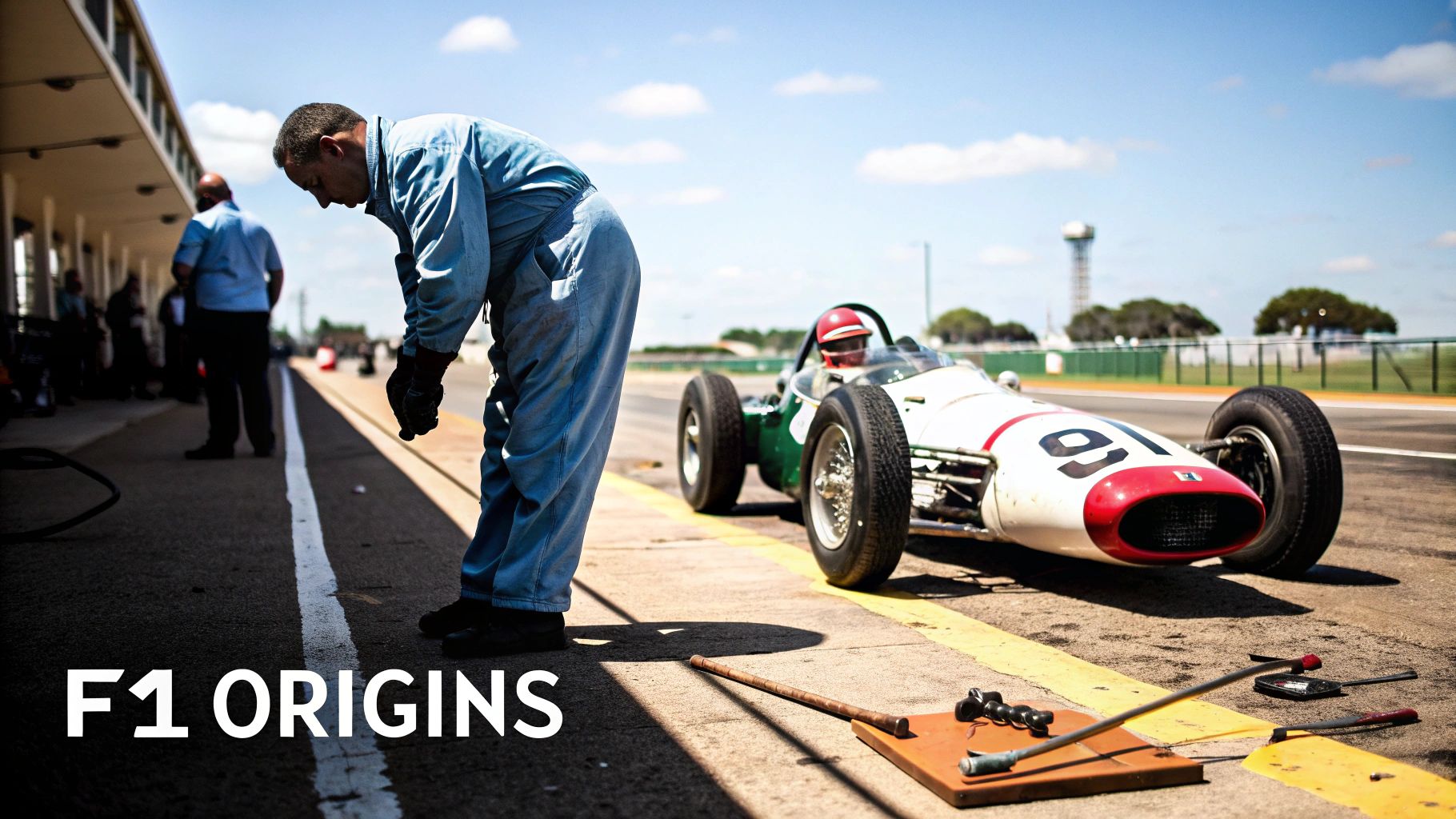
When the first-ever Formula 1 World Championship race roared to life at Silverstone in 1950, it wasn't just a new beginning. It was the moment that decades of fiery, high-stakes Grand Prix racing finally got a formal structure.
These pioneering teams weren't the slick corporate machines we see today. Far from it. They were often born from the singular vision of one determined individual. Think of Enzo Ferrari, a man whose name would become utterly synonymous with motorsport, or the Maserati brothers, whose engineering talent was the stuff of legend.
The Italian Powerhouses
In those earliest days, the grid had a distinctly Italian flavour. The dominant forces were Alfa Romeo, Ferrari, and Maserati, and they ruled the roost with powerful, front-engined beasts that were as beautiful as they were brutally fast.
- Alfa Romeo: The first true powerhouse of the sport. Their "Alfetta" 158 and 159 cars were actually pre-war designs, but they were perfected for the new championship. They were so good, in fact, that they won the first two drivers' world championships in 1950 and 1951 with Nino Farina and the legendary Juan Manuel Fangio.
- Ferrari: While their first cars were based on earlier designs, Enzo Ferrari’s ambition was crystal clear from day one. Incredibly, they are the only team to have competed in every single season since the championship began—a powerful testament to their enduring legacy.
- Maserati: A constant threat and a formidable competitor, Maserati supplied its chassis to numerous privateer teams. They memorably powered Fangio to his 1957 world title.
This initial era was all about raw power. Engineering felt more like an art than a science, and just getting the car to the finish line was a victory in itself. The drivers were genuine daredevils, wrestling these machines with almost no safety features on circuits that were often just closed-off public roads. You can get a richer picture of the sport's origins by diving into our detailed look at F1 history.
The spirit of the early F1 constructors was a potent mix of national pride and sheer personal ambition. It was Italy against the world, with Enzo Ferrari's scarlet cars becoming a global symbol of Italian excellence.
The Engineering of an Era
The cars of the 1950s were marvels for their time, but they're a world away from the precision-engineered beasts of today. You had supercharged 1.5-litre engines going head-to-head with much larger, naturally aspirated 4.5-litre power units.
Aerodynamics was a concept still in its infancy; car bodies were shaped more for looks and cooling than to create downforce. The driver sat bolt upright, completely exposed, gripping a huge wooden steering wheel connected to skinny, treaded tyres. It was an age of unbelievable grit, where the driver's skill and the engine's raw grunt were the main ingredients for victory. This foundational period cemented the constructor as the true heart of Formula 1, paving the way for the innovators who would soon turn the sport on its head.
The Rise of the British Garagistas
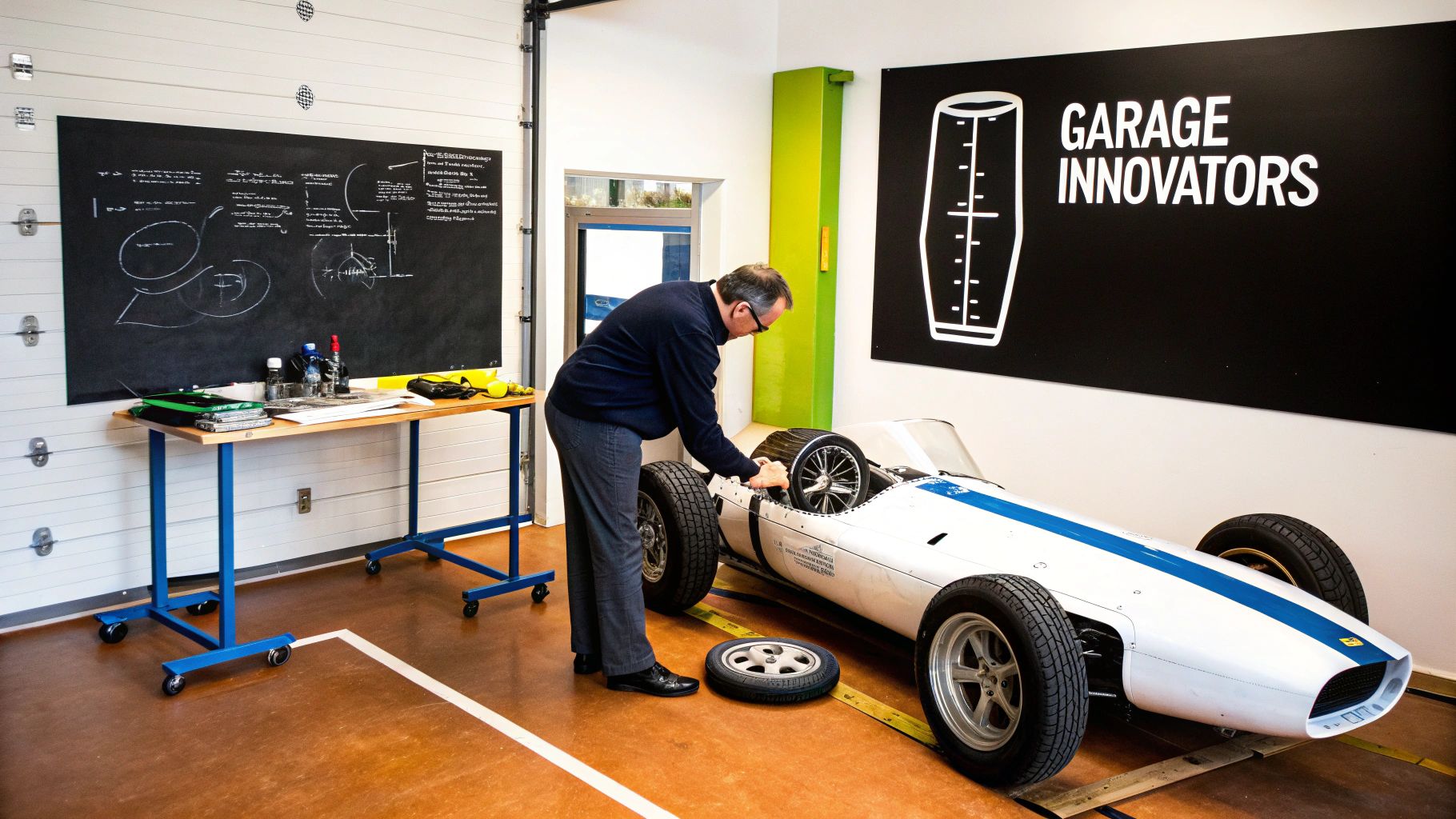
While the Italian giants were busy building their empires with brute horsepower, a different kind of revolution was brewing across the English Channel. This wasn't happening in sprawling factories, but in tiny sheds and workshops dotted across the UK.
Enzo Ferrari, in a now-famous moment of derision, labelled them the “garagistas”—the garage tinkerers. Little did he know, these British upstarts were about to prove that a clever idea could always outsmart a big engine, changing the very DNA of Formula 1 for good.
Their secret weapon wasn't money; it was brainpower. These were engineers who saw motorsport as a complex physics puzzle just waiting to be cracked. They simply had to out-think their rivals.
The Rear-Engine Revolution
The first real shock to the system came from the Cooper Car Company. In 1958, their small, nimble race car did something unthinkable: it put the engine behind the driver. This wasn't some minor adjustment; it was a complete rethink of how a racing car should be built.
Placing the engine at the back gave the car vastly superior balance and handling, letting it slice through corners with newfound stability. The Italian teams scoffed at first, but they couldn't argue with the stopwatch. By 1961, every single car on the grid was a rear-engine design. British ingenuity had won.
The "garagista" ethos was simple: innovation over tradition. It was a philosophy that proved a small team with a great idea could topple an empire, forever changing the balance of power in the sport.
This breakthrough kicked the door wide open. A wave of legendary British constructors like Lotus, Brabham, McLaren, and later Williams, all born from this same humble, think-outside-the-box spirit, would go on to dominate the next two decades.
Defining the True Constructor
If one person embodied the garagista spirit, it was Sir Jack Brabham. A phenomenal driver and a gifted engineer, he represents a totally unique moment in F1 history. He didn't just want to drive for a constructor; he wanted to be one.
He founded the Brabham team in 1960, building it on his own deep mechanical knowledge. Then, in 1966, he did the impossible—he won the World Drivers' Championship in a car that had his own name on the side. It's a feat that has never been repeated and likely never will be.
The Dawn of Aerodynamics
While Cooper had flipped the car's layout on its head, it was Colin Chapman of Lotus who started playing with the air itself. Chapman was a visionary, obsessed with his famous mantra: "Simplify, then add lightness."
He was the brains behind several breakthroughs that are now fundamental to motorsport:
- Monocoque Chassis: Chapman created a single, stressed-skin body and chassis. This made the car lighter, stronger, and more rigid than anything before it.
- Aerodynamic Wings: Lotus was the first team to bolt wings onto their cars to generate downforce, literally pushing the car into the track for mind-bending cornering speeds.
- Ground Effect: His masterstroke was the Lotus 79. It used the car's underside to create a massive low-pressure zone, effectively sucking it to the tarmac with incredible force.
These British teams, born in unassuming workshops, proved that F1 races would be won in the wind tunnels and design offices, not just on the engine dyno. The garagistas had arrived, and their influence is still felt on every modern grid, from street circuits to legendary tracks like the one in our Silverstone Grand Prix guide.
Understanding F1's Dominant Eras
Formula 1 history doesn’t move in a straight line. It’s a story of seismic shifts, where one team gets everything so right—the rules, the tech, the talent—that they create an era of near-unstoppable dominance. These periods are what define the sport, forging the legends and rivalries we still talk about decades later.
Getting a handle on these dynasties is the key to understanding how power ebbs and flows at the very pinnacle of motorsport.
Think of each dominant era like a perfect storm. It's never just one thing. It’s the magic combination of a genius designer, a once-in-a-generation driver, a monster of an engine, and a visionary team boss all hitting their stride at the exact same moment. When that happens, a team doesn't just win races; they completely change the game.
The McLaren-Honda Turbo Powerhouse
The late 1980s simply belonged to McLaren. With those formidable Honda turbo engines bolted in the back and the explosive driver pairing of Ayrton Senna and Alain Prost, the team was a force of nature. Their 1988 season is still the stuff of legend, winning an absurd 15 out of 16 races with the iconic MP4/4.
But it wasn't just about pure grunt. The team’s laser-focused operational excellence, driven by Ron Dennis, fostered a clinical, no-compromise atmosphere where winning was the only option. That fierce internal rivalry between Senna and Prost only pushed the entire organisation to greater heights, making their scarlet and white cars an undeniable symbol of victory.
Williams and the Age of Active Suspension
As the 90s dawned, F1 entered a technological arms race, and Williams was its undisputed master. With design guru Adrian Newey and technical director Patrick Head at the helm, Williams churned out cars that looked like they’d time-travelled from the future. Their secret weapon? Active suspension, a computer-controlled system that kept the car at a perfect ride height for mind-bending aerodynamic grip.
Paired with powerful Renault engines, drivers like Nigel Mansell and Alain Prost were piloting machines that were simply in a different postcode to everyone else. The Williams FW14B of 1992 is a masterpiece of this era—a car so advanced its rivals were left scratching their heads. This period cemented Williams' reputation as engineering titans, proving that clever electronics could be just as potent as a big engine.
"When one team gets a significant technological advantage, the championship becomes a showcase of their brilliance. For Williams in the '90s, it wasn't a question of if they would win, but by how much."
Ferrari's Golden Age with Schumacher
After what felt like an eternity in the wilderness, Ferrari roared back to life at the turn of the millennium, building a dynasty that has never been matched since. The combination of Michael Schumacher, team principal Jean Todt, technical director Ross Brawn, and designer Rory Byrne was the ultimate "dream team," and they were ruthlessly efficient.
From 2000 to 2004, Ferrari and Schumacher swept up five consecutive drivers' and constructors' championships. Their success was built on a foundation of flawless strategy, incredible reliability, and Schumacher's relentless, mesmerising talent behind the wheel. This era put the Prancing Horse back on top and created a legacy of dominance that remains the benchmark for all others.
The team's success was felt across the globe, especially at key events like the Australian Grand Prix. Australia's deep connection to Formula 1 shines through this iconic race, which has seen some incredible team performances over the years. While McLaren has secured an impressive 11 pole positions at the Australian GP—more than any other constructor—it's Ferrari that leads in race wins, boasting 14 victories. You can find out more about the fascinating statistics from the Australian GP to see how these eras played out on track.
Red Bull and Vettel's Aerodynamic Mastery
Just as Ferrari's reign was fading, a new force burst onto the scene. Red Bull Racing, armed with the aerodynamic genius of Adrian Newey and the prodigious talent of a young Sebastian Vettel, took over. Newey's mastery of aerodynamics, particularly his work on the exhaust-blown diffuser, gave Red Bull's cars a staggering downforce advantage.
From 2010 to 2013, Vettel and Red Bull stormed to four straight double championships. Their cars were famous for their physics-defying high-speed cornering, seeming to be glued to the track where others were struggling for grip. This era proved that in modern F1, mastering the airflow over the car was the ultimate key to victory.
Mercedes and the Hybrid Juggernaut
The switch to turbo-hybrid power units in 2014 triggered the most sustained period of dominance F1 has ever witnessed. The Mercedes-AMG Petronas F1 Team just absolutely nailed the new regulations, producing an engine that was lightyears ahead of its rivals in both power and efficiency.
With Lewis Hamilton leading the charge, Mercedes went on to win an unprecedented eight consecutive constructors' championships from 2014 to 2021. This era was all about engineering perfection. The team from Brackley set a new standard for reliability, strategic execution, and relentless development, making them the undisputed kings of the hybrid era.
Each of these teams left an indelible mark on Formula 1, creating moments and memories that define the sport. Let's take a quick look at how their golden eras stack up.
Iconic Teams and Their Dominant Eras
This table summarises the most successful periods for these key constructors, highlighting their incredible championship runs and the legendary drivers who made it happen.
| Team | Era of Dominance | Constructors' Titles | Key Drivers |
|---|---|---|---|
| McLaren | 1988-1991 | 4 | Ayrton Senna, Alain Prost |
| Williams | 1992-1997 | 5 | Nigel Mansell, Alain Prost, Damon Hill, Jacques Villeneuve |
| Ferrari | 2000-2004 | 5 | Michael Schumacher, Rubens Barrichello |
| Red Bull Racing | 2010-2013 | 4 | Sebastian Vettel, Mark Webber |
| Mercedes | 2014-2021 | 8 | Lewis Hamilton, Nico Rosberg, Valtteri Bottas |
From McLaren's turbo-powered brilliance to Mercedes' hybrid perfection, these eras showcase what happens when talent, technology, and teamwork align perfectly. They set the benchmarks that every other team on the grid still aspires to reach.
Tracing the Lineage of Modern F1 Teams
In Formula 1, the name on the side of the car often tells only a fraction of the story. Teams you see on the grid today can have deep, complex histories hiding just beneath the surface. They aren’t static businesses; think of them as living organisms that change owners, names, and even nationalities over the decades.
It’s a bit like a family tree. A team might start out with one identity, but through sales, sponsorship deals, or massive rebranding efforts, it can morph into something entirely new. Yet, it often carries the same core DNA—the same factory, the same dedicated people, and crucially, the same entry on the F1 grid.
Tracing these lineages uncovers some of the most fascinating stories of survival, raw ambition, and the sheer financial turbulence of competing at the pinnacle of motorsport.
The Journey From Tyrrell to Mercedes
One of the most incredible transformations on the modern grid belongs to the Mercedes-AMG Petronas F1 Team. If you trace their lineage all the way back, you’ll land at a plucky British outfit founded by Ken Tyrrell way back in 1958.
Tyrrell was a true giant-killer in its day, famously powering Jackie Stewart to championships. But as the team’s fortunes faded, it was sold and began a long, winding journey through different identities:
- British American Racing (BAR): In 1999, the team became BAR, backed by British American Tobacco and fronted by driver Jacques Villeneuve.
- Honda: The Japanese manufacturing giant took full control in 2006, leading to a memorable maiden victory for Jenson Button in Hungary.
- Brawn GP: When Honda abruptly pulled out of F1 at the end of 2008, Ross Brawn led a management buyout to create Brawn GP. What followed was one of motorsport's greatest fairy tales, as they won both the drivers' and constructors' championships in 2009—their one and only season.
That unbelievable success story caught the eye of a giant. Mercedes-Benz purchased the team for the 2010 season, laying the groundwork for the works team that would go on to absolutely dominate the hybrid era. The factory in Brackley, UK, remains the heart of this historic entry, connecting every single chapter of its story.
From Emerald Green to British Racing Green
Another compelling family tree on today’s grid is that of the Aston Martin team. Their story kicks off with the vibrant, much-loved Jordan Grand Prix team, which burst onto the scene in 1991 with its iconic emerald green cars.
Eddie Jordan’s team was legendary for its rock-and-roll attitude and for giving a young Michael Schumacher his F1 debut. After years of punching well above its weight, financial struggles led to a sale and a series of identity changes.
The team became Midland F1 in 2006, then Spyker F1 in 2007. In 2008, it was bought by Indian businessman Vijay Mallya and rebranded as Force India, a fiercely competitive midfield team known for getting massive results on a tiny budget. After Force India fell into administration, it was saved by a consortium led by Lawrence Stroll, becoming Racing Point before finally being reborn as the Aston Martin works team in 2021.
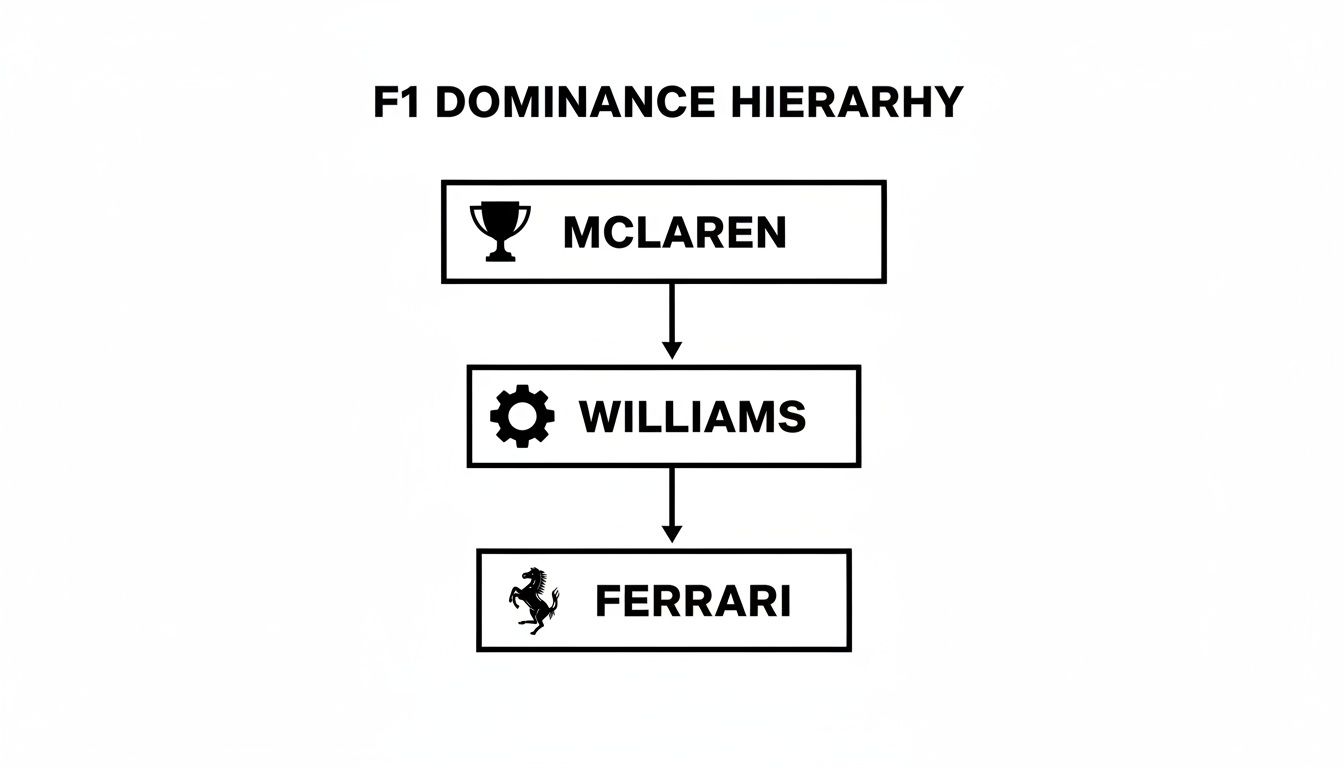
This chart shows how certain legendary names have consistently stayed at the top of the sport's pecking order. It highlights the sustained presence of powerhouse constructors like McLaren, Williams, and Ferrari, who have built unshakable legacies across different F1 eras.
Other Notable Team Evolutions
The two examples above are just the tip of the iceberg; the paddock is full of these stories. To give you a clearer picture of how these teams evolve, we’ve put together a table tracing the DNA of some of the current grid.
Tracing the DNA of Modern F1 Teams
| Original Team (Founder) | Key Intermediate Names | Current Team Identity |
|---|---|---|
| Toleman (Ted Toleman) | Benetton, Renault (works team) | Alpine F1 Team |
| Tyrrell (Ken Tyrrell) | BAR, Honda, Brawn GP | Mercedes-AMG F1 |
| Jordan (Eddie Jordan) | Midland, Spyker, Force India, Racing Point | Aston Martin F1 |
| Sauber (Peter Sauber) | BMW Sauber, Alfa Romeo Racing | Stake F1 Team Kick Sauber |
This constant state of flux is a fundamental part of the sport’s character. Teams adapt to survive, ensuring the history of Formula 1 is one continuous, sprawling narrative rather than a collection of separate stories.
For a closer look at the history of one of these iconic constructors, you can explore the story of McLaren in our detailed guide.
How Iconic Liveries Define Team Identity
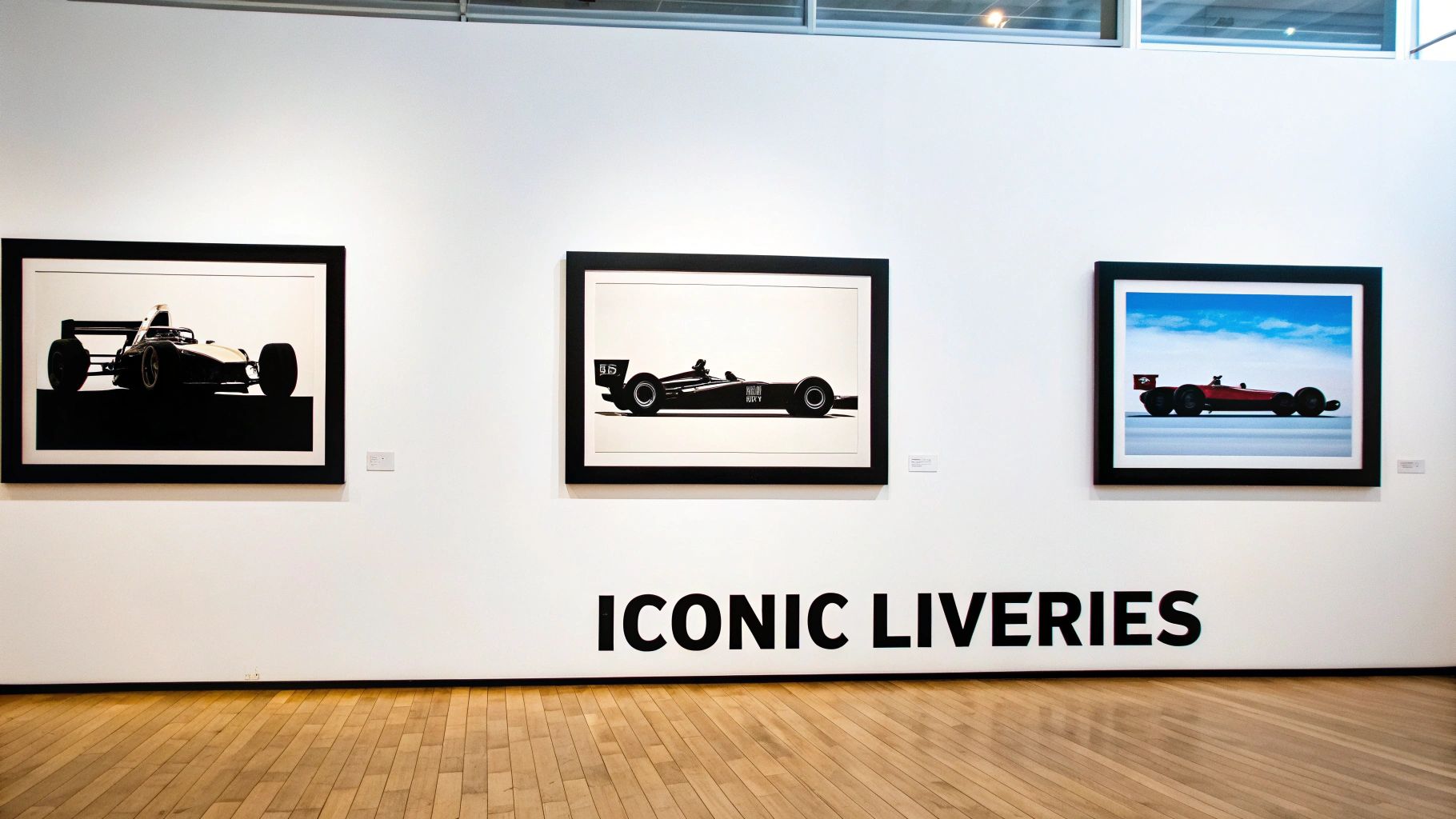
In Formula 1, a team’s identity is much more than a name on a trophy. It’s a visual language spoken at over 300 kilometres per hour. Liveries have evolved from simple national colours into rolling billboards that define entire eras of motorsport. These aren't just paint jobs; they're symbols of ambition, technology, and pure culture.
More than anything else, a car’s livery captures the spirit of its time. It tells a story of sponsorship deals, wild innovations, and the bitter on-track battles that fans will never forget. For us, these colour schemes trigger powerful emotions and memories, turning a machine of carbon fibre and metal into a legend.
Colours That Became Legends
Some liveries are so deeply woven into the sport's fabric they're instantly recognisable. They represent the absolute peak of design and performance, becoming just as famous as the champions who drove them.
- Ferrari's Rosso Corsa: This is the quintessential racing colour. That deep, passionate red isn't just a choice; it's the lifeblood of the Scuderia, representing Italian national pride and a legacy stretching back to the very first championship race.
- Lotus's John Player Special: Nothing screams 1970s and 80s cool quite like this. The sophisticated black and gold of the JPS cars was a masterclass in branding, projecting an image of elegance and swagger that perfectly matched the team's innovative spirit.
- McLaren's Marlboro Livery: For an entire generation of fans, the fluorescent red and white of the McLaren cars was Formula 1. This unmistakable design became the backdrop for the epic Senna-Prost rivalry and one of the most dominant periods any team has ever seen.
These are perfect examples of how a simple combination of colours can come to symbolise victory and an entire chapter in F1 history.
A great livery does more than just identify a car on track; it forges an emotional connection. It's the reason a static piece of art, like a framed print of a classic F1 car, can feel so alive with speed and nostalgia.
The Power of Sponsorship in Design
The switch from national racing colours to sponsor-driven designs in the late 1960s completely changed the look and feel of F1. This new era brought a vibrant explosion of creativity to the grid, as brands battled to create the most memorable and eye-catching liveries out there.
Teams like Williams with their iconic Camel yellow or Benetton with its bold, multi-coloured palette used their cars as canvases. The designs were daring, instantly recognisable, and perfectly captured the commercial energy just starting to fuel the sport. This relationship between teams and sponsors gave us some of the most enduring visual identities in motorsport history.
This is why displaying a classic livery is more than just decoration; it's a nod to a specific moment in time. A high-quality framed print of a legendary car, like this stunning piece celebrating the modern Ferrari F175 driven by Charles Leclerc, lets you own a piece of that legacy. It turns a passion for racing into a sophisticated statement, honouring the artistry and history of F1 teams in any home or office. It's how the stories of these incredible machines live on.
Bring the History of F1 Teams Into Your Home
The story of Formula 1 is so much more than a list of winners and losers. It’s a powerful, decades-long narrative of brilliant innovation, fierce rivalries, and pure human ambition. Getting to know this rich heritage helps us appreciate the sport on a whole new level, but your connection doesn't have to stop when the chequered flag falls.
You can celebrate this incredible story right in your own space. It’s about creating an environment that speaks to what you love about motorsport, keeping the adrenaline and artistry of F1 alive every single day. You're not just decorating; you're turning a simple wall into a tribute to the engineers, drivers, and visionaries who built this sport.
Curate Your Personal Grid
Think bigger than just hanging a single poster. What if you created a dynamic display that tells a specific story from the long and winding history of F1 teams? This approach transforms your space from mere decoration into a meaningful exhibit of your passion.
Here are a few ideas to get the engine started:
- A Timeline Wall: Imagine selecting framed prints of iconic cars from different dominant eras. Juxtapose a classic, ground-effect Lotus 79 with a modern, sculpted Red Bull to create a stunning visual map of how aerodynamics and design have evolved over the years.
- Team Homage Corner: Dedicate an entire space to your favourite constructor. You could combine prints of their most successful cars with detailed layouts of the circuits where they sealed their greatest victories.
- Driver and Machine: This is a classic for a reason. Pair a striking portrait of a legendary driver with a print of the car they made famous. Think Senna with the McLaren MP4/4 or Schumacher with his championship-winning Ferrari. The connection is undeniable.
High-quality art acts as a bridge between the past and the present. It honours the legacy of each team, transforming a machine built for speed into a timeless piece of motorsport heritage that captures a specific moment in time.
Ultimately, bringing the sport into your home is about celebrating the stories that truly resonate with you. Each artwork, circuit map, or piece of memorabilia becomes a daily reminder of the drama, the genius, and the brilliance that makes Formula 1 so utterly compelling.
To dive deeper into creating your own personal collection, you can explore our guide to Formula One memorabilia for even more inspiration.
Your F1 Team History Questions, Answered
As you get deeper into the rich tapestry of Formula 1, questions are bound to pop up. Think of this as a quick pit stop to get you the answers you need, connecting the dots between the sport's pioneering days and the high-tech powerhouses of today.
So, Who Is the Oldest F1 Team?
That honour belongs to the one and only Scuderia Ferrari. Founded by the legendary Enzo Ferrari, they are the only team to have lined up on the grid for every single World Championship season since it all kicked off back in 1950.
Their constant presence isn't just a statistic; it makes them a fundamental part of the sport's soul. That incredible longevity is a testament to an unwavering passion for racing that has defined them for generations.
Did All F1 Teams Build Their Own Cars from the Start?
Not at all, especially in the early days. The term you’ll often hear is "constructor," which is the outfit responsible for designing and building the car's chassis. While giants like Ferrari have always built their own machines, many smaller teams in the 1950s and 60s were known as "privateers."
These privateer teams would buy a chassis from a constructor—think Cooper or Lotus—and then go racing with it themselves. This is a rare sight today, as modern rules demand teams design and manufacture most key parts in-house. This has really cemented the constructor's role as the heart of any F1 operation.
The real mark of a constructor is owning the car's core design. Sir Jack Brabham took this to the absolute limit in 1966 when he won the championship in a car he built himself—the ultimate mic-drop moment for a true constructor.
Why Do F1 Team Names Change So Often?
Team names are constantly shifting, and it almost always comes down to business and money. There are a few common reasons you'll see a team rebrand:
- Change of Ownership: When a team gets sold, the new owners usually want to put their own stamp on it. A perfect example is when Racing Point was bought and became Aston Martin.
- Title Sponsorship: A big-name sponsor might pay a fortune for naming rights, which is how you end up with names like "Stake F1 Team Kick Sauber."
- Manufacturer Takeover: Sometimes a major car company buys an existing team to create its own official "works" entry, just like Mercedes did when they purchased Brawn GP.
Following these name changes is like tracing a team's family tree. It tells a fascinating story of survival, ambition, and evolution in the cut-throat world of Formula 1, with each name marking a new chapter in the team's ongoing legacy.
At TrackNation, we celebrate every single chapter of this incredible story. Bring the legacy of your favourite teams into your home with our premium collection of motorsport wall art, from iconic liveries to legendary circuit layouts. Explore the collection and find the perfect piece to honour the history of F1. Find your piece at https://tracknation.au.