

Silverstone Grand Prix: The Ultimate Guide to the silverstone grand prix
There are certain names in motorsport that just feel like history. Silverstone is one of them. It's more than just a race on the Formula 1 calendar; it's the spiritual home of British motorsport, a place woven into the very fabric of the sport.
Famous for its blistering high-speed layout and the roar of its passionate crowds, Silverstone's legendary status was cemented when it hosted the first-ever F1 World Championship race way back in 1950. This isn't just another race weekend; for fans across the globe, it's a pilgrimage.
Welcome to the Heart of British Motorsport
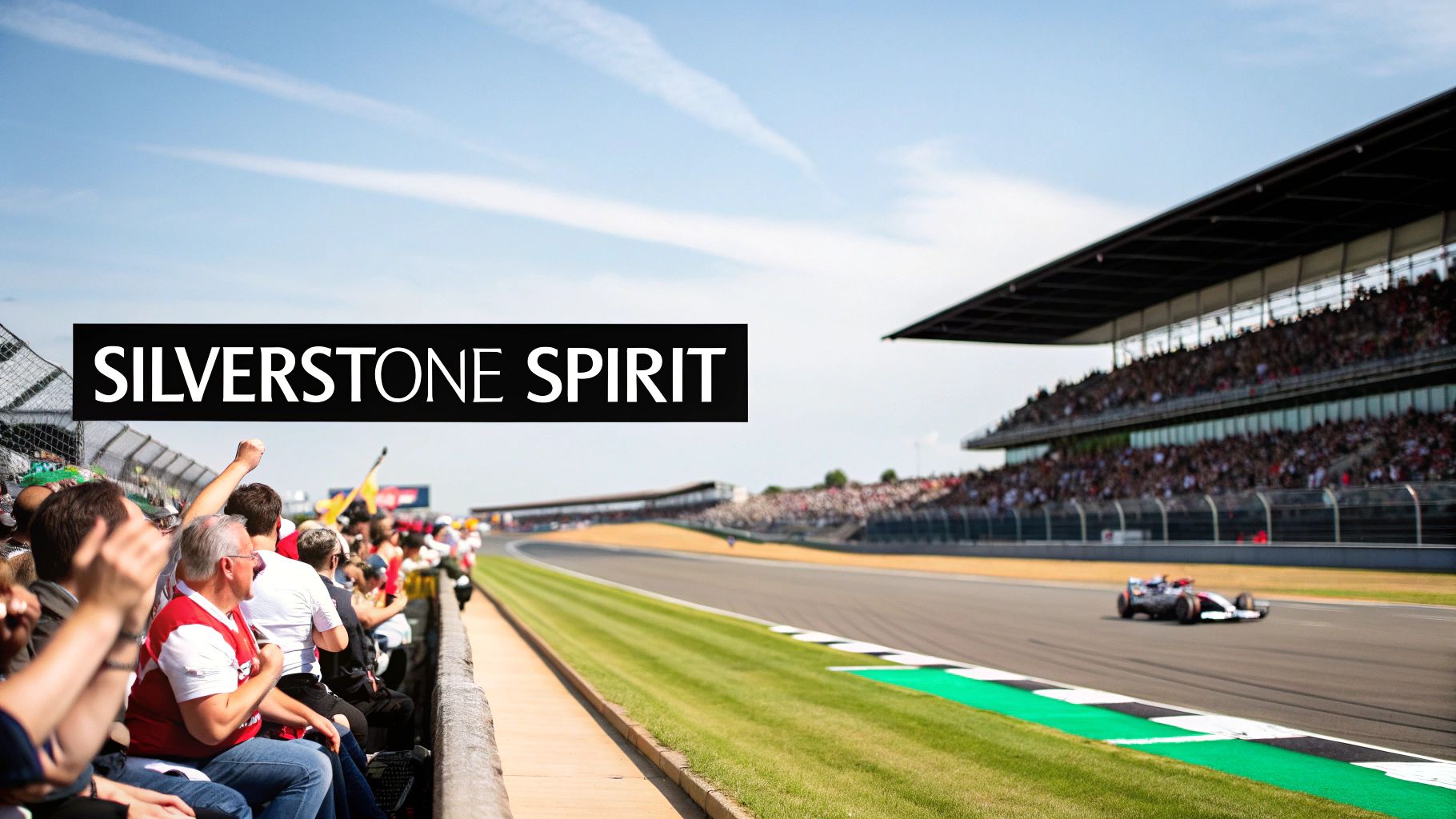
Honestly, there are few places on Earth where the shriek of an F1 engine sounds more at home. The Silverstone Grand Prix is a cornerstone of Formula 1's identity, a circuit steeped in decades of drama, glory, and, of course, famously unpredictable British weather.
Every year, hundreds of thousands of fans descend on the former airfield, creating an electric atmosphere that turns the entire venue into a theatre of motorsport passion. It's an experience you never forget.
This guide is your all-access pass to understanding exactly what makes this race weekend so special. We’re going to dive into every corner of the Silverstone experience, from its incredible history to the immense technical demands of its legendary corners.
What This Guide Covers
We'll get you up to speed on everything you need to know about this iconic event, including:
- The History: Discover how a WWII bomber base was transformed into a world-class racing circuit.
- The Circuit: We'll take you on a lap, breaking down legendary corner sequences like Maggotts and Becketts.
- The Moments: It's time to relive some of the unforgettable races that have defined F1 history right here.
- The Experience: Get the inside line on the best grandstands and tips to make your visit truly memorable.
Beyond the Racetrack
But the buzz for the Silverstone Grand Prix doesn't just stop when the chequered flag waves. For a true enthusiast, that feeling is something you want to hold onto every day. That’s where the connection between the thrill of the track and your own personal space begins.
Motorsport art is a way for fans to capture the raw energy of a high-speed battle or the pure elegance of a perfectly designed circuit. It transforms a fleeting moment into a lasting centrepiece for a home or office.
Throughout this guide, we'll show you how unique art from TrackNation can help bridge that gap. You'll see how a minimalist framed circuit map or a vibrant canvas can turn your passion for Silverstone into something tangible, keeping the adrenaline of race day alive all year long.
From Wartime Airfield To Legendary F1 Circuit
Long before the scream of Formula 1 engines echoed across the Northamptonshire countryside, the soundscape of Silverstone was all about the roar of RAF Wellington bombers. The circuit's story doesn't begin with motorsport, but with national service. Opened in 1943 as RAF Silverstone, it was a vital training base for bomber crews during World War II.
When the war ended, the airfield lay silent. Its vast, interconnected runways seemed destined to fade into the landscape. But a group of racing enthusiasts saw something special in the flat, expansive layout. In 1948, the Royal Automobile Club organised an impromptu race, using nothing more than hay bales to mark out a makeshift track. A legend was born.
That primitive first race set the stage for something much bigger. Just two years later, on 13 May 1950, Silverstone etched its name into history by hosting the very first race of the brand-new Formula 1 World Championship. The event, attended by King George VI, was the official start of modern F1 as we know it today.
Shaping a Temple of Speed
The circuit has changed dramatically over the decades, morphing from a simple perimeter track into the high-speed challenge drivers face now. Every tweak and redesign was made to improve safety while keeping the fast, flowing character that has become its signature.
Here’s a look at its evolution:
- Early Layouts: The initial races used the runways themselves, creating a blazingly fast but incredibly dangerous circuit.
- The Classic Bridge: The addition of the famous bridge in the early years created one of motorsport's most iconic images.
- Modern Redesigns: Major changes in the 1990s and again in 2010 introduced the "Arena" complex and the "Wellington Straight," adding new overtaking hot spots and technical sections.
The circuit is a living piece of motorsport history. Every corner tells a story, from the heroic overtakes at Stowe to the high-stakes strategy calls on the Hangar Straight. It's a place where legends are made.
This rich heritage is what makes the Silverstone Grand Prix so special. Legendary drivers like Giuseppe Farina, who won that first-ever F1 race, and modern heroes like Lewis Hamilton have all battled for glory on this historic tarmac. The layout demands immense bravery and precision, cementing its reputation as a true test of a driver's skill. To see how Silverstone fits into the bigger picture, you can explore the fascinating history of Formula 1 in more detail.
For fans, this history is something to be celebrated. Retro-style art or detailed map canvases let you own a tangible piece of this journey, showcasing the iconic corner names and historical facts that make Silverstone a true temple of speed.
Unpacking the Silverstone Circuit Layout
To really get Silverstone, you have to understand the track itself. This isn't just a ribbon of tarmac; it’s a high-speed puzzle that pushes drivers and their machines to the absolute breaking point. With an average speed rocketing past 230 km/h, Silverstone proudly stands as one of the fastest, most relentless circuits on the entire Formula 1 calendar.
The layout is a beautiful study in contrasts. It masterfully blends legendary, high-G corners that test a driver's raw nerve with immense straights demanding every ounce of power from the engine. Unlike the stop-start nature of a typical street circuit, Silverstone demands a car with near-perfect aerodynamic balance, needing massive downforce to stay glued to the track through its iconic sweeping turns.
This visual tells the incredible story of Silverstone's journey, from its humble beginnings as a WWII airfield to the world-class racetrack it is today.
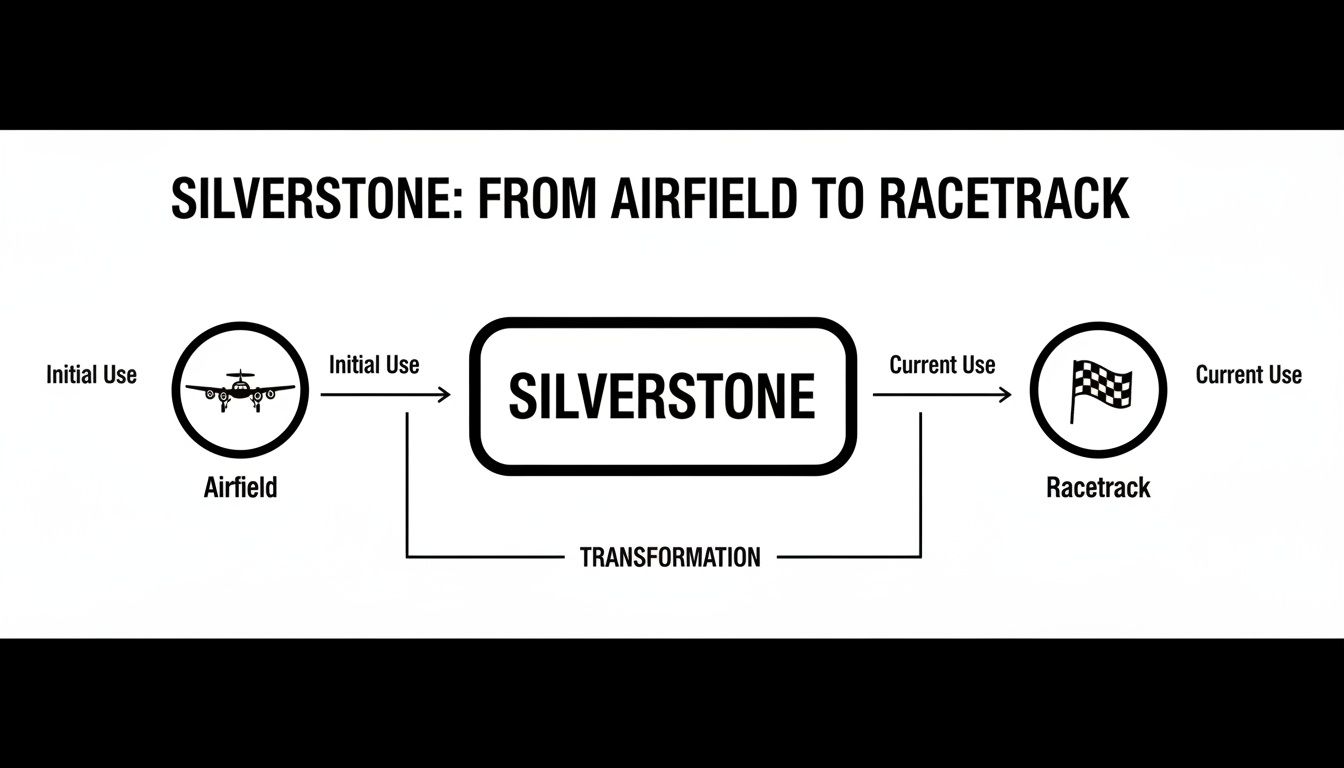
You can clearly see how the original, long runways were cleverly repurposed into the fast, flowing layout that both drivers and fans have adored for generations.
The Legendary High-Speed Sections
Alright, let's get into the corners that give Silverstone its fearsome reputation. The section that truly defines the experience here is the Maggotts, Becketts, and Chapel complex. This isn't just a sequence of bends; it’s a breathtaking, high-speed ballet where drivers flick the car left, then right, then left again, all while wrestling with incredible G-forces.
Think of it like trying to thread a needle while riding a rollercoaster—that’s the kind of pinpoint precision needed here. Drivers blast into this section at nearly 300 km/h, and the slightest hesitation or miscalculation can cost them a huge chunk of time or, worse, send them spinning off into the gravel. Finding a rhythm through here is everything.
Following this dizzying complex is the legendary Hangar Straight, one of the fastest stretches of track in all of F1. It’s a prime opportunity for drivers to deploy the Drag Reduction System (DRS) and line up an overtake before they slam on the brakes for the tight Stowe corner. If you're curious how this layout stacks up against another fan favourite, our deep dive on the Melbourne GP Circuit Map offers a fantastic comparison.
Key Overtaking and Technical Zones
Now, let's look at the key corners and complexes that make this track such a challenge.
Key Silverstone Circuit Corners Explained
While the high-speed sections get all the glory, races at Silverstone are often won and lost in the heavy braking zones and more technical parts of the lap. This table breaks down the most famous spots.
| Corner Name/Complex | Type of Corner | Key Challenge for Drivers |
|---|---|---|
| Maggotts & Becketts | High-speed esses (left-right-left) | Maintaining momentum and rhythm while battling extreme G-forces at over 290 km/h. |
| Stowe Corner | Fast, sweeping right-hander | Braking from over 320 km/h on the Hangar Straight and carrying speed through the apex. A classic overtaking spot. |
| Club Corner | Long, double-apex right-hander | A tricky corner that requires a perfect exit onto the main straight. Easy to get wrong. |
| Village & The Loop | Slow-speed left-right chicane | A sudden change of pace that demands heavy braking and precision. A modern addition designed for overtaking. |
| Brooklands & Luffield | Medium-speed left into a long right | A technical sequence where a good exit from Luffield is critical for a fast run down the National Pits Straight. |
Understanding these sections reveals why a detailed circuit map isn't just a piece of art; it's a tribute to the sheer engineering genius and human skill required to conquer such a demanding and iconic track.
Unforgettable Moments That Defined Silverstone
Silverstone is so much more than just tarmac and grandstands; it's a stage where motorsport's most incredible stories have played out. Over the decades, the British Grand Prix has given us everything from nail-biting title deciders to emotional underdog victories that have become woven into the fabric of Formula 1 folklore.
Every corner holds a memory. Just think of Nigel Mansell’s iconic "Silverstone taxi" moment in 1991, where he gave his stranded rival Ayrton Senna a lift back to the pits after the race. It was a pure gesture of sportsmanship that perfectly summed up the spirit of the event and remains one of its most cherished images.
These moments aren't just about who crossed the line first; they're about the raw human drama that makes F1 so completely captivating. It’s exactly this kind of high-stakes action that has also inspired countless works of art, turning those fleeting trackside victories into lasting pieces that celebrate the sheer passion of motorsport.
Legendary Clashes and Victories
The circuit has been a battleground for some of the sport's greatest rivalries. Who could ever forget the intense 1987 British Grand Prix? Mansell hunted down his own teammate, Nelson Piquet, selling him a brilliant dummy into Stowe corner to snatch an improbable victory in the final laps. The roar from the home crowd was deafening as he crossed the line, his car famously running out of fuel on the cool-down lap.
More recently, a modern Silverstone legend was born when Lando Norris secured his first-ever home win after 52 intense laps. He masterfully fended off late pressure from his teammate in tricky, changeable conditions to deliver McLaren's first British GP victory since 2008. Starting in the shadow of the pole-sitter, Norris held his nerve through a mid-race safety car amid the spray, maintaining a crucial gap to claim the chequered flag as the 13th British driver to win at home. This triumph, coming after six prior attempts, felt almost destined amid a record-breaking crowd. You can read more about the record-breaking 2025 British Grand Prix weekend.
It's these kinds of performances that define a driver's career. A win at the Silverstone Grand Prix, in front of one of the most passionate and knowledgeable crowds in the world, means more than just points—it means cementing your place in history.
This circuit has a unique ability to test even the most seasoned drivers, much like another iconic track we’ve covered in our guide to the Formula One Monaco Grand Prix.
The Modern Era of Drama
The drama certainly hasn't stopped in the modern era, with championship narratives often taking a sharp turn right here. Lewis Hamilton’s unbelievable recovery drive in 2022 after a first-lap incident stands out as a display of pure determination, showcasing his absolute mastery of a circuit he has dominated for so long.
- Underdog Triumphs: Carlos Sainz's maiden F1 victory in 2022 was a hugely popular and emotional moment for Ferrari and fans everywhere.
- Championship Deciders: The circuit has often played a crucial role in the title fight, with vital points won and lost on its fast, sweeping corners.
- Rain-Soaked Classics: The famously unpredictable British weather has often thrown a spanner in the works, leading to chaotic and unforgettable wet-weather races.
From historic wins to modern-day heroics, the Silverstone Grand Prix consistently delivers the moments that remind us why we love this sport. Each race simply adds another chapter to its incredible story, ensuring its legendary status for generations to come.
Your Essential Spectator Guide for Race Weekend
Heading to the Silverstone Grand Prix is an experience you'll never forget, but a little bit of planning can turn a great weekend into an absolutely epic one. This isn't just a race; it's a massive festival of motorsport, and the electric atmosphere created by the record-breaking crowds is something you have to feel to believe.
The sheer scale of it all can be a bit overwhelming if you're a first-timer. To give you an idea, the British Grand Prix recently smashed its attendance records, drawing a mind-boggling 500,000 fans over the four-day weekend. That's the highest in its entire Formula 1 history. On race day alone, 168,000 people packed into the venue, a testament to its legendary status. You can dig into the numbers yourself with these impressive attendance figures at GPdestinations.com.
With that many people, getting in and out of the circuit is a mission in itself. Driving is an option, of course, but be prepared for some serious traffic. A lot of seasoned race-goers swear by the Park and Ride services, which are brilliantly organised and take a huge amount of stress out of the commute.
Choosing Your Vantage Point
Where you watch the action from is going to shape your whole experience, and thankfully, Silverstone has a fantastic mix of spots to suit every budget and viewing preference.
- Club Corner: This spot is a massive fan favourite for a reason. It gives you a killer view of the final two corners and the all-important pit entry. You get to see the cars wrestling through the technical low-speed section before absolutely launching down the main straight.
- Becketts Grandstand: For the real purists, this is the place to be. You get a panoramic view of the iconic Maggotts and Becketts complex, a place where you can truly appreciate the insane aerodynamic grip of a modern F1 car. It’s breathtaking.
- General Admission: Don't write off the general admission areas! If you're willing to explore a bit, you can find some incredible spots. The banks around the high-speed Hangar Straight are perfect for watching the cars at full throttle.
Pro Tip: Get there early, especially with a general admission ticket. The best grassy banks fill up fast, but if you claim a prime spot, you can get a view that’s just as thrilling as any grandstand.
Navigating the Circuit and Accommodation
Once you're inside, wear comfortable shoes. The circuit is enormous, and you’ll be doing a lot of walking as you check out the fan zones, merchandise stalls, and food vendors. The festival vibe is a huge part of the Silverstone experience, with live music and entertainment keeping the energy high all weekend.
Accommodation is the other big thing to lock in early. Your options range from on-site camping, which puts you right in the heart of the action, to hotels in nearby towns like Milton Keynes or Northampton. Just make sure you book well in advance, as everything gets snapped up months before the race. The logistics are a world away from a city-based event like the Australian Grand Prix, so a bit of forward planning pays off.
Bringing the Silverstone Spirit Home

The buzz of a race weekend at Silverstone is electric, but that passion for motorsport doesn't have to fade when you head home. For true fans, the energy is something you want to keep close, turning your own space into a personal tribute to the sport you love.
Premium wall art is the perfect way to do just that, bottling the high-speed drama and rich history of Silverstone. It transforms your appreciation for Formula 1 into a stylish, tangible part of your home or office, keeping the thrill of race day alive all year round.
Choosing the Right Art for Your Space
The great thing about motorsport art is its versatility. You can find a piece that perfectly matches the vibe of any room, from a subtle nod in the corner to a bold statement piece that commands attention. It’s all about channelling your personal style while honouring the spirit of the track.
- For the Modern Office: A minimalist, framed circuit layout of Silverstone is a fantastic choice. Its clean lines and sophisticated design add a touch of personality without looking out of place in a professional setting.
- For the Living Room: Why not go for a larger, stylised canvas print of the circuit? It’s a brilliant conversation starter that effortlessly blends artistic flair with your passion for F1.
- For the Ultimate Fan Cave: This is where you can go all out. A detailed map-style canvas, often featuring corner names and historic facts, creates an immersive display that celebrates the legendary track in all its glory.
Great motorsport art does more than just fill a space on the wall; it tells a story. It captures the precision engineering, the driver's sheer guts, and the iconic layout of a circuit like Silverstone, letting you appreciate its complexities from a whole new angle.
Finding that perfect piece is everything. Diving into a quality collection of Formula 1 posters can spark some serious inspiration, whether you're buying a gift for a fellow fan or building your own gallery. Art is a powerful way to bring a piece of that Silverstone magic home.
Your Silverstone Questions, Answered
Planning a trip to Silverstone or just brushing up on your F1 knowledge? We get it. There’s a lot to take in when it comes to the spiritual home of British motorsport.
Here are some of the most common questions we hear, with straight-up answers to help you get sorted for race weekend or simply feed your curiosity.
Key Event Details
What’s the best way to get to Silverstone for the Grand Prix? Driving is always an option, and you can pre-book parking, but be prepared for some serious traffic. Honestly, the best bet for a stress-free journey is using the Park and Ride services. Another brilliant choice is public transport. You can catch a train to a nearby station like Milton Keynes Central or Northampton, where dedicated shuttle buses are waiting to zip you right to the circuit.
How long is the Silverstone F1 circuit? The current Grand Prix circuit at Silverstone measures 5.891 kilometres (that's 3.660 miles). An F1 race here runs for 52 laps, which adds up to a total race distance of about 306.198 kilometres of pure, high-speed action.
Can I visit the Silverstone circuit outside of race weekend? Absolutely! Silverstone is buzzing with activity all year round, not just on Grand Prix weekend.
You can book your own track day driving experiences, jump on a guided tour of the circuit and its top-notch facilities, or check out the Silverstone Interactive Museum. It’s a fantastic deep-dive into British motor racing history and a must-do for any enthusiast.
Ready to bring the high-speed thrill of every corner home? Explore premium motorsport art from TrackNation. Our collection of circuit maps and iconic race posters captures the spirit of the Silverstone Grand Prix perfectly. Find your perfect piece today at https://tracknation.au.