

Your Definitive Melbourne GP Circuit Map Guide
Looking at a map of the Melbourne GP circuit, you're seeing more than just lines on paper – you're looking at a blueprint for high-speed drama. This guide is here to turn that simple diagram into a vivid story of pure racing strategy.
Bringing The Albert Park Circuit To Life
Let's take a virtual lap of Albert Park together. We'll dive into its fast-flowing sections, unpack its tricky chicanes, and pinpoint the crucial overtaking zones that have written chapters in Australian motorsport history. Think of this as your co-pilot's guide, explaining exactly why each corner matters and how races are won and lost on these specific patches of asphalt.
Whether you're a seasoned F1 fan wanting to sharpen your strategic eye or just looking for the perfect piece of motorsport art, this guide connects you to the heart of the action. To get the full picture, you can explore the circuit's rich history in our detailed article on the evolution of the Australian Grand Prix. Our goal is simple: to make the circuit's iconic design a tangible and exciting centrepiece for any enthusiast's wall.
A Turn-By-Turn Guide To The Circuit Map
To really get what makes Albert Park special, you have to understand the battlefield. The 5.303 km Melbourne Grand Prix Circuit is a brilliant street circuit that’s been the heart of Australian Formula 1 since 1996. It’s a clockwise layout with 14 turns, each designed to push drivers and their cars to the absolute limit.
For a quick look at the track's core stats, here’s a handy table.
Albert Park Circuit Key Characteristics
This table provides a snapshot of the essential details that define the Melbourne Grand Prix Circuit.
| Feature | Specification |
|---|---|
| Circuit Length | 5.303 km |
| Number of Turns | 14 |
| Direction | Clockwise |
| DRS Zones | 4 |
| First Grand Prix | 1996 |
These numbers give you the basics, but the real story is in how those corners and straights connect.
A lap kicks off with a massive charge down to the legendary Turn 1. It's a notorious bottleneck where a race can be won or lost in the blink of an eye. Nailing this tight right-hander is everything—get it wrong, and your flow into the fast, sweeping Turn 2 is completely ruined.
The High-Speed Middle Sector
Once you're through the opening sequence, the track really opens up. The middle sector is all about a series of high-G sweepers that put a car's aerodynamic grip to the ultimate test.
The re-profiled Turns 9 and 10 are a perfect example—a rapid-fire chicane that demands pure bravery and laser-sharp precision. It’s a section that flows beautifully, leading directly into one of the best overtaking opportunities on the circuit. This flowing character is what sets it apart from other Aussie tracks; you can see just how different it is in our guide to the Mt Panorama circuit map.
Albert Park is a circuit of contrasts. It demands aggressive, late-braking moves into corners like Turn 11, yet requires a delicate touch through the fast, flowing sections. Mastering this balance is the key to a quick lap.
The heavy braking zone into the re-profiled Turn 11 is where you'll see a lot of the action unfold. It's a prime spot for late lunges and strategic out-braking moves, especially with another DRS zone right after it. From there, drivers power through the final sequence of corners to complete the lap.
This visual guide breaks down how all those elements—the layout, the strategy, and the art—come together.

As the infographic shows, the physical layout of the track directly shapes race strategy, and it’s that dance of speed and tactics that inspires its representation as motorsport art.
Overtaking, Strategy, and High-Speed Chess
The Melbourne GP circuit map reveals a fascinating game of high-speed chess, where a single, well-timed move can define an entire race. While its flowing nature has historically made overtaking tricky, recent modifications have introduced four crucial DRS (Drag Reduction System) zones to spice things up.
But these zones are so much more than just "push-to-pass" buttons; they're genuine strategic tools. Drivers use the first DRS zone on the main straight not just to attack into Turn 1, but to pressure the defender into a mistake, setting up a better run through the next sequence of corners. It’s all about thinking several moves ahead.
Beyond The DRS Zones
More often than not, the most powerful moves on this circuit happen away from the DRS straights. Strategy plays a monumental role here, especially with the delicate dance of tyre degradation and pit stop timing.
The Albert Park circuit is a masterclass in strategic racing. Winning isn't just about raw speed; it's about anticipating your rival's next move, managing your resources perfectly, and executing a flawless pit stop under immense pressure.
This is where the nail-biting concepts of the undercut and the overcut come into play:
- The Undercut: A team pits their driver earlier than a rival. The driver then uses the superior grip of fresh tyres to set a blistering pace, hoping to emerge ahead after the rival finally makes their stop.
- The Overcut: The opposite approach. A driver stays out longer on older tyres. This is a gamble that works if the tyres are still performing well, allowing the driver to maintain a strong pace and capitalise when their rival gets stuck in traffic after pitting.
Understanding these strategic layers completely transforms how you watch the race. You start seeing the bigger picture—the silent battles of tyre wear and timing that unfold lap after lap. Suddenly, you've gone from being a spectator to a trackside analyst.
The Story Behind Albert Park's Asphalt
The tarmac at Albert Park is steeped in history. While most of us know it as the home of the Australian Grand Prix since 1996, the park’s racing roots run much deeper, all the way back to non-championship races in the 1950s. Fun fact: the original circuit actually ran anti-clockwise, a complete reversal of the clockwise layout we see today.
This journey from a post-war track to a world-class F1 venue is a tale of constant evolution. The Melbourne GP circuit map has never been a static document; it’s a living blueprint that has been refined over the decades to push the limits of modern racing. Legends like Michael Schumacher dominated its earlier configurations, laying down benchmarks that drivers still chase today.
Tweaked for Modern Racing
The circuit's biggest facelift came in 2021 with a massive reprofiling project. This was far more than just a fresh layer of asphalt. Key corners were widened and their cambers adjusted, while the awkward chicane at Turns 9 and 10 was completely removed to create a blistering, flat-out run down to Turn 11.
These changes weren't just for show. They were specifically engineered to improve safety and, more importantly, to encourage more wheel-to-wheel action by creating genuine overtaking opportunities. The aim was to make the on-track spectacle as electric as the lakeside atmosphere.
It’s this continuous improvement that keeps the circuit so compelling. Every tweak adds a new layer to its character, ensuring it remains a proper challenge for the drivers and a phenomenal show for the fans. If you're keen to see how Albert Park fits into the bigger picture, our guide to the rich history of Formula 1 dives into the sport's fascinating timeline.
Finding The Perfect F1 Circuit Map For Your Space
A circuit map is so much more than just a piece of decor. It’s a statement, a nod to your passion for motorsport that tells a story without saying a word. Choosing the right Melbourne GP circuit map for your wall is a bit like being an interior designer—it’s all about balancing scale, style, and placement to create a sophisticated tribute to the pinnacle of racing.

First thing’s first: what role will this artwork play in your room? Are you looking for a bold centrepiece that grabs everyone’s attention in the living room? Or maybe just a more subtle hat-tip to F1 for your home office? Answering that question will help you pick a size that complements the room instead of completely taking it over.
Matching The Map To Your Aesthetic
Once you’ve got a size in mind, the frame and finish are your next big decisions. The right frame can elevate a print from a simple poster to a genuine piece of art, and it should work in harmony with your existing furniture to create a really cohesive look.
Here are a few popular options to get you thinking:
- Sleek Black Frame: A modern, minimalist choice that provides a sharp contrast, making the track layout really pop. It's incredibly versatile and slots perfectly into almost any contemporary space.
- Natural Wood Finish: This brings a warmer, more traditional vibe to the room. It’s a fantastic choice for spaces with other wooden elements or a more relaxed, Scandi-inspired feel.
- Crisp White Frame: Perfect for creating a bright, airy atmosphere. A white frame lets the circuit map's colours and details be the star of the show without fighting for attention.
The goal is to choose a piece that feels like it belongs, not like it was just tacked on. When you get the combination of size, frame, and placement right, a simple map becomes a powerful conversation starter that reflects your own unique style.
Final Touches For Maximum Impact
Okay, last but not least, let’s talk placement and lighting. As a rule of thumb, hang your art at eye level—which is roughly 145-155 cm from the floor to the centre of the print. This just makes it comfortable to look at.
Good lighting is also a game-changer. A well-placed spotlight or even just good ambient light can highlight the intricate details of the Melbourne GP circuit, bringing its famous lines and curves to life.
By thinking through these elements, you can transform your space with a stylish homage to motorsport. If you want to see a great example of a ready-to-hang piece, check out the TrackNation Albert Park Circuit Framed Canvas Print, which combines a detailed map with a premium finish.
How To Style Your Home With Motorsport Art
So, you’ve got your Melbourne GP circuit map. Now, how do you make it look incredible on your wall? It’s all about creating a space that shows off your passion for racing in a way that’s stylish, not cluttered. The trick is to strike that perfect balance.
A fantastic way to start is by building out a dynamic gallery wall.
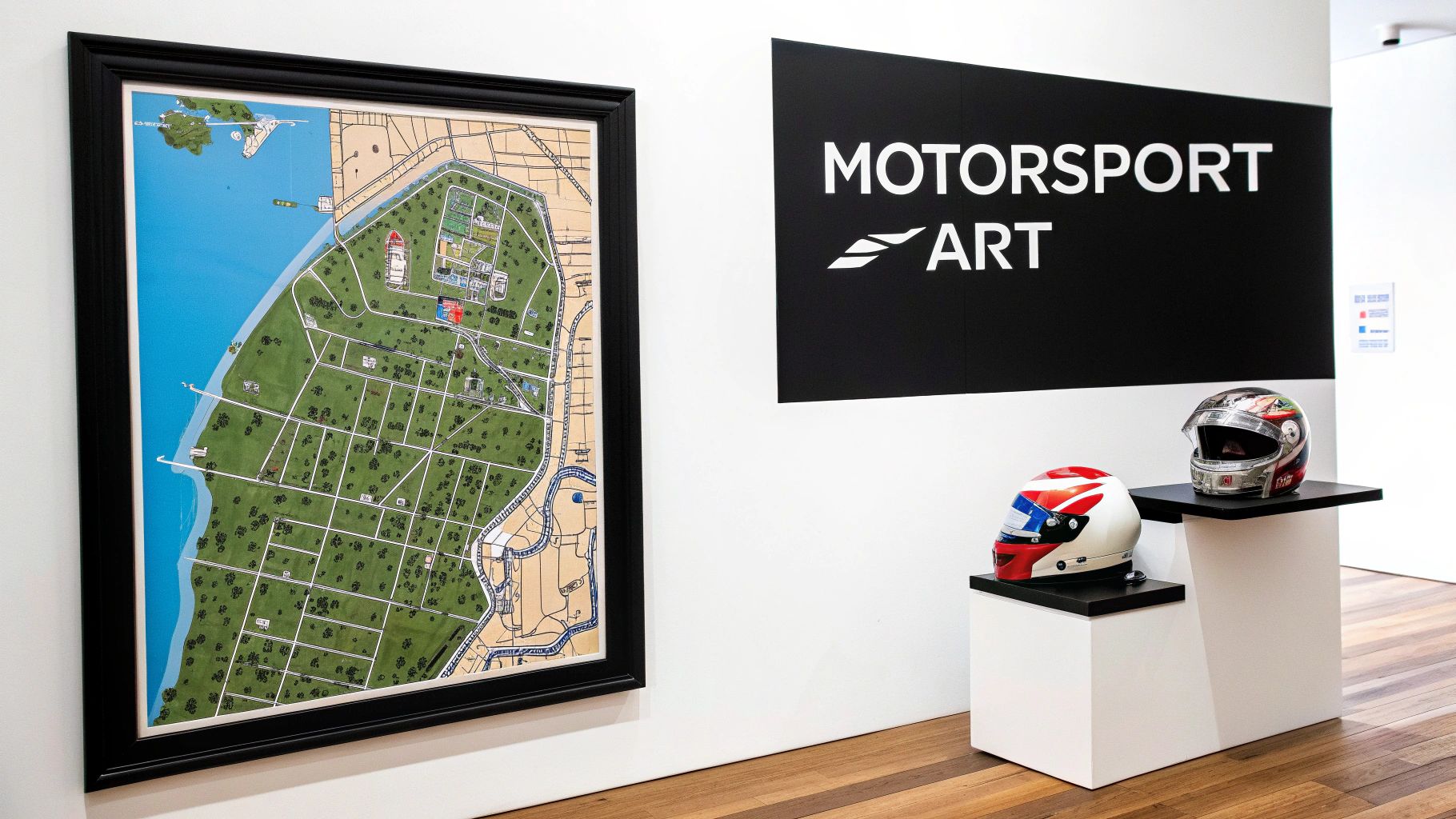
Think of your Albert Park map as the hero piece—the centre of attention. From there, you can build around it with other TrackNation prints to tell a bigger story. Why not pair it with some iconic driver helmets or a few retro race cars? It’s a great way to add a bit of variety and depth to your display.
Tailoring Art To Your Room
Where you hang your print can completely change its impact. A simple piece of art can become a real statement if it’s in the right spot, and different rooms call for different vibes.
Here are a few ideas to get the wheels turning:
- The Sophisticated Fan Cave: In your office or study, try framing the map with dark wood. Add some subtle motorsport memorabilia, and you've got a polished, focused atmosphere that still whispers 'racing fan'.
- High-Energy Accent Wall: Got a living room or a corporate lounge that needs a bit of a kick? A large-scale map makes a bold statement and instantly energises the room.
- Complete the Theme: Tie the whole look together with smaller touches. Think F1 radio message mugs and coasters on the coffee table or your desk.
When you thoughtfully curate your display, a simple circuit map transforms into something more. It's no longer just a poster; it’s the centrepiece of a well-designed tribute to the sport we love.
If you’re looking for more inspiration, our complete guide to choosing Formula One wall art is packed with extra tips and ideas to help you create that perfect look.
Your Questions Answered
So, you're eyeing up a piece of motorsport art or just want to get your head around the details of the Albert Park track? Let's clear up a few common questions. Think of this as your quick pit stop for all the info you need.
Whether it’s about what makes the track such a beast to drive or how to make your new print look its best, we've got you covered.
What Makes The Melbourne GP Circuit So Unique?
First off, the Melbourne GP circuit isn’t a permanent, purpose-built track. It’s a temporary street circuit, which means for most of the year, it’s just regular roads used by everyday traffic. This creates what the drivers call a "green" track – it starts off with very little grip and changes dramatically as the race weekend unfolds.
This forces teams and drivers to constantly adapt their strategy. Its layout is also a brilliant mix of flowing, high-speed sections and super tight, technical corners. This split personality demands a car setup that can handle both heavy braking and explosive acceleration, a real balancing act that sets it apart from many other tracks on the F1 calendar.
What’s The Best Way To Display A Circuit Map Canvas?
To really make your canvas pop, hang it at eye level. A good rule of thumb is to have the centre of the artwork about 145-155 cm from the floor. Pick a spot with good lighting, but try to avoid direct sunlight, as that’ll help protect the vibrant colours for years to come.
Thinking of a gallery wall? Perfect. Use the Melbourne GP circuit map as your anchor piece and arrange smaller prints around it to create a killer focal point. The best part? All our canvases show up ready-to-hang, so you can get that motorsport passion on your wall straight out of the box.
Are Circuit Maps A Good Gift For A Formula 1 Fan?
Absolutely. A circuit map is a far more stylish and thoughtful gift than the usual fan merch. It’s a piece of art that speaks to the technical side and rich history of Formula 1, making it a perfect fit for a home office, living room, or man cave.
It’s less of a poster and more of a statement piece. It shows you get their passion for the sport on a deeper level.
Here at TrackNation, we design every piece to be a conversation starter. Go on, have a look through our full collection of motorsport art and find the perfect gift for the F1 fan in your life at https://tracknation.au.