

The Enduring Legacy of McLaren in Formula 1
In the world of Formula 1, some names are simply synonymous with greatness. McLaren is one of them. It's more than just a team; it's a symbol of a relentless chase for perfection that has echoed down the grid for decades. This iconic British outfit is a true cornerstone of motorsport, celebrated for its engineering brilliance, its roster of legendary drivers, and an unshakeable will to win that has defined it since 1963.
The Roar of a Motorsport Legend
It all started in a humble workshop in New Malden, England, where a global powerhouse was about to be born. Bruce McLaren, a phenomenal driver and a gifted engineer, founded his team with one audacious goal: to build the fastest, most advanced racing cars the world had ever seen. This guide is a deep dive into the soul of that vision, tracing the team’s journey from its gritty beginnings to its status as a titan of motorsport.
We'll take a trip through the eras, revisiting the legendary drivers who became household names behind the wheel of a McLaren. The team's history isn't just about stats and figures; it's a story of raw human talent and mechanical perfection working in perfect harmony.
More Than Just Speed
To truly get McLaren, you have to appreciate its culture of constant innovation. The team’s influence stretches far beyond race wins and championships. They were pioneers, changing the game with their approach to material science—most famously, introducing the first full carbon fibre monocoque in Formula 1 with the MP4/1 in 1981. That single development completely revolutionised car design, making them lighter and safer. It set a standard that everyone else follows to this day.
McLaren’s philosophy has always been about pushing boundaries. It’s a team built on the belief that what is considered the limit today is simply the starting point for tomorrow. This mindset is woven into every car they produce.
A Legacy in Papaya
We'll also unpack the stories behind the team’s most iconic symbols, like the vibrant papaya orange livery that became an emblem of their innovative spirit. That colour wasn't just a random choice; it was picked for its high visibility on the grainy television broadcasts of the 1960s. A practical decision that became the stuff of legend.
Finally, we’ll look at how this incredible heritage inspires fans today, connecting the past glories on iconic tracks like Albert Park in Melbourne to the art that celebrates them. This is your all-access pass to McLaren's enduring cultural impact, from the starting grid to the gallery wall.
Forging a Legacy: From a Humble Workshop to the World Stage
Every great motorsport team has an origin story, and McLaren’s is pure grit. It all started back in 1963, not in some high-tech facility, but in a small workshop in New Malden, England. A brilliant young driver and engineer from New Zealand, Bruce McLaren, founded Bruce McLaren Motor Racing Ltd with a simple but powerful vision: to build and race his own cars, pushing the absolute limits of design and performance.
This wasn't some corporate venture; it was a team forged from pure, hands-on passion. In the early days, Bruce himself was the lead driver, the chief designer, and the dreamer pushing it all forward. Success didn't take long to find them, with dominant victories in the Can-Am series that put their engineering prowess on the map. But the real prize was always Formula 1. In 1966, the team made its Grand Prix debut in Monaco, planting the first seeds of what would grow into a global motorsport powerhouse.
From Tragedy to Triumph
A devastating blow struck the team in 1970 when Bruce McLaren tragically lost his life while testing a new car. For many, that would have been the end. But for McLaren, his resilient spirit became the very foundation of the team’s culture. They rallied, determined to honour his legacy by finishing the work he started. That incredible resolve paid off when they clinched their first F1 Constructors' Championship in 1974, a huge achievement that cemented their place on the world stage for good.
This timeline traces McLaren's incredible journey, from its humble workshop beginnings to a globally recognised symbol of racing excellence.
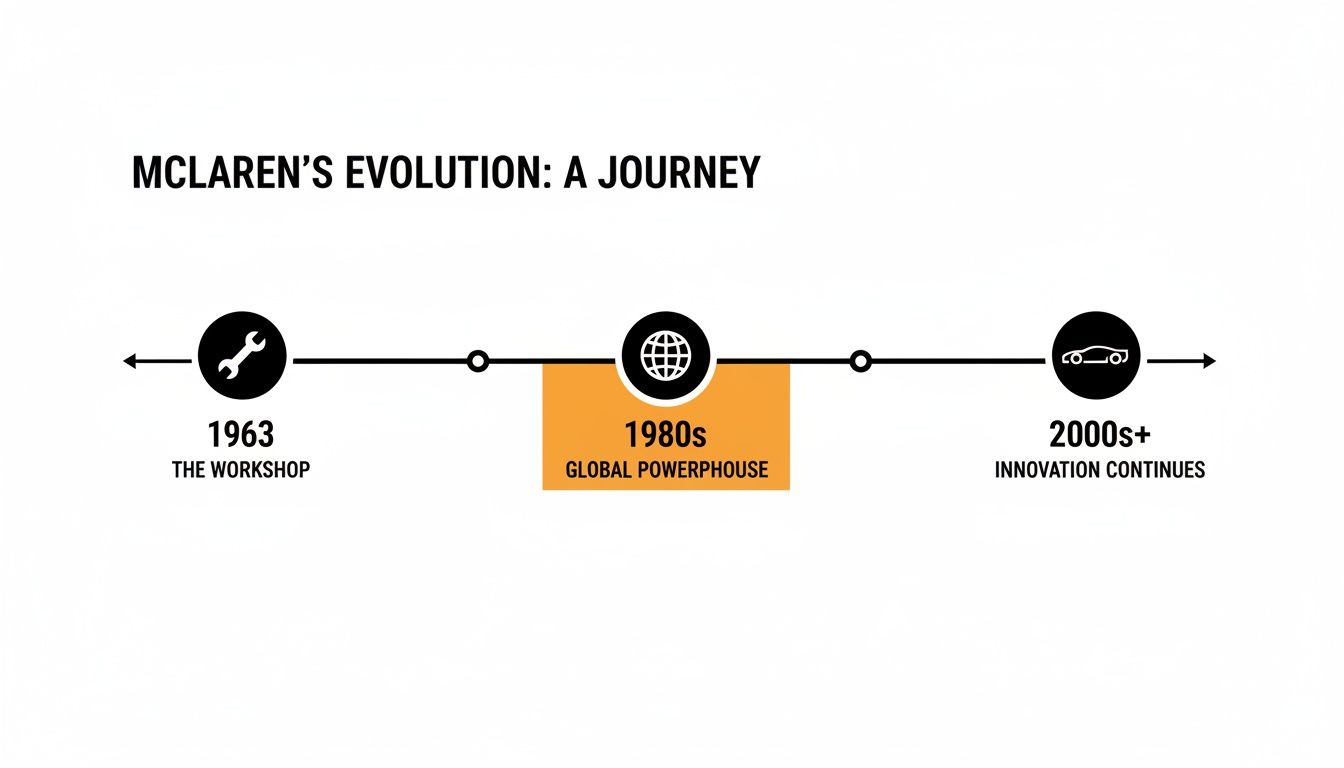
You can really see how decades of relentless innovation transformed a small-scale racing operation into an absolute titan of the industry.
The Dawn of a New Era
The late 1970s brought some lean years, but everything changed with the merger orchestrated by Ron Dennis in 1980. This move kicked off an era of incredible success and technical leaps for McLaren. The game-changer? The introduction of the MP4/1 in 1981, the very first F1 car to use a full carbon fibre composite monocoque chassis.
This wasn't just a minor upgrade; it completely rewrote the rules of F1 car construction. The carbon fibre design offered an unmatched mix of lightness, stiffness, and driver safety that made traditional aluminium chassis look ancient overnight.
That single innovation set a new standard for the entire sport. It was a masterclass in the forward-thinking engineering that would define McLaren for decades, laying the groundwork for the dominant, championship-winning cars of the 1980s and beyond.
If you’re keen to dive deeper into how the sport developed, you can explore the rich tapestry of F1 history in our detailed guide. This foundational period of ingenuity is what cemented McLaren’s reputation not just as a race team, but as a true pioneer in automotive technology.
The Titans of Papaya: Drivers and Cars That Made History
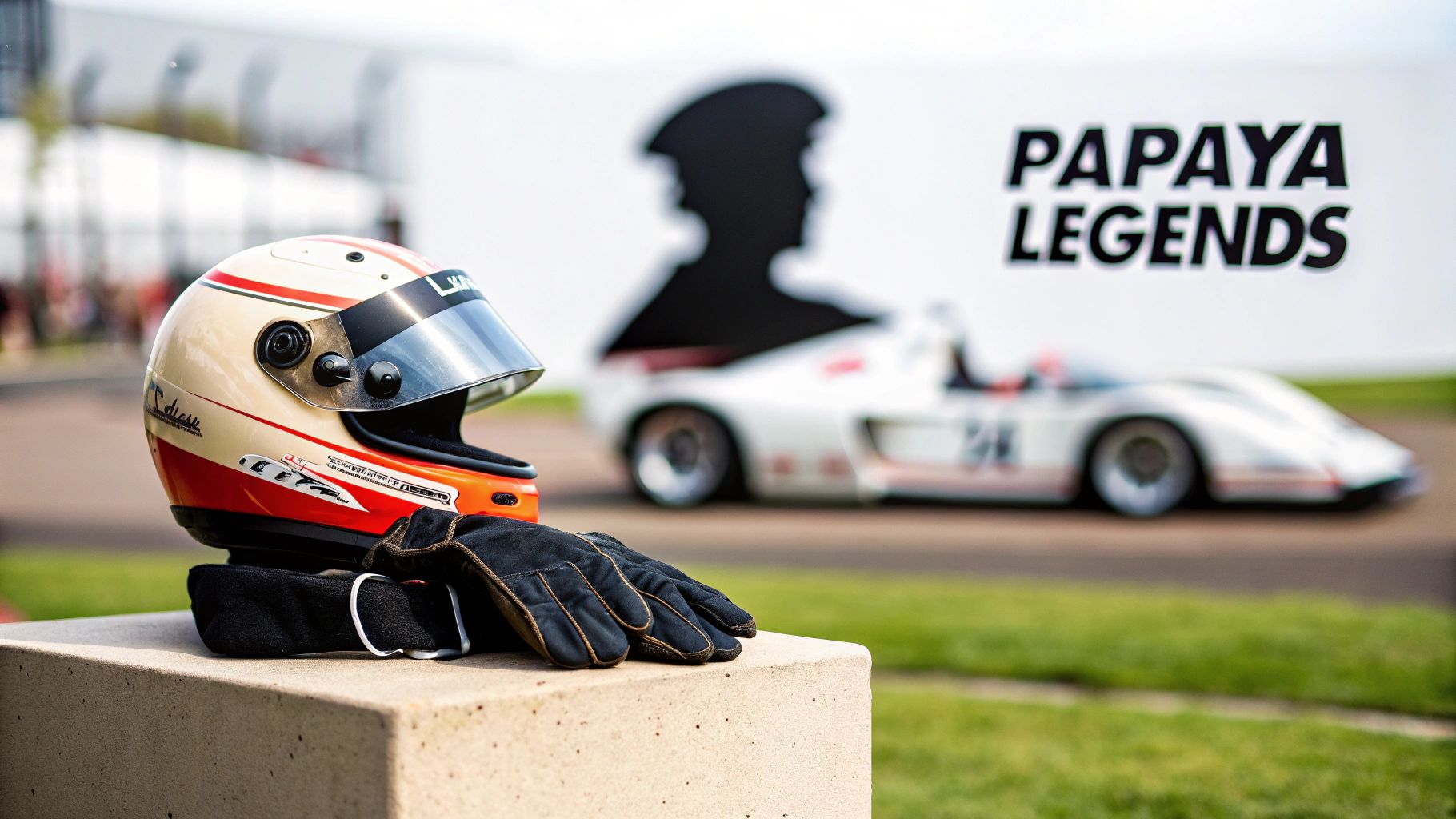
A race car is an incredible machine, but it takes a true hero behind the wheel to unleash its full potential. McLaren’s history is defined by these perfect pairings of human talent and engineering mastery, creating legends that echo through the ages.
The team’s story isn’t just written in championships won, but in the unforgettable drivers who piloted their cars to glory. These partnerships were symbiotic. A driver’s feedback would push engineers to find another tenth of a second, while the car’s capability gave the driver the confidence to attempt the impossible. This is the very soul of McLaren's success.
The Senna-Prost Era and the Untouchable MP4/4
You can’t talk about F1 history without mentioning the rivalry between teammates Ayrton Senna and Alain Prost. In the late 1980s, these two titans went head-to-head in the same papaya-liveried cars, putting on a spectacle of fierce, uncompromising competition that pushed them both to their absolute limits.
Their weapon of choice? The legendary McLaren MP4/4. During the 1988 season, this car achieved a level of dominance that has never been repeated, winning an astonishing 15 out of 16 races. The combination of its superior Honda engine, a revolutionary chassis, and two of the greatest drivers of all time created a perfect storm of performance.
The MP4/4 represents the zenith of McLaren's engineering philosophy. It wasn't just a fast car; it was an icon of perfection, a machine so far ahead of its rivals that it turned every race into a masterclass.
Champions of the Modern Era
As the years rolled on, McLaren continued to produce champions. The late 1990s belonged to the "Flying Finn," Mika Häkkinen. Known for his cool, calculated approach, Häkkinen battled Michael Schumacher and Ferrari, securing back-to-back World Championships in 1998 and 1999 at the wheel of the sleek, silver McLaren MP4/13 and MP4/14.
Then came a young British sensation named Lewis Hamilton. Making his debut with McLaren in 2007, he nearly won the title in his rookie year before dramatically clinching his first World Championship in 2008 on the very last corner of the last race. It was a heart-stopping moment that cemented another legendary driver-team pairing.
McLaren's Most Iconic Driver and Car Pairings
McLaren's history is peppered with legendary driver-car combinations that redefined what was possible in Formula 1. Here’s a look at some of the most iconic pairings that brought home the glory.
| Driver | Iconic Car(s) | Key Achievement |
|---|---|---|
| Ayrton Senna | McLaren MP4/4, MP4/5, MP4/6 | 3 World Championships ('88, '90, '91) |
| Alain Prost | McLaren MP4/2, MP4/4, MP4/5 | 3 World Championships ('85, '86, '89) |
| Mika Häkkinen | McLaren MP4/13, MP4/14 | 2 World Championships ('98, '99) |
| Lewis Hamilton | McLaren MP4-23 | 1 World Championship ('08) |
| James Hunt | McLaren M23 | 1 World Championship ('76) |
These names are more than just statistics; they represent eras of dominance and the pinnacle of motorsport achievement, all achieved in a McLaren.
The Next Generation of Papaya Talent
Today, the legacy continues with a fresh generation of talent. Oscar Piastri, McLaren's rising Australian star, has electrified the local fanbase since joining the team. Hailing from Melbourne, Piastri grabbed a sensational maiden podium at Albert Park in 2023, finishing P3 in a chaotic race with three red flags—the first F1 event ever with so many stoppages.
It was a brilliant showcase of his raw talent and McLaren's renewed pace. You can discover more about this rising star in our profile on Oscar Piastri. His impact shines brightest at home races, where the Formula 1 fervour is at its peak.
Mastering The World's Most Demanding Circuits
In Formula 1, some teams and tracks just click. It's a special kind of chemistry where a car's design philosophy perfectly syncs up with the twists, turns, and unique character of a specific circuit. For McLaren, this bond is felt at several legendary venues, but nowhere is their mastery more obvious than Down Under.
Certain circuits become hallowed ground, the stage for a team's greatest triumphs. And while you might think of British teams dominating on home turf, McLaren carved out a remarkable legacy on the other side of the world, turning Australia's demanding street circuits into their personal playground for decades. This wasn't just luck; it was a masterclass in engineering meeting tactical brilliance.
The Australian Advantage
The Australian Grand Prix, whether it was on the tight, unforgiving streets of Adelaide or the fast, flowing layout of Melbourne's Albert Park, has always rewarded cars with superb balance and aerodynamic efficiency. These happen to be the hallmarks of McLaren's design philosophy. Their cars consistently shine on circuits that demand precision and stability through a mix of high-speed corners and heavy braking zones.
The numbers back up this incredible history. McLaren holds the record for the most wins at the Australian Grand Prix with an impressive 12 victories out of the 39 races held since 1985, cementing them as the dominant force in F1's Aussie chapter. This success, spanning both the Adelaide and Albert Park eras, means McLaren has won nearly 31% of all Australian GPs. It's a staggering statistic that screams adaptability. If you're a numbers geek, you can explore more of these historic Grand Prix statistics on GPRacingStats.com.
McLaren's success in Australia is a testament to their engineering prowess. It proves that a well-designed car, capable of handling complex street circuits, can create a lasting legacy at a single venue, turning it into a fortress of victory.
This knack for conquering specific types of tracks is a defining feature of the team. And it's a skill they’ve flexed not just in Australia, but at other iconic venues right across the globe.
Conquering Motorsport's Crown Jewels
While Australia is a standout, McLaren's legacy is also deeply woven into the fabric of motorsport's most prestigious events. Their success at circuits like Monaco and Silverstone further cements their status as a versatile and formidable competitor.
- Monaco Grand Prix: The winding, barrier-lined streets of Monte Carlo demand absolute driver skill and a perfectly poised chassis. McLaren has triumphed here time and again, with legends like Senna and Prost wrestling their cars through the iconic circuit to victory.
- British Grand Prix: A team's home race always carries a bit of extra weight. We talk more about the challenges of this legendary track in our deep dive on the Silverstone Grand Prix. McLaren has delivered some truly unforgettable wins here, much to the delight of their home crowd.
Each of these tracks presents a unique puzzle, and McLaren’s history is filled with moments where they found the perfect solution. Their ability to master these varied and demanding circuits is a core part of what makes the McLaren name so respected in the world of motorsport.
Bringing The McLaren Legend Into Your Space
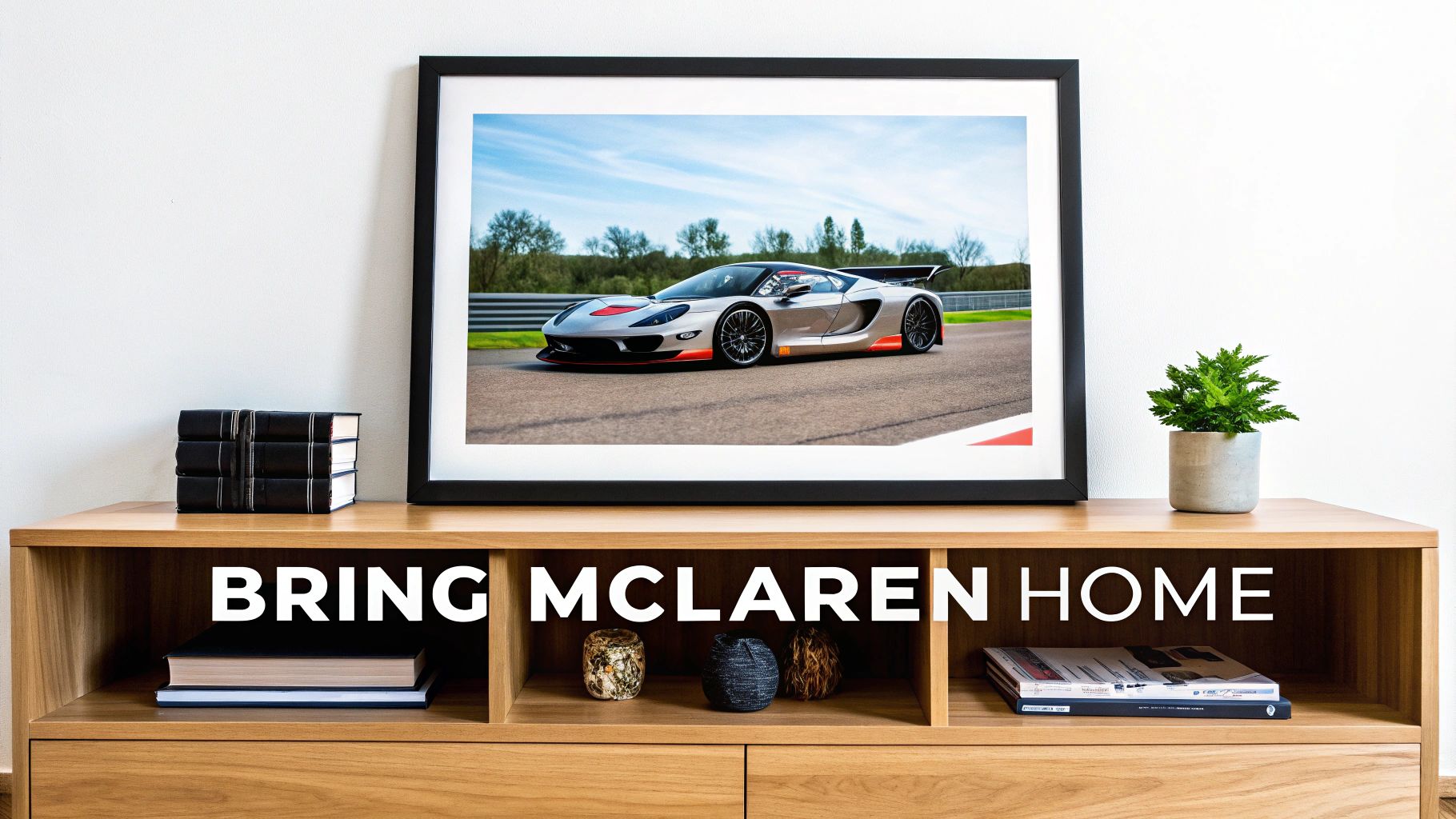
That heart-pounding thrill of a McLaren victory doesn't have to end with the chequered flag. For proper fans, motorsport is a part of who we are, and bringing that energy home is the ultimate tribute. This isn't just about sticking a poster on the wall; it’s about creating a space that lives and breathes the team's legacy of design, innovation, and pure, unadulterated speed.
Whether you're kitting out a dedicated fan cave, a slick home office, or just adding a touch of class to the living room, weaving the spirit of McLaren into your decor is all about getting the details right. With a bit of thought, you can craft a space that feels deeply personal and connected to the team’s incredible history.
Designing Your Personal Grid
The secret to great motorsport decor is all about balance—mixing bold, statement pieces with more refined, subtle details. A gallery wall is a brilliant way to tell a story, pulling together different elements to create a dynamic focal point. Try mixing minimalist layouts of iconic tracks like Albert Park with vibrant, retro-style prints of legendary cars.
Another great approach is to anchor your design in a specific era. You could build your theme around the iconic red and white Marlboro livery from the Senna and Prost years, or maybe go for the sleek, silver-and-black aesthetic of the Mika Häkkinen era. It adds a real layer of narrative to your space and makes for a fantastic conversation starter with any other fan who walks in.
Good design, just like a perfectly engineered race car, strikes the ideal balance between form and function. Your McLaren-themed space should look amazing, sure, but it also needs to feel comfortable and uniquely you. It’s all about creating an atmosphere that gets you inspired every single day.
Curating Your McLaren Collection
Putting together the perfect display means choosing pieces that really speak to your personal connection with the McLaren story. It’s not just about the cars; think about what makes the team so special to you.
- Celebrate a Driver: You could focus on one driver's legacy. A piece like a framed print of the McLaren MCL36 Lando Norris car is a perfect nod to the team's current era and its exciting young talent.
- Iconic Liveries: Pick out art that puts those famous liveries front and centre—whether it’s the eye-popping papaya orange or the classic red and white. Those colour schemes are instantly recognisable and hit you right in the feels.
- Historic Circuits: Minimalist track maps of circuits where McLaren has absolutely dominated—think Monaco or Silverstone—add a touch of understated class while paying homage to their greatest triumphs.
And don't forget the frames! The right frame is just as crucial as the art itself. A simple, clean black frame makes the artwork pop, giving it a modern, gallery-style feel. If you’re after something a bit warmer, a natural wood finish can look fantastic. The end goal is a cohesive, intentional display that truly honours the precision and style that the McLaren name represents.
Building Your Ultimate McLaren Collection
For any true fan, owning a piece of motorsport history is the ultimate tribute. Building a collection is your chance to curate a personal story of what McLaren means to you, turning raw passion into a tangible display of speed, design, and history. This isn't just about buying stuff; it's about making choices that celebrate the team's incredible legacy.
A great collection always starts with a focus. Pinpoint which chapter of the McLaren story really gets your engine running. Is it the sheer dominance of a driver like Ayrton Senna? Or maybe it's the engineering brilliance behind an unbeatable car like the MP4/4? Honing in on a theme is what turns a few posters on a wall into a cohesive and meaningful narrative.
Choosing Your Theme
To get you started, here are a few popular angles collectors take:
- Driver Tributes: Centre your collection around one legendary driver. Think about pairing a stunning portrait with prints of the iconic cars they piloted to victory.
- Iconic Cars: Celebrate the machines themselves. You could showcase everything from the ground-breaking M23 to the modern marvels tearing up the track today.
- Circuit Victories: Collect art that immortalises the tracks where McLaren has historically dominated, like the season opener at Albert Park or the glamorous streets of Monaco.
A curated collection is so much more than just decor. It’s a personal gallery that tells a story of triumph, innovation, and the relentless pursuit of victory that defines McLaren. Each piece becomes a conversation starter, connecting you to some of motorsport's greatest moments.
At the end of the day, the best approach is the one that reflects your personal connection to the team. By picking high-quality pieces that honour a specific driver, car, or moment, you'll build a display that truly does justice to McLaren's staggering history. For a bit more inspiration, have a look at our guide to collecting meaningful Formula One memorabilia.
Got McLaren Questions? We’ve Got Answers.
The world of McLaren is an epic saga of engineering brilliance, legendary rivalries, and moments that have left fans breathless for generations. Whether you're a new supporter joining the papaya army or a seasoned fan reliving the glory days, a few questions always seem to surface. Let’s tackle some of the most common ones.
From their iconic team colour to the drivers who became gods of the sport, every piece of the McLaren story is steeped in meaning. These questions get right to the heart of what makes this team a giant in the high-stakes world of Formula 1.
Why Is McLaren's Team Colour Papaya Orange?
You might think the vibrant papaya orange was chosen just because it looks good, but the real reason is far more practical. When Bruce McLaren picked the colour back in the 1960s, he did it for a brilliantly simple reason: it was unmissable on the track.
More importantly, it popped on the new colour television broadcasts that were just becoming popular. This savvy move for visibility quickly became a symbol of the team's bold and innovative spirit. While liveries have evolved, papaya orange remains the soul of McLaren’s identity—a nod to its clever, forward-thinking origins.
Who Are Considered The Greatest McLaren Drivers Of All Time?
Now this is a topic that can spark a proper debate among fans, but a few names always rise to the top. Ayrton Senna is often the first name mentioned; his three world titles and almost otherworldly talent have made him a motorsport myth. His great rival and fellow three-time McLaren champion, Alain Prost, is right there with him, celebrated for his cunning and calculated genius.
Beyond that legendary duo, you have to talk about Mika Häkkinen. The two-time champion is revered for his ice-cool composure and those epic dogfights with Michael Schumacher. And of course, there’s Lewis Hamilton, who clinched his very first F1 title with the team in a heart-stopping 2008 season finale, cementing his place in the McLaren story.
What Made The McLaren MP4/4 So Special?
The McLaren MP4/4 isn't just a special car; it's widely seen as the most dominant machine in the history of Formula 1. The stats are just staggering.
In the 1988 season, it won an unbelievable 15 out of 16 races. It was near-total supremacy. With Ayrton Senna and Alain Prost behind the wheel, its mix of a superior Honda engine, a groundbreaking chassis, and two of the greatest drivers ever created a force that has rarely, if ever, been matched since.
Ready to bring the legacy of these motorsport legends into your own space? At TrackNation, we've put together a collection of premium wall art celebrating McLaren's most iconic cars, drivers, and circuits. Explore the collection and find your piece of history.