

Your Nurburgring Race Track Map Wall Art Guide
A Nürburgring track map is so much more than a simple navigational tool. Think of it as a detailed blueprint of motorsport's most legendary challenge. It perfectly captures the circuit's split personality—the sprawling, historic Nordschleife and the modern GP-Strecke—immortalising the very layout that has been testing drivers and machines for nearly a century.
The Story Behind The Green Hell
Welcome to the Nürburgring, a circuit that feels less like a race track and more like a living piece of motorsport history carved into Germany’s Eifel mountains. To really get what makes this place so special, you need to understand its dual identity and the fearsome reputation that precedes it. This isn't just one track; it's a complex of circuits with a story that has gripped fans for generations.
At its core, the 'Ring has two distinct personalities, each with its own purpose and legend. The first is the sprawling, untamed beast known as the Nordschleife (North Loop). The second is the polished, professional GP-Strecke, a modern Grand Prix circuit built for the absolute highest levels of international racing.
Why The Green Hell Nickname
The Nordschleife is the soul of the Nürburgring. This is the circuit that earned the infamous nickname ‘The Green Hell,’ a term brilliantly coined by Formula 1 legend Sir Jackie Stewart. He called it that for good reason: its daunting, high-speed corners, relentless elevation changes, and the dense, unforgiving forest that lines the track, waiting for the slightest mistake. The Nordschleife is a raw, non-stop test of driver skill and courage.
The Nürburgring is a monster. It’s raw, it’s fast, and it demands respect on every single metre. Looking at a map of it is like looking at the DNA of motorsport itself.
By contrast, the GP-Strecke was built in the 1980s with modern safety standards front and centre. While it might lack the raw terror of its older, wilder sibling, it’s still a world-class facility that hosts premier racing events year after year.
Understanding these two layouts is the first step to appreciating why a Nürburgring track map makes for such a compelling piece of art. It’s not just a drawing of asphalt; it’s a tribute to:
- Engineering and bravery: Representing the absolute pinnacle of both car and driver performance.
- Motorsport history: A visual record of countless iconic moments, from legendary victories to heartbreaking defeats.
- A unique challenge: Showcasing the sheer complexity that makes this circuit the ultimate benchmark for automotive excellence.
Understanding The Nürburgring's Two Circuits
To really appreciate any Nürburgring race track map, you first have to know you’re looking at a tale of two completely different circuits. This legendary place isn’t just one track; it’s a monster combination of an old, wild beast and a modern, polished arena.
Each layout has its own story, character, and purpose, which is why they so often appear as separate pieces of art. The two main players are the Nordschleife (North Loop) and the GP-Strecke (Grand Prix Circuit).
Think of it like this: the Nordschleife is the raw, historic heart of the ‘Ring, while the GP-Strecke is the professional, purpose-built stage for today's top-tier racing.
The Old Guard: The Nordschleife
This is the one. The circuit of legends. The Nordschleife is that sprawling, terrifyingly fast ribbon of tarmac winding through the Eifel mountains that earned the nickname ‘The Green Hell’.
Built way back in the 1920s, its design is a pure product of its time—narrow, unforgiving, and draped over the natural terrain with mind-bending elevation changes. This is the layout most fans picture when they hear "the Nürburgring".
It's where the world’s fastest road cars come to prove their mettle and where the gruelling 24 Hours of Nürburgring endurance race is held, often connecting it with the GP circuit. Its sheer length and complexity make it an incredible challenge for drivers and a stunning subject for a map.
This infographic gives you a glimpse into the Nordschleife's daunting stats.
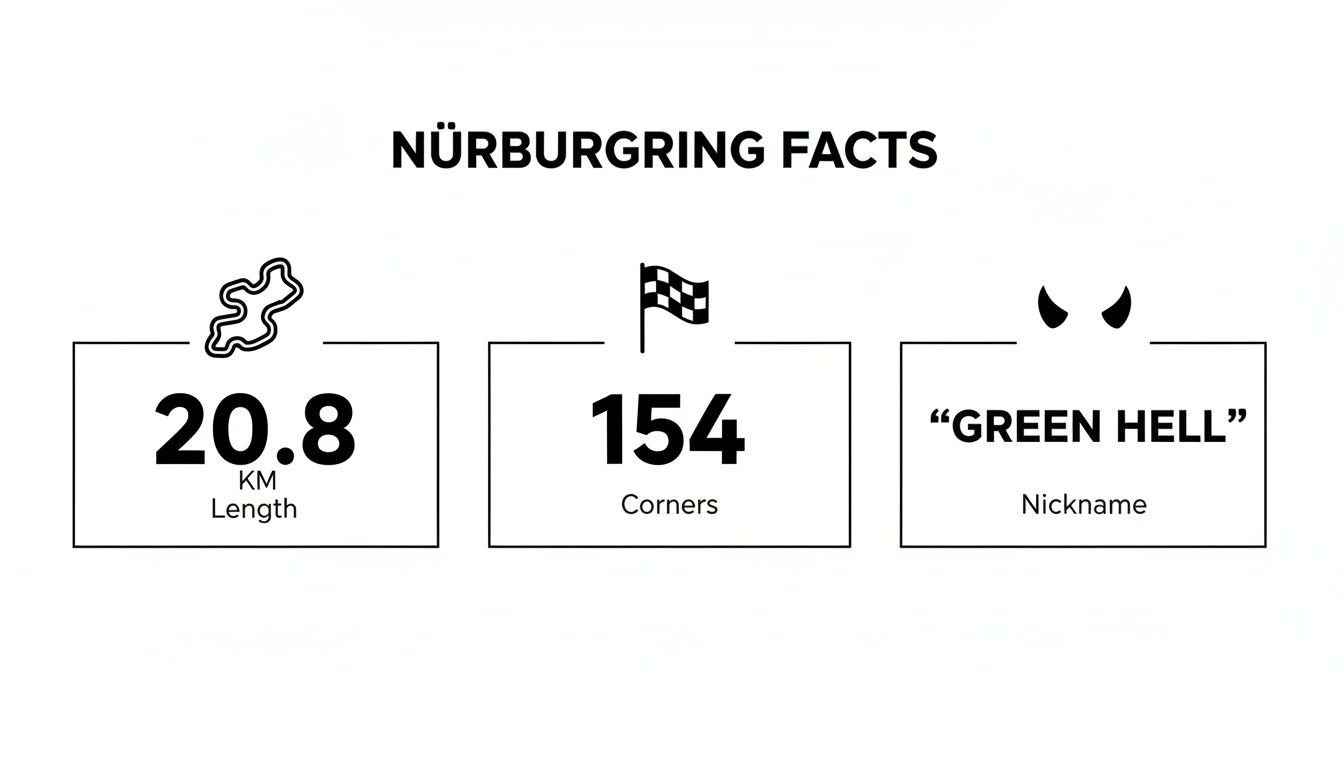
The numbers alone show you just how demanding this track is compared to almost any other circuit on the planet.
The Modern Arena: The GP-Strecke
In complete contrast, the GP-Strecke was built in 1984 with modern safety as its top priority. It was created to host Formula 1 and other major international championships that had long outgrown the dangerously fast Nordschleife.
While it doesn't have the raw, historical terror of its older sibling, the GP-Strecke is a fantastic circuit in its own right. It’s packed with technical sections and high-speed corners that demand absolute precision. It features a more conventional design with huge runoff areas, making it a suitable battleground for modern F1 cars.
The Nordschleife tests courage and instinct. The GP-Strecke tests technical precision and strategy. Together, they represent the full spectrum of motorsport challenge, from raw history to modern execution.
To put it simply, here’s a quick look at how these two iconic layouts stack up against each other.
Nordschleife vs GP-Strecke At A Glance
| Feature | Nordschleife ('The Green Hell') | GP-Strecke (Grand Prix Circuit) |
|---|---|---|
| Length | A massive 20.832 kilometres | A more standard 5.148 kilometres |
| Corners | Officially 73, but drivers count over 150 turns | A total of 15 distinct corners |
| Primary Use | Industry testing, public driving sessions, endurance racing | Formula 1, DTM, international championships |
| Character | Narrow, bumpy, huge elevation changes, little runoff | Wide, smooth, modern kerbs, extensive safety zones |
Knowing this fundamental split is key. It helps you pick a map that reflects the part of the Nürburgring story you connect with most—whether that's the untamed history of the Nordschleife or the clinical perfection of the GP-Strecke. Both are icons, but they tell very different tales.
It's much like another legendary track down under; you can learn more about its unique character in our guide to the Mt Panorama circuit map.
A Lap Of The Legendary Nordschleife
Looking at a Nürburgring track map is one thing, but feeling it is another. A map is like sheet music – just lines and curves on a page. To really get it, you have to imagine the roar of the engine and the G-forces pulling at you through every single turn.
Let's turn that static image on your wall into a full-throttle tour of the Nordschleife's most notorious sections. This isn't just a drive; it's a pilgrimage through motorsport folklore. A lap here is a relentless assault on the senses, demanding everything you've got from the moment you leave the pits.
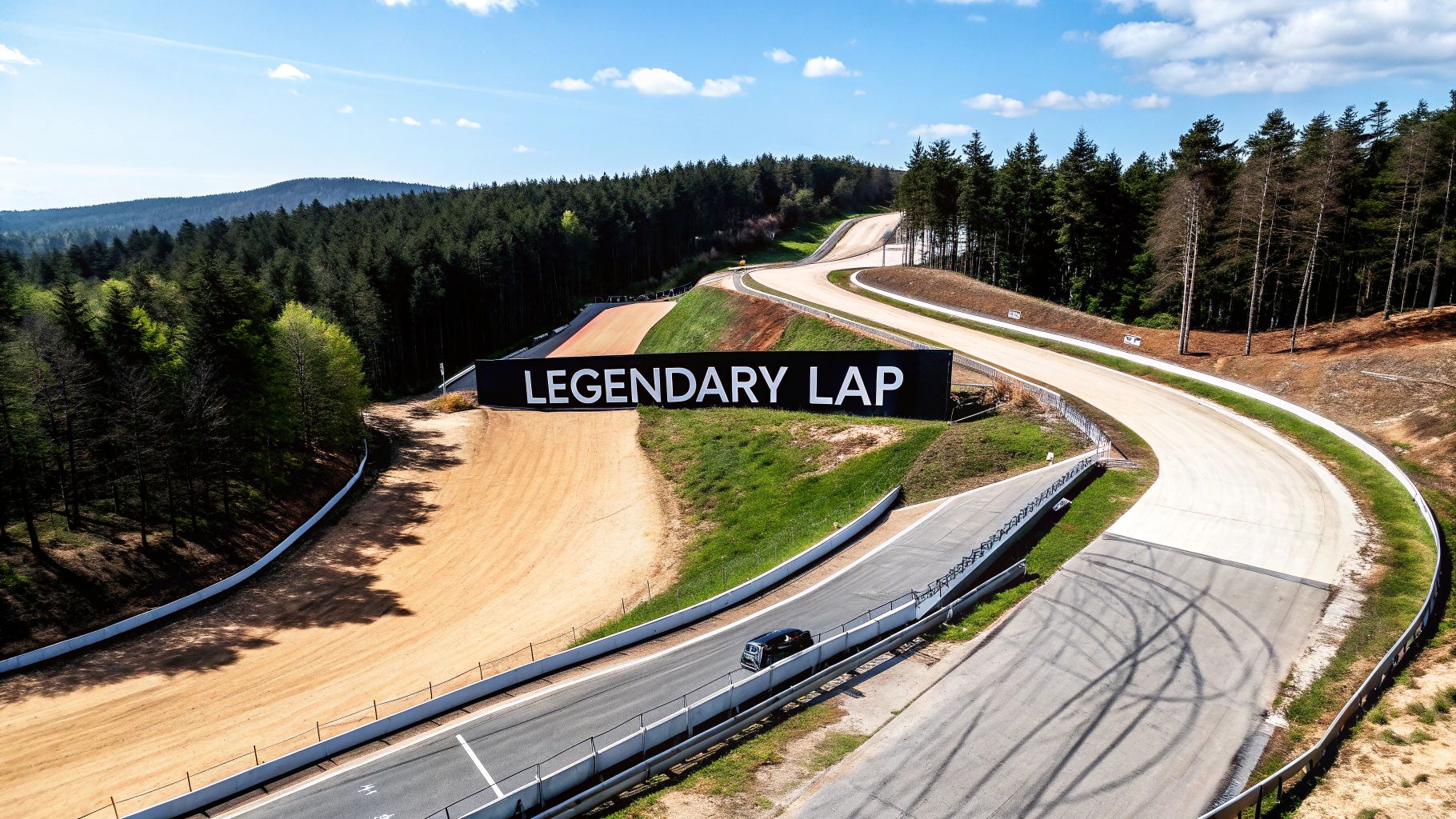
The photo above says it all. It’s a ribbon of pure chaos carved through the Eifel mountains, where every single bend has a story. This is what the circuit is all about: raw, natural beauty mixed with a brutal challenge.
From Flugplatz To Bergwerk
Our lap kicks off with the fast, flowing kinks of the Tiergarten section before we arrive at our first major landmark: Flugplatz. The name means ‘airfield,’ a nod to a nearby glider field, and it’s famous for a massive crest that sends cars flying. Get it wrong, and you’re literally taking off. It’s a moment that requires total faith in your car and your own skill.
From there, the track dives downhill through Schwedenkreuz and Aremberg before you hit the Fuchsröhre, or 'Foxhole'. This is a gut-wrenching compression that batters the car's suspension and tests your nerve, immediately followed by a blind, uphill climb.
Next up is Adenauer Forst, a tricky chicane that has claimed countless victims over the years. Then, it’s on to the infamous Bergwerk corner. This is where Niki Lauda had his fiery, near-fatal crash in 1976. It’s a medium-speed right-hander at the lowest point of the circuit, and getting it right is crucial for carrying speed onto the long Kesselchen straight that follows.
A map shows you the corners. A lap of the Nordschleife makes you feel them. Each one, from the Karussell’s jarring concrete to the Flugplatz’s heart-stopping crest, is a piece of living history.
Winding through Germany's Eifel mountains, the Nürburgring Nordschleife is one of the world's most gruelling circuits, stretching over 20.832 kilometres. Built in 1925, it officially has 73 corners, but with constant elevation changes—nearly 300 metres from its lowest to highest point—it feels more like 150 different challenges. It was this unforgiving nature that led Sir Jackie Stewart to give it the perfect nickname: "The Green Hell." A name that has stuck for good reason. You can dive deeper into its incredible history on its Wikipedia page.
Conquering The Karussell And Beyond
You can't talk about the Nordschleife without mentioning its most iconic corner: the Karussell. This isn't a normal corner; it's a crazy, 210-degree banked hairpin paved with brutally uneven concrete slabs.
- The Challenge: You have to drop your inside wheels into the banking to find the fastest line, which sends violent shocks through the entire car. It’s a bone-jarring experience.
- The Reward: Getting the Karussell right is a badge of honour. It's the key to a good lap time and a moment you'll never forget.
After you've survived the Karussell, you're fired into the high-speed sections of Hohe Acht and the fast, flowing esses of Pflanzgarten, another spot famous for its jumps. The lap finally ends on the long Döttinger Höhe straight, where cars hit top speed before slamming on the brakes for the final chicane.
This quick tour through just a few key landmarks shows exactly why a Nürburgring track map isn't just a poster—it's a tribute to motorsport's greatest test of all.
The Nürburgring's Golden Era in F1
The soul of the Nordschleife is woven into the very fabric of Formula 1's golden age. Between 1951 and 1976, this was the ultimate battlefield—a place that forged legends and pushed the boundaries of bravery. Looking at a Nürburgring race track map from this time is like staring at a blueprint from motorsport’s most punishing era.
This is where the track cemented its fearsome reputation. Drivers weren't just racing each other; they were in a constant fight with the circuit itself. Its lethal combination of blistering speeds, blind crests, and virtually non-existent runoff demanded a level of raw courage and skill that modern circuits simply can't replicate.
This period was packed with incredible milestones. A huge moment came in 1961 when American driver Phil Hill, behind the wheel of a Ferrari 156, became the first person to lap the beast in under nine minutes. His time of 8:57.800 didn't just break a record; it shattered a psychological barrier, proving the impossible was within reach.
An Era Ends at Bergwerk
The Nordschleife’s reign as the king of Grand Prix circuits came to a dramatic, fiery end in 1976. During the German Grand Prix, Niki Lauda suffered a near-fatal crash at the fast left-hand kink just before the Bergwerk corner, an incident that sent a shockwave through the entire sport.
That crash laid bare the track's inherent dangers in an age of increasingly powerful cars. It was a brutal wake-up call and a definitive turning point for F1.
Following Lauda's accident, the drivers collectively decided the Nordschleife was simply too dangerous for modern Formula 1. The 1976 race was the last time the premier class would officially compete on the legendary North Loop, marking the end of a truly heroic chapter in motorsport.
The legacy of this era elevates any Nürburgring map from a piece of art to a historical document. It captures the very layout where icons like Fangio, Clark, and Stewart proved their mastery. From its first Grand Prix to its last, the Nordschleife hosted 22 seasons of F1 racing, forever embedding itself in the sport's DNA.
The Modern Champion
While the Nordschleife's F1 story had ended, the Nürburgring legend was reborn on the new GP-Strecke. It was here that a new master emerged: Michael Schumacher. The German icon was utterly dominant on home soil, racking up five incredible victories between 1995 and 2006 and becoming the most successful F1 driver at the venue.
These historical chapters add so much depth to a Nürburgring map, connecting the simple lines on paper to incredible moments of triumph and tragedy. For a deeper dive into the sport's most compelling stories, you can explore more about F1 history in our dedicated article.
How To Choose Your Nürburgring Map Art
Now that you know the story behind the circuit, it's time for the fun part: picking the perfect piece of art to celebrate it. Choosing a Nürburgring track map is a seriously personal decision. It has to reflect your own style and your connection to motorsport. Get it right, and it’s not just filling a space on a wall; it becomes a genuine conversation starter.
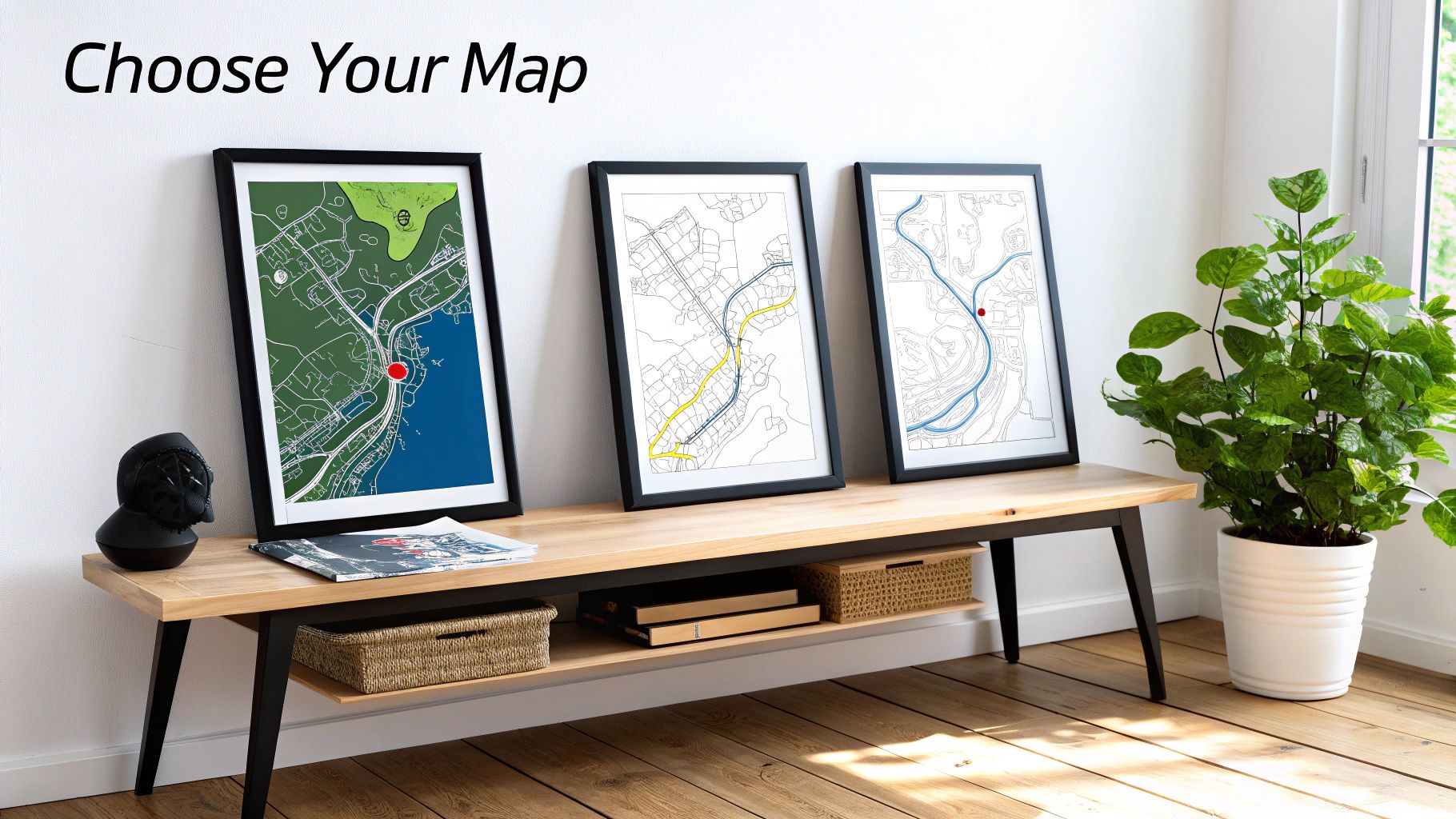
The first big question is usually about detail. Are you after a clean, minimalist outline of the Nordschleife, or do you want a detailed map calling out every named corner, from Flugplatz all the way to the Karussell? Each style has a completely different vibe.
Finding Your Artistic Style
Minimalist designs are incredibly versatile. They slot seamlessly into modern offices, living rooms, or any space where you want a subtle nod to your passion without shouting about it. The focus is purely on that iconic, twisting shape, letting its legendary form do all the talking. It’s an elegant and seriously understated approach.
On the other hand, a detailed map is for the true enthusiast—the one who lives and breathes this stuff. These prints are often packed with extra info:
- Corner Names: Every legendary bend is clearly labelled, turning the art into a bit of a history lesson.
- Track Statistics: You might find things like circuit length, the total corner count, and maybe even lap records.
- Colour Schemes: Some designs use colour to highlight specific sections or the track's dramatic elevation changes.
These highly detailed versions are perfect for a dedicated fan cave, a garage workshop, or any room where motorsport is front and centre. They practically beg you to get a closer look and can spark some deep chats about specific moments in the track’s history.
A minimalist map shows you love the Nürburgring. A detailed map shows you know the Nürburgring. It all comes down to whether you want the art to whisper or to shout its motorsport credentials.
Matching The Map To Your Space
Beyond the design itself, you've got to think about the physical format and how it'll work with your room's decor. A framed print gives you that classic, sophisticated look that never goes out of style. A sharp black or white frame creates a clean, modern aesthetic, while a natural wood finish can bring a bit of warmth to the space. Canvas prints, however, offer a more contemporary, gallery-style feel without any of the reflections you get from glass.
Take a look at the colour palette in your room. A monochrome black-and-white map is always a safe and stylish bet that works almost anywhere. But if your space has specific accent colours, you could even hunt for a custom print that pulls in those tones for a really cohesive look. It’s a bit like choosing from our range of Formula 1 posters; the goal is to find a piece that just makes your environment better.
Ultimately, the perfect Nürburgring track map is the one that really speaks to you. Whether it’s a simple outline that reminds you of the Green Hell’s beautiful brutality or a data-rich print ready for analysis, choose the art that best captures your passion for this one-of-a-kind circuit.
Displaying Your Motorsport Art Like A Pro
A brilliant piece of art deserves an equally brilliant presentation. Once you’ve picked out your perfect Nürburgring race track map, the next step is hanging it in a way that truly elevates your space. Getting this right is what turns a print from a simple poster into a sophisticated focal point that immediately draws the eye.
It’s all about thoughtful placement. The goal here isn't just to fill a blank spot on the wall; it's to integrate the art into the room's overall flow. Think about the scale of the wall and the furniture nearby to strike a balance that looks deliberate and professional.
Finding The Perfect Spot
One of the most common mistakes people make is hanging art way too high. A simple professional tip is to ensure the centre of your Nürburgring map is at eye level, which is generally around 145-155 cm from the floor. This rule of thumb makes the artwork feel connected to the room and its inhabitants, rather than just floating awkwardly above everything.
When you're placing art above furniture, like a couch or a console table, aim to leave about 15-20 cm of clear space between the bottom of the frame and the top of the furniture. This little gap is key to creating a cohesive visual unit that looks intentional.
Don't just hang your art; compose it. Think of the wall as your canvas and the map as the centrepiece. The right placement, frame, and lighting all work together to tell a story of speed, history, and style.
Creating A Motorsport Gallery Wall
Your Nürburgring map doesn’t have to go it alone. In fact, it can be the star player in a larger motorsport-themed gallery wall, creating a powerful narrative that showcases your passion.
Here’s a quick guide to building one:
- Anchor with the ‘Ring: Start by placing your largest piece, the Nürburgring map, slightly off-centre. This will be the focal point that grounds the whole arrangement.
- Mix It Up: Surround it with smaller framed prints of other legendary circuits, photos of iconic race cars, or even some classic black-and-white shots from motorsport’s golden era.
- Unify with Frames: Keep things looking sharp and organised by sticking to a consistent frame colour. All black or all natural wood frames, for example, create a clean, unified look that lets the art do the talking.
This approach adds a ton of depth and personality to any room, especially a home office, den, or living area. For more inspiration on curating a stylish wall, check out our guide on selecting the right dining room wall decor—many of the same principles apply.
Still Got Questions About Nürburgring Maps?
Let's clear up a few common queries. Getting the details right is all part of appreciating what makes this place so special, and it helps you pick the perfect piece of art for your wall.
What’s the Difference Between the Nordschleife and the Full Layout?
Think of it this way: the Nordschleife is the old-school, legendary beast. It's the original 20.8km ‘Green Hell’ circuit that is revered for its brutal history and mind-boggling complexity.
The full ‘Gesamtstrecke’ layout is what you get when you bolt the modern GP-Strecke (the Grand Prix circuit) onto the Nordschleife. They mainly do this for massive events like the 24 Hours race. For art, though, most people stick with the classic Nordschleife—its iconic shape and sheer intricacy just make for a more compelling visual story.
Why Are There So Many Corners on the Map?
It’s a great question. Officially, the Nordschleife has 73 rated corners. But if you've ever driven it, even on a simulator, you know that number doesn't tell the whole story.
Because of its wild, flowing nature, drivers are actually navigating over 150 distinct turns, blind crests, compressions, and scary-fast kinks. This is exactly what makes mastering the track such a monumental achievement and what makes its map a mesmerising piece to look at.
A Nürburgring map is more than just decor; it’s a tribute to motorsport history and engineering. It's a sophisticated and meaningful gift that celebrates one of racing's ultimate challenges, making it perfect for any Formula 1, endurance, or general car enthusiast.
Ready to see how these legendary layouts look as art? Take a look at our collection of racetrack framed prints and see for yourself.