

Explore sandown international raceway: Iconic corners, history, and tips
Step into the electric atmosphere of Sandown International Raceway, a place where the echoes of motorsport history meet the roar of modern racing. Nestled in Melbourne, this circuit is truly hallowed ground for Australian motorsport, celebrated for its challenging layout and a heritage that runs deep. It's one of the very few venues in the world that successfully marries the thunder of horse racing with the scream of motorsport engines.
A Legacy of Speed and Spectacle
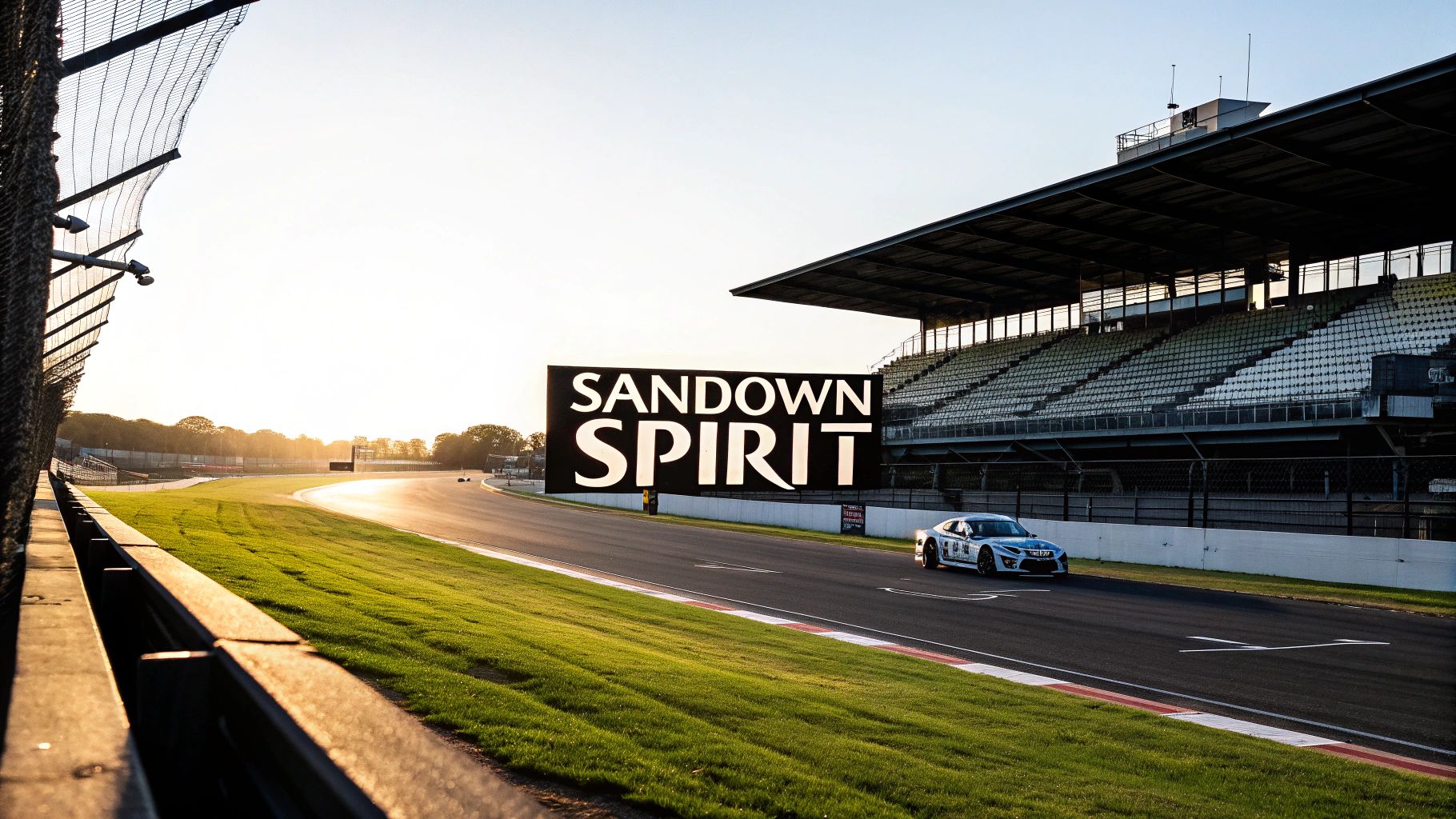
This guide is your all-access pass, taking you beyond the grandstands and deep into what makes Sandown a genuine icon. It's far more than just a strip of bitumen; this track tells a uniquely Australian story of speed, rivalry, and passion that has gripped fans for decades.
Its dual-purpose nature isn’t just a quirky novelty—it directly shapes the circuit's character. The result is a fast, flowing, and often unforgiving layout that tests both driver and machine to their absolute limits.
From its very first car race way back in 1904 to its pivotal role in the legendary Holden vs. Ford rivalry, Sandown has set the stage for countless unforgettable moments. This is where heroes were made and championships were won and lost.
What Makes Sandown Unique
You can't separate the circuit’s design from its history as a horse racing venue. The two massive straights, originally part of the horse track, demand immense horsepower and bravery on the brakes. Then, you're thrown into technical infield sections that require pinpoint precision. This blend creates a thrilling spectacle for fans and a formidable challenge for drivers.
Sandown's layout is a pure test of a car’s balance. The long straights reward top-end power, but the tight, technical infield sections can punish even the slightest mistake. Mastering it requires a perfect blend of aggression and finesse.
In this guide, we'll uncover the stories, break down the corners, and celebrate the heroes that define this circuit. You’ll come away with a new appreciation for why Sandown holds such a special place in Australian motorsport, standing proudly alongside other legendary tracks. For a closer look at another of Victoria's iconic circuits, check out our guide on the Melbourne GP Circuit map and its unique features.
Get ready to understand not just the track, but the soul of Sandown. It’s a story written in tyre marks and fuelled by the passion of generations.
The Rich History and Heritage of Sandown
Long before the roar of V8s echoed down its famous straights, Sandown was a place of thundering hooves and cheering crowds. Its story begins not on bitumen, but on turf, as a major horse racing venue dating back to the 19th century. This dual identity is the very heart of its character, giving Sandown International Raceway a soul that sets it apart from any other circuit in Australia.
The shift from horsepower of the four-legged kind to the mechanical kind kicked off in the early 20th century. The automobile was a noisy, thrilling, and frankly, brand-new invention. It was right here, amidst the established world of equestrian sport, that a unique piece of Australian motorsport history was made.
This pioneering spirit laid the groundwork for what would become one of the country's most legendary motorsport destinations. The story of Sandown's transformation is one of vision, ambition, and a deep, undeniable passion for speed.
Australia's First Car Race
It might be hard to believe, but Sandown holds the prestigious title of hosting Australia's very first car race. On 5 March 1904, while still known simply as Sandown Park Racecourse, a handful of primitive yet powerful machines lined up for a go. James Robert Crooke etched his name into the history books, piloting his 4.5hp Locomobile steam-powered car to victory. He completed the course in an impressive 3 minutes and 55.5 seconds after being given a 500-yard head start. You can dive deeper into this foundational event and Sandown's early days by reading about the circuit's detailed history.
This wasn't just a race; it was the spark that ignited Australia's love affair with motor racing. It proved that Sandown could be a stage for both equine and mechanical beasts, a dual-purpose identity it still proudly wears today.
The Birth of the Modern Circuit
While its motorsport roots go way back to 1904, the Sandown we know and love today really began to take shape in the early 1960s. The vision was ambitious: create an international-standard motor racing circuit wrapped around the existing horse track. In 1962, that vision became a reality when the permanent bitumen circuit was finally built.
The layout was designed to be fast, flowing, and seriously challenging. Its defining features were dictated by the horse track it encircled: two incredibly long straights that would test the courage of any driver and the horsepower of any machine. Connecting them was a series of technical corners and esses that demanded absolute precision.
The new circuit immediately started attracting major events, announcing its arrival as a serious player in Australian motorsport. The stage was set for decades of iconic moments that would cement Sandown's legendary status.
The circuit's design is a direct reflection of its heritage. The long straights exist because of the horse track, and they define the racing. It’s a place that rewards raw power but punishes mistakes in the technical sections.
The Sandown 500 and the Great Rivalry
Just two years after the bitumen was laid, an institution was born. In 1964, the circuit hosted the first-ever Sandown 500 endurance race. This event would grow to become one of the crown jewels of Australian motorsport, traditionally serving as the all-important lead-up race to the Bathurst 1000.
It was during this era that Sandown became the spiritual home of the fierce Holden versus Ford rivalry. The sight and sound of V8-powered Falcons and Commodores battling tyre-to-tyre down the long back straight became a defining image of Australian touring car racing. For decades, the Sandown 500 was a tribal battleground where fans cheered passionately for their chosen manufacturer.
This intense competition made legends. Drivers like Peter Brock, Allan Moffat, Dick Johnson, and Craig Lowndes became household names through their heroic performances at this very circuit. The battles they fought at Sandown International Raceway weren't just for trophies; they were for brand supremacy and bragging rights that echoed across the nation.
The key milestones in Sandown's history aren't just dates; they represent the evolution of Australian motorsport itself:
- 1888: The Victorian Amateur Turf Club establishes Sandown Park for horse racing.
- 1904: The first officially recognised car race in Australia is held at the venue.
- 1962: The permanent 3.1-kilometre motor racing circuit is constructed.
- 1964: The inaugural Sandown 500 endurance race is held, won by Roberto Bussinello and Ralph Sachs in an Alfa Romeo.
- 1984: The track is extended to 3.9 kilometres to meet Formula One standards, adding a tight infield loop before rejoining the main circuit.
- 1989: The circuit reverts to its faster, more popular 3.1-kilometre layout, which remains in use today.
From a dusty track for steam cars to a modern arena for Supercars, Sandown’s journey is a rich tapestry of speed and heritage. It has constantly evolved while staying true to its challenging, high-speed character, securing its place as a cherished icon of Australian motorsport.
Decoding the Sandown Circuit: A Lap Analysis
To really get what makes Sandown International Raceway so special, you need to see it through a driver’s eyes. This 3.1-kilometre ribbon of tarmac is a beast of two halves, demanding both raw power and delicate precision all in a single lap. Let's break it down, corner by corner.
The lap kicks off with your foot flat to the floor, rocketing down the main straight with the iconic grandstand a blur to your left. This isn't just a simple drag strip; it's got a slight curve to it, keeping you on your toes before you stomp on the brakes for Turn 1. It’s a tight right-hander that slingshots you into the most intimidating part of the circuit.
No sooner are you out of Turn 1, the car goes light over a crest before you plunge downhill into the fastest, most fearsome sequence on the track. This is the white-knuckle climb up to Turns 2 and 3, a sweeping left-right combo taken at eye-watering speed. Commitment here is everything.
Navigating the Technical Infield
After surviving that high-speed climb, it’s time to recalibrate. Fast. The tight, technical infield is where races are often won or lost. You’re hard on the brakes approaching Turn 4, a sharp, almost 90-degree left that has a nasty habit of catching people out.
Getting the power down smoothly out of Turn 4 is vital, as it flows straight into Turn 5. This whole sequence is completely unforgiving; one small mistake here will ruin the next three corners. It’s far less about brute force and all about finding a smooth, clean rhythm.
"Sandown's character is defined by its two extremes. You have these incredibly fast straights where you can stretch the car's legs, then you're thrown into a tight, complex infield that feels like a completely different circuit. Finding a car setup that works for both is the ultimate challenge."
This part of the track is a real test of a car’s agility and a driver's finesse, a world away from the horsepower-hungry straights. It’s a puzzle you have to solve perfectly, lap after lap.
The Power and the Esses
Once you’re out of the infield, you get a quick breather on a short straight before diving into the "Dandenong Road" corners—the complex at Turns 6, 7, and 8. This series of esses demands a delicate touch on the wheel and throttle.
Carrying your speed through here is absolutely crucial because it feeds you onto the legendary back straight. At a massive 910 metres long, it’s one of the longest in Australian motorsport. This is a pure, unadulterated test of engine power and the best overtaking spot on the circuit.
Think of it like a cyclist getting a tow. Drivers will tuck in right behind a rival to get in their slipstream, reducing drag to save fuel or just to line up a move. As the end of the straight rushes towards them, they’ll pull out and use that conserved energy—and a massive dose of bravery on the brakes—to lunge for a pass. It’s a completely different kind of challenge to the flowing, high-speed corners you’d see when looking at the Phillip Island raceway map, which is all about maintaining rhythm and momentum.
The Final Challenge
The back straight ends abruptly at Turn 9, a sharp right-hander that marks the single hardest braking zone on the entire circuit. Drivers scrub off an incredible amount of speed here, making it a hotspot for dramatic, late-braking overtakes.
From there, you’re into a flowing sequence through Turns 10, 11, and 12. This final set of corners is all about patience, carefully balancing the car to get the best possible drive onto the main straight to do it all over again. A clean exit is critical, whether you're defending your position or setting up a pass across the start-finish line.
A single lap of Sandown is a complete test of a driver's toolkit, covering:
- High-Speed Commitment: Being brave enough to carry speed through the climb from Turn 1 to 3.
- Technical Precision: Threading the needle through the tight and tricky infield at Turns 4 and 5.
- Race Craft and Strategy: Knowing exactly how and when to use the slipstream down the back straight.
- Braking Prowess: Nailing your braking points lap after lap into Turn 1 and the monster stop at Turn 9.
It's this incredible variety that has made Sandown International Raceway such an enduring and beloved challenge for decades.
Kings of Sandown: Legendary Races and Lap Records
More than just a layout of tarmac and kerbs, Sandown International Raceway is a theatre of speed where legends have been forged. Its history isn't just written in record books, but in the unforgettable moments of triumph and drama that have defined Australian motorsport. Central to this legacy is the iconic Sandown 500, a gruelling endurance race that has long served as the ultimate test before the annual pilgrimage to Mount Panorama.
The event’s prestige naturally attracted the biggest names, but one driver stands peerless above them all. For an entire generation of fans, Sandown was simply Peter Brock's kingdom. His connection with this circuit was almost supernatural, a mastery that translated into an incredible record of success.
It takes a special kind of driver to conquer Sandown's unique blend of high-speed straights and a technical infield—someone who can balance raw courage with pinpoint accuracy. The names etched into Sandown's honour roll are a who's who of Australian motorsport royalty, and every single one of them proved their mettle on this demanding stage.
The Reign of Peter Brock
When you speak of Sandown, you have to speak of Peter Brock. His dominance at Sandown International Raceway cemented his status as the undisputed 'King of Sandown'. Brock conquered the Sandown 500 a staggering nine times, a tally that perfectly mirrors his nine iconic victories at Bathurst.
Even more astonishing was his unbroken streak of seven consecutive wins from 1975 to 1981. This was a period that turned the Melbourne circuit into the epicentre of Australia's touring car frenzy. You can learn more about this incredible era and Peter Brock's remarkable achievements at Sandown.
Brock's mastery wasn't just about raw speed; it was about a deep, intuitive feel for what the circuit demanded. He knew precisely when to push and when to be patient, a skill that made him nearly unbeatable in the high-stakes world of endurance racing. His reign defined an entire era and set a benchmark that may never be surpassed.
Peter Brock's seven-year winning streak at the Sandown 500 is one of the most remarkable feats in Australian sporting history. It demonstrated a level of sustained excellence and dominance that cemented his legendary status and his special connection with the circuit.
Other Icons of the Raceway
While Brock's shadow looms large, he wasn't the only hero to tame the Sandown beast. His great rival, Allan Moffat, also etched his name into the circuit's history with six victories in the endurance classic, fuelling the fiery Ford vs. Holden rivalry that captivated a nation.
In the modern era, new kings have been crowned. Craig Lowndes, a driver whose career bridged generations, claimed five Sandown 500 titles, showcasing his remarkable adaptability and longevity. His teammate and contemporary, Jamie Whincup, matched that tally, with the pair often proving to be an unstoppable force in endurance events. These drivers, along with countless others, have contributed to the rich tapestry of competition that makes Sandown so special.
Memorable Moments and Tumbling Records
Sandown has been the backdrop for some of motorsport’s most dramatic moments. Think last-lap passes down the long back straight and nail-biting finishes decided by mere fractions of a second—the circuit consistently delivers incredible racing.
The annual 500-kilometre enduro has always been a critical form guide for the Bathurst 1000, and a win here often signals a team's strength heading into the season's biggest race. If you're keen to understand the challenges of The Mountain, you might enjoy our deep dive into the Mt Panorama Circuit map.
A lap of Sandown is a relentless sequence of heavy braking, technical navigation, and flat-out acceleration, as this process flow shows.
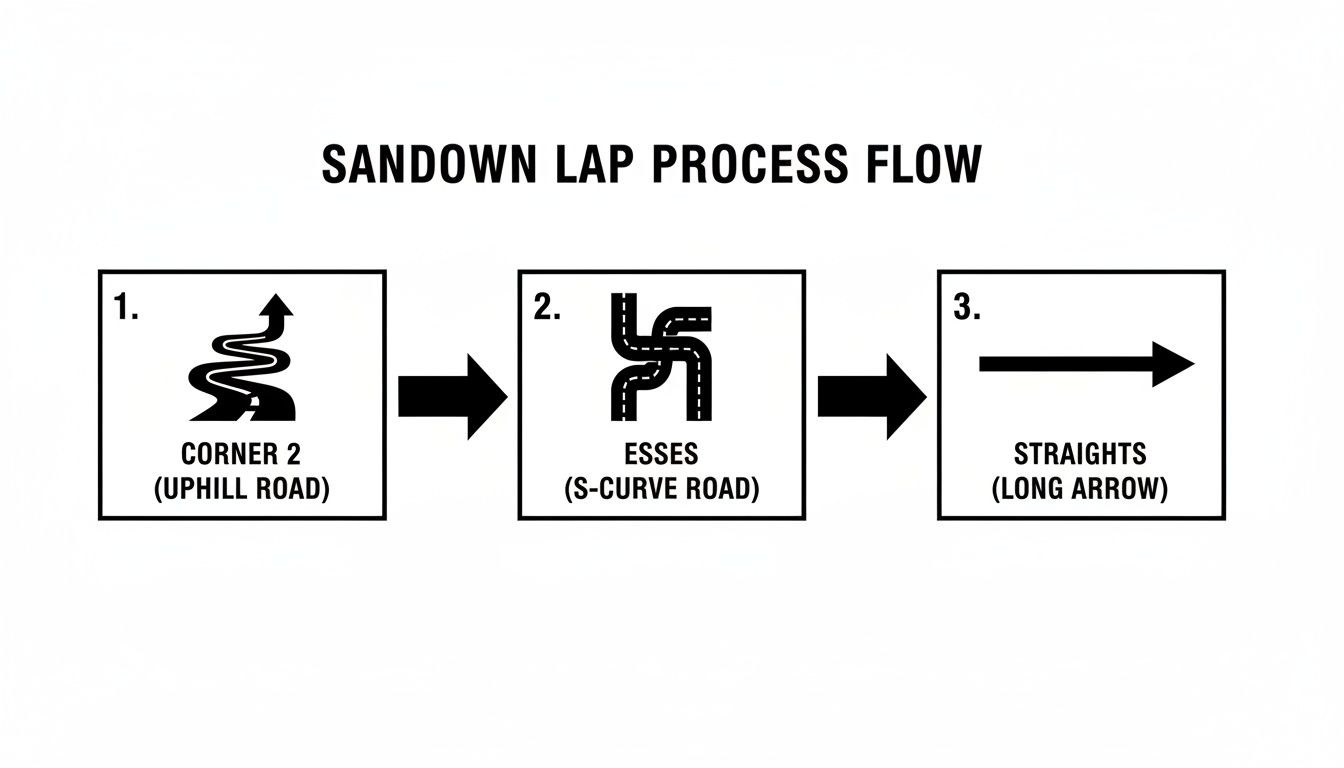
This visualisation really highlights how drivers have to immediately switch from the high-speed commitment of the opening corners to the precision needed for the esses, all before unleashing the car's full power on the straights.
Over the decades, lap records have continuously tumbled as technology has advanced and drivers have pushed the limits ever further. The evolution of racing cars is written clearly in the circuit's ever-decreasing lap times. What was once considered a blistering pace is now eclipsed by modern machinery, a true showcase of the relentless pursuit of speed.
Sandown International Raceway Lap Records
Here’s a look at the fastest official race lap times recorded at Sandown International Raceway across the major motorsport categories. These are the benchmarks that every driver aims to beat.
| Category | Driver | Vehicle | Lap Time | Date |
|---|---|---|---|---|
| Outright | Simon Wills | Reynard 94D Holden | 1:05.6672 | 11 Sep 2000 |
| Supercars | Will Brown | Chevrolet Camaro ZL1 | 1:08.2045 | 16 Sep 2023 |
| GT3 | Will Brown | Mercedes-AMG GT3 | 1:07.8285 | 12 Feb 2023 |
| Australian Drivers' | Tim Macrow | Tatuus FT-50 Toyota | 1:07.0189 | 22 Mar 2014 |
These records represent the absolute pinnacle of performance, a testament to the perfect synergy of driver skill and engineering brilliance required to conquer this legendary circuit. Every lap is a new opportunity to make history, adding another chapter to the incredible story of Sandown.
How to Experience a Sandown Race Day
A trip to see the action at **Sandown International Raceway** is a proper pilgrimage for any Aussie motorsport fan. There's nothing quite like a day at the track—the sounds, the smells, and the electric buzz of live racing create an experience that just can't be replicated on a screen. To get the most out of your visit, a little bit of prep goes a very long way.Whether you're a seasoned regular who knows the place like the back of your hand or a first-timer soaking it all in, this guide is packed with practical tips to make sure your race day is comfortable, fun, and totally unforgettable. From picking the perfect vantage point to knowing what to chuck in your bag, we've got you covered.
Choosing Your Spectator Spot
One of the brilliant things about Sandown is the sheer variety of viewing spots available. Where you decide to set up camp can completely shape your day, so it’s worth thinking about what you want to see most.
The main grandstand, right along the pit straight, gives you a commanding view of the action. From here, you’ll catch the drama of the race start, the frantic energy of pit stops, and the cars blasting across the finish line. It's the absolute best spot for soaking in the pre-race grid preparations and the celebrations afterwards.
If you're after a more relaxed, picnic-style vibe, the general admission areas are fantastic. The spectator mounds overlooking the sweeping esses between Turn 1 and Turn 4 offer a superb view of cars at high speed, testing the limits of grip. Another great option is to position yourself at the end of the long back straight to watch the thrilling, late-braking overtakes into Turn 9.
Getting to the Circuit
Sandown is located in the Melbourne suburb of Springvale, and thankfully, it's well-serviced by both public transport and major roads, making it pretty easy to get to.
- By Car: There’s usually plenty of on-site parking for major events, but it's always a good idea to get there early to snag a decent spot. The circuit is conveniently located near the Princes Highway and Monash Freeway.
- By Train: This is often the best way to go. Sandown Park has its own dedicated railway station on the Pakenham and Cranbourne lines, located right at the circuit’s doorstep. It's the most convenient and stress-free way to travel on a busy race weekend.
A hot tip for any race day is to bring a small radio and tune into the local broadcast commentary. It gives you live updates, expert analysis, and insights into team strategies, so you’ll never miss a key moment, no matter where you are around the track.
Your Race Day Checklist
A comfortable spectator is a happy spectator. Packing a few key items will make a massive difference to your day, letting you focus on what you came for—the racing.
Think about bringing:
- Portable Seating: A folding chair or a picnic blanket is an absolute must if you're in the general admission areas.
- Sun Protection: Sunscreen, a wide-brimmed hat, and sunnies are non-negotiable. You’ll be outdoors most of the day, and the Aussie sun doesn't mess around.
- Portable Radio: As mentioned, an AM/FM radio is your best friend for following the live race commentary.
- Ear Protection: Motorsport is loud! Earplugs or defenders are a great idea, especially for the younger fans.
- Food and Water: While there are always food vendors, bringing your own snacks and a water bottle can save you time and money. Just be sure to check the event-specific rules on what you can bring in.
Capturing the Action
For the amateur photographers out there, Sandown offers some brilliant opportunities to get stunning shots. The relatively open viewing areas and close proximity to the track mean you can capture fantastic photos without needing a massive professional lens. The esses and the braking zone for Turn 9 are prime spots for snapping cars right on the limit.
And for those looking to explore another challenging Australian circuit, you can learn more about The Bend Motorsport Park in our detailed guide. With these tips in hand, you're all set to experience the unique thrill of a race day at this legendary venue.
Bringing the Sandown Legacy Home
The buzz of a race day at Sandown International Raceway is electric, but it doesn’t have to fade when the engines go quiet. For true enthusiasts, motorsport is more than just a hobby—it’s part of who you are. Bringing that same energy into your own space is the perfect way to honour the track's incredible legacy.
This is about so much more than sticking a poster on the wall. It’s about creating a space that speaks to your connection with the sport’s history, the genius of the circuit design, and the unforgettable moments that have played out on its tarmac. With everything from clean, modern designs to vibrant, retro-inspired art, you can keep the spirit of Sandown alive and well.
The trick is finding a style that feels right for you and fits with your home, turning your passion into a killer design statement.
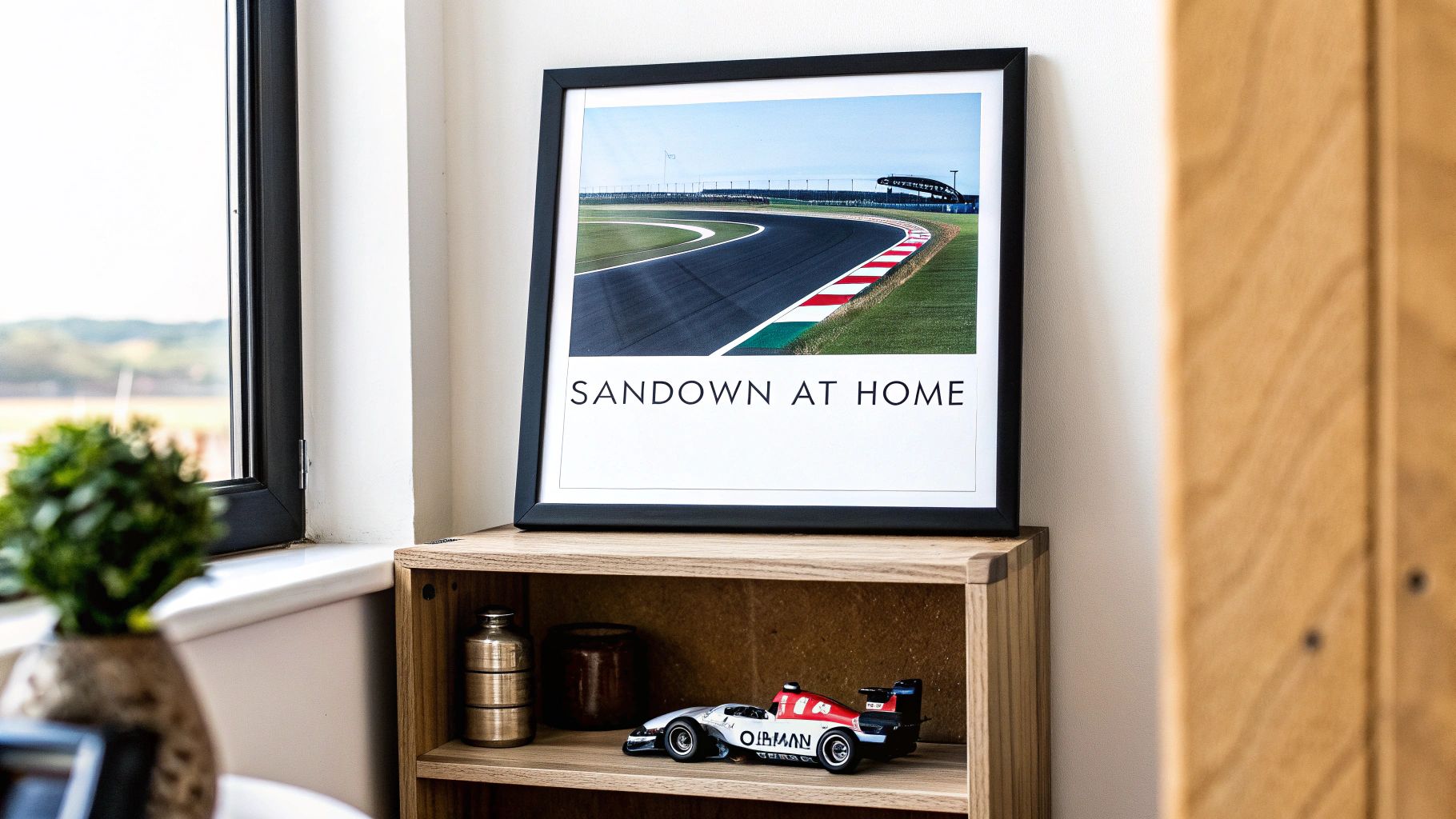
Finding Your Sandown Style
Not all motorsport art is made the same. The right piece can completely transform a room, serving as either a subtle nod to your passion or a bold centrepiece that grabs everyone's attention. Getting to know the different styles out there is the first step to finding the perfect match.
One of the most popular and versatile choices is the minimalist circuit layout. These pieces strip everything back to focus on the pure, beautiful form of the Sandown track—its famous straights, tricky esses, and tight infield section. Rendered in a clean, often monochromatic style, they give off a modern, understated vibe that slides effortlessly into just about any setting, from a professional office to a cool, contemporary living room.
But if you want to channel the golden era of Australian touring cars, retro-inspired posters are a fantastic way to go. These designs often feature bold colours, old-school typography, and classic imagery straight out of the 1970s and 80s. They’re a celebration of the legendary Holden vs. Ford rivalries that made Sandown what it is today and bring a massive dose of nostalgic energy to a room—especially a dedicated fan cave or entertainment space.
Curating a Motorsport-Inspired Space
Once you’ve picked your art, how you display it is what really makes it pop. A single, large-scale piece can act as a stunning focal point, while a carefully arranged collection can tell a deeper story.
"A piece of racetrack art is more than decor; it's a conversation starter. It represents a shared passion for engineering, speed, and history. Displaying a circuit like Sandown is a way to connect with that legacy every single day."
Here are a few practical ideas for bringing Sandown-themed art into your life:
- The Office Statement: A framed minimalist layout of Sandown behind your desk adds a touch of personality to your professional space without being over the top.
- The Living Room Centrepiece: Hang a large, detailed canvas of the circuit over the sofa or fireplace. It instantly becomes a point of interest and a natural talking point for guests.
- The Gallery Wall: Create a dynamic feature by grouping several smaller pieces. You could mix a Sandown layout with art from other iconic Aussie circuits or even portraits of legends like Peter Brock.
If you're looking to start your own collection, exploring a range of high-quality racetrack framed prints can spark some inspiration and help you find pieces that truly capture the essence of motorsport.
Ultimately, bringing the legacy of Sandown International Raceway into your home is a personal thing. It’s a way to celebrate the history and pure excitement of a circuit that has captured the hearts of fans for generations.
A Few Quick Answers About Sandown Raceway
Got a question about Sandown? You're not the only one. Here are the answers to some of the most common things people want to know about this iconic Melbourne circuit.
How Long Is the Sandown Circuit?
The main International circuit at Sandown clocks in at 3.104 kilometres (1.929 miles). It's a classic power circuit, with two enormous straights that demand serious horsepower and even more bravery on the brakes. The current 13-turn layout has been testing drivers and machines since 1989.
What Is the Biggest Race Held at Sandown?
That’s an easy one: the legendary Sandown 500. This endurance classic for the Supercars is more than just a race; it's a hallowed tradition. For decades, it has been the final, high-stakes shakedown before teams head to the mountain for the Bathurst 1000.
The Sandown 500 is where Bathurst contenders are made or broken. It’s the ultimate test of strategy, driver chemistry, and car setup before the big one. A win here is a massive psychological advantage heading to Mount Panorama.
Can the Public Drive on Sandown Raceway?
While you can't just show up and do a few hot laps, there are definitely ways for the public to get on track. A number of track day operators and performance driving schools host events at Sandown, giving you the chance to drive your own car on this famous piece of tarmac in a safe, controlled environment.
Ready to celebrate the history of this legendary circuit? A premium piece of motorsport art from TrackNation is the perfect way to do it. Grab a framed print of Sandown or another one of your favourite tracks and bring the spirit of racing right into your home or office. Check out the full collection at https://tracknation.au.