

Explore f1 circuits map: The Ultimate Track Layout Guide
An F1 circuit map is so much more than a poster. It's a piece of motorsport history, a snapshot of the unique character that makes tracks like Silverstone and Monza truly legendary. These maps take all the complex data and racing heritage and turn it into striking decor.
Bringing the Racetrack into Your Home
Think of an F1 circuit map as the soul of a racetrack, distilled into a single, elegant piece. It’s a celebration of motorsport, blending technical detail with genuine artistry to create a visual story that really grabs you. It’s not just about the lines on a page; it’s about what they represent—the insane high-speed straights of Spa, the impossible hairpins of Monaco, and the sweeping, iconic corners of Suzuka.
These maps turn any wall into an instant conversation starter, giving you a sophisticated way to show off your passion. They perfectly bridge the gap between typical sports memorabilia and high-quality home decor, making them a brilliant fit for a modern living room, a focused home office, or a dedicated fan cave. Every single map tells a story of speed, strategy, and triumph.
More Than Just a Map
A really well-designed circuit map does more than just show you the layout of a track. It captures the entire feeling of a race weekend, inviting you to trace the path your favourite drivers take. For a true enthusiast, it’s a tool for analysis and appreciation, helping you visualise those perfect overtaking opportunities, the tyre-shredding zones, and the sheer challenge drivers face lap after gruelling lap.
And for those who just appreciate great design, these pieces stand on their own as works of art. Their clean lines and minimalist aesthetic can complement all sorts of interior styles, adding a touch of dynamism and character to a room without overwhelming it.
A circuit map immortalises the theatre of motorsport. It’s where engineering precision meets human courage, and having one on your wall is a daily reminder of the sport's incredible drama and history.
The Perfect Tribute to F1 History
Ultimately, choosing an F1 circuits map is about connecting with the sport on a much deeper level. It’s a tribute to the legendary venues that have shaped decades of racing history and a nod to the engineering brilliance behind every single Grand Prix.
Whether you're a lifelong fan or just getting into the world of motorsport, these maps offer a unique and stylish way to connect with the pinnacle of racing. Explore our curated collections of Formula 1 wall art to find the perfect piece that really speaks to your passion.
Decoding Different Circuit Map Styles
Not every F1 circuit map tells the same story. Just like each racetrack has its own unique character, the maps that represent them do too. Getting your head around the different styles is the first step to finding a piece that perfectly captures your personal taste and the vibe of your space.
Think of it like choosing a watch. Some people prefer a clean, elegant analogue face, while others want a digital display packed with data. Each style serves a different purpose, and the best choice comes down to what you want to see.
This visual flow shows how circuit art connects the sport's deep history and complex strategy with modern home decor.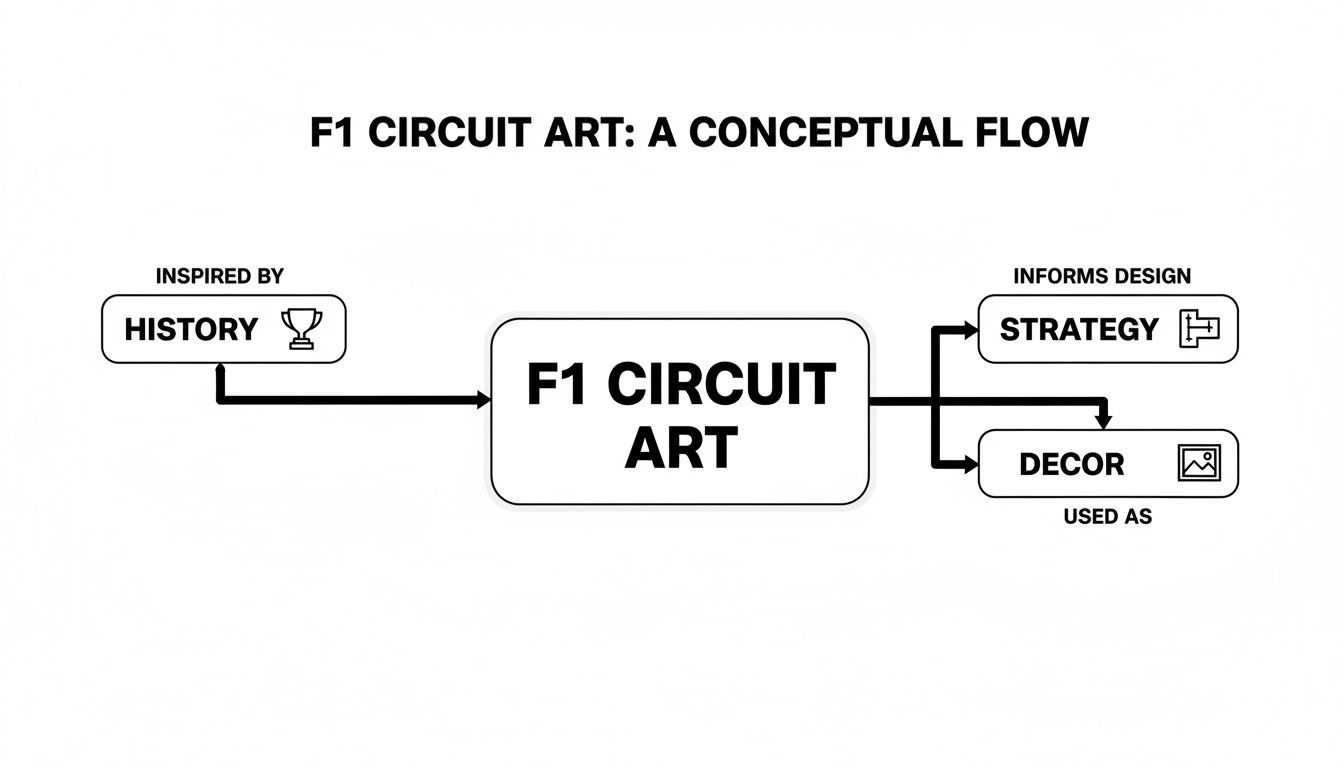
From legendary victories to tactical blueprints, every element informs the final design, transforming a simple track layout into a meaningful piece of art.
Before we dive into the details, here's a quick look at how the main styles stack up against each other.
F1 Circuit Map Styles at a Glance
This table offers a quick comparison of the four main types of F1 circuit maps, designed to help you choose the best style for your needs—whether you're after pure aesthetics or deep, detailed information.
| Map Style | Primary Focus | Best For | Example |
|---|---|---|---|
| Schematic | The pure, unbroken line of the track layout. | Minimalist home decor, subtle nods to motorsport. | A clean, black-on-white outline of Monza. |
| Annotated | Detailed race information like corner names, DRS zones. | Fan caves, offices, sparking technical conversations. | A Silverstone map with Maggots & Becketts labelled. |
| Historical | Nostalgic aesthetics, vintage layouts, and retro fonts. | Celebrating F1 heritage, adding a classic touch. | A sepia-toned map of the old Spa-Francorchamps. |
| Interactive | Digital engagement, multimedia content, and real-time data. | Tech-savvy fans, educational purposes, event build-up. | A digital map with clickable hotspots for famous overtakes. |
Each style offers a unique way to connect with the sport. Now, let's explore what makes each one special.
Schematic and Minimalist Layouts
The most common and popular style is the schematic layout. Think of it as the architectural blueprint of the racetrack, stripped back to its purest form. It focuses solely on the flowing lines of the circuit itself, often presented in a bold monochrome colour scheme against a clean, uncluttered background.
These maps are loved for their simplicity and elegance. With no distracting data, the track's unique shape—like the iconic ribbon of the Nürburgring or the tight, glamorous confines of Monaco—becomes the hero. This minimalist approach makes them incredibly versatile for home decor, fitting seamlessly into modern, industrial, or Scandi-inspired interiors.
If you appreciate clean design and want a piece that acts as a subtle nod to your passion for motorsport, a schematic map is a brilliant choice. To see just how powerful a simple layout can be, you can learn more about the legendary Nürburgring race track map and its incredible history.
Annotated and Data-Rich Maps
At the complete other end of the spectrum, you’ll find annotated maps. These are the strategist's playbook, designed for fans who live for the details. They go far beyond the basic layout to pack in the crucial information that defines a race weekend.
These details often include:
- Corner Names and Numbers so you can follow the on-screen action and know exactly where "Eau Rouge" or "Maggots and Becketts" are.
- DRS Zones pinpointing the key overtaking opportunities on the track.
- Sector Markings that break the circuit down into the three timed sections.
- Track Length and Turn Count for quick-reference stats and easy comparison.
This style transforms the map from a simple decorative item into a proper informative tool. It’s perfect for a dedicated fan cave or office, where it can spark conversations about race strategy, famous overtakes, and historic moments. An annotated map of Silverstone, for example, becomes a detailed guide to one of the most beloved circuits on the F1 calendar.
Historical and Vintage Maps
For those who love the rich heritage of Formula 1, historical maps offer a nostalgic trip into the sport's past. These maps often feature older, sometimes defunct, circuit layouts or are designed with a retro aesthetic, using sepia tones and vintage fonts.
They do a fantastic job of capturing the raw, untamed spirit of tracks from a bygone era, celebrating the absolute legends who raced on them.
How to Read an F1 Circuit Map Like a Pro
An F1 circuits map is so much more than just a slick design on a canvas; it's a story waiting to be told. When you learn to read its lines and symbols, a simple piece of art transforms into a tool for a deeper appreciation of the sport. Every single element explains the unique challenges drivers and engineers are up against on race day.

Think of it like reading sheet music. At first glance, it might just look like a jumble of dots and lines. But once you understand the notation, you can almost hear the symphony. It's the same with a circuit map—understanding it lets you see the race unfold before it even starts.
Identifying the Key Markers
Most good F1 circuit maps will include several key markers that are absolutely essential for following the action. These are the fundamental building blocks you need to understand any track’s layout and rhythm.
Here are the key things to look for:
- Start/Finish Line: This is the most obvious one, usually shown as a bold or checkered line. It’s where every lap officially begins and ends.
- Pit Lane Entry and Exit: These are absolutely crucial for race strategy. The pit lane is a separate road off the main straight where teams do their pit stops.
- Corner Numbers: Every turn on the circuit is numbered. This helps commentators, teams, and fans refer to specific parts of the track, like the chaos of "Turn 1" at the start of a lap.
Nailing these basics is your first step. They give you the core structure of the track, letting you get your bearings before diving into the more complex features.
Reading a circuit map is like learning the language of a racetrack. The straights are its declarative sentences, the corners are its punctuation, and the DRS zones are where the most dramatic plot twists happen.
Analysing Strategic Zones
Once you've got the basic layout down, an F1 circuits map starts to reveal the strategic heart of the track. These zones are where races are so often won or lost, making them vital for any fan to recognise.
The most important strategic elements are the DRS (Drag Reduction System) zones. These are specific sections of a straight where a driver within one second of the car ahead can open a flap on their rear wing. This slashes drag and gives them a massive speed advantage for an overtake. A map will clearly mark these zones, highlighting the prime spots for on-track battles.
You'll also see sector markings on a map, which split the lap into three segments (Sector 1, 2, and 3). Teams live and breathe these timings to analyse performance, pinpointing where their car is fastest or where they're losing time. Knowing the sectors helps you understand why one driver might be brilliant in one part of the lap but struggle in another. For a great look at a track with really distinct sectors, check out our guide to the Melbourne GP Circuit Map.
The Enduring Legacy of Iconic Motorsport Venues
Some racetracks are just more than asphalt and kerbs. They’re cultural landmarks—hallowed ground where motorsport history is written. An F1 circuit map does more than just trace a layout; it bottles the spirit, the legacy, and the nail-biting moments that give a venue its soul.
These places become characters in the F1 story, each with a unique personality. Think of Monza, the legendary "Temple of Speed," or the glamorous, unforgiving streets of Monaco. A map of one of these circuits is a direct connection to decades of racing heritage. For a fan, it’s like owning a small piece of that history, celebrating the heroes who tamed its corners and the epic battles that unfolded on its straights. You can dive deeper into another iconic street circuit in our guide to the legendary Monaco Grand Prix.
The Australian Grand Prix: A Case Study in Evolution
To really get how a venue builds its legacy, just look at the Australian Grand Prix. Its story is one of massive change, with the massive move from Adelaide to Melbourne in 1996 kicking off a whole new chapter for Formula 1 down under.
Adelaide was a beast of a track, hosting the season finale from 1985 to 1995. It was wildly popular, pulling in a staggering 520,000 spectators for its final race. But when rising costs forced a move, the Grand Prix relocated to Melbourne's Albert Park. The new venue immediately silenced the critics, attracting 401,000 fans in its debut year and winning awards for its brilliant organisation.
This wasn't just a change of scenery; it was the birth of a new legacy. One that has seen attendance numbers climb to over 465,000, cementing Melbourne's place as a world-class motorsport destination.
A circuit map is a snapshot of history. It captures not just the layout of a track, but the evolution of the sport itself—from the screaming V12s of Adelaide to the hybrid power units roaring through Albert Park.
This rich, evolving story is what gives a circuit map its soul. A print of Albert Park isn't just a diagram; it’s a celebration of Australia's vibrant F1 history. It's about honouring the end of one incredible era and the spectacular rise of another. For any true enthusiast, that map becomes a tangible connection to the enduring spirit of motorsport.
Choosing the Perfect F1 Print for Your Space
Picking an F1 circuit map for your wall is about so much more than just choosing your favourite track. It's about finding a piece of art that nails the look and feel of your space. The right print can take a room from zero to hero, turning a boring blank wall into a real statement about your passion for motorsport.
Think of it like choosing the right tyre compound for a race. A massive, bold canvas might be perfect for a spacious living room—it's your 'soft tyre' for maximum visual impact. But in a smaller home office, a more subtle, framed print could be the 'hard tyre'—a durable, stylish choice that looks sharp without dominating the room.
Matching Scale and Size to Your Room
First things first, you need to think about the scale of the artwork in relation to your wall. One of the most common mistakes is picking a print that's either too small and gets completely lost, or way too big and just overwhelms everything. A great rule of thumb is to aim for artwork that fills about two-thirds of the empty wall space above furniture like a sofa or desk.
Before you even think about buying, grab some painter's tape and mark out the print's dimensions on your wall. It's a simple trick, but it gives you a proper feel for how that size will actually work with your existing decor. This way, you can be sure your chosen map will be a perfectly balanced focal point.
Your F1 circuit map should feel like it belongs in the room's ecosystem. It needs to command attention without shouting, drawing the eye and starting conversations for all the right reasons.
Selecting Materials and Framing Options
The material and frame you go for will have a huge effect on the final look. Each combo brings its own vibe, so it’s important to match it to your room's current style.
- Framed Canvas: This is your ticket to a modern, gallery-quality look. The texture of the canvas adds a nice depth, and a clean black or white frame provides a crisp, finished edge that works beautifully in contemporary spaces.
- Paper Prints: You can't go wrong with a classic. A high-quality paper print behind glass has a timeless feel and gives you endless options for framing—from minimalist metal to warm, rustic wood—to match any decor.
Have a think about where the piece will be hanging. A durable canvas is a fantastic option for a high-traffic area or a dedicated "fan cave," while a framed paper print might be better suited for a more formal office or living space. If you're searching for some ideas, you can find a huge range of high-quality Formula 1 posters to suit any style.
Finally, consider the colour palette. A black-and-white schematic map is incredibly versatile and will fit in almost anywhere. But if you want to get clever, a print with subtle colour accents can be used to tie into other elements in the room, like cushions or rugs, to create a really cohesive and professionally styled look.
Creative Ways to Display Motorsport Wall Art
The right display can turn an F1 circuits map from a simple print into a knockout centrepiece. How you show off your motorsport art is just as important as the piece itself, transforming a boring blank space into a dynamic tribute to the pinnacle of racing.
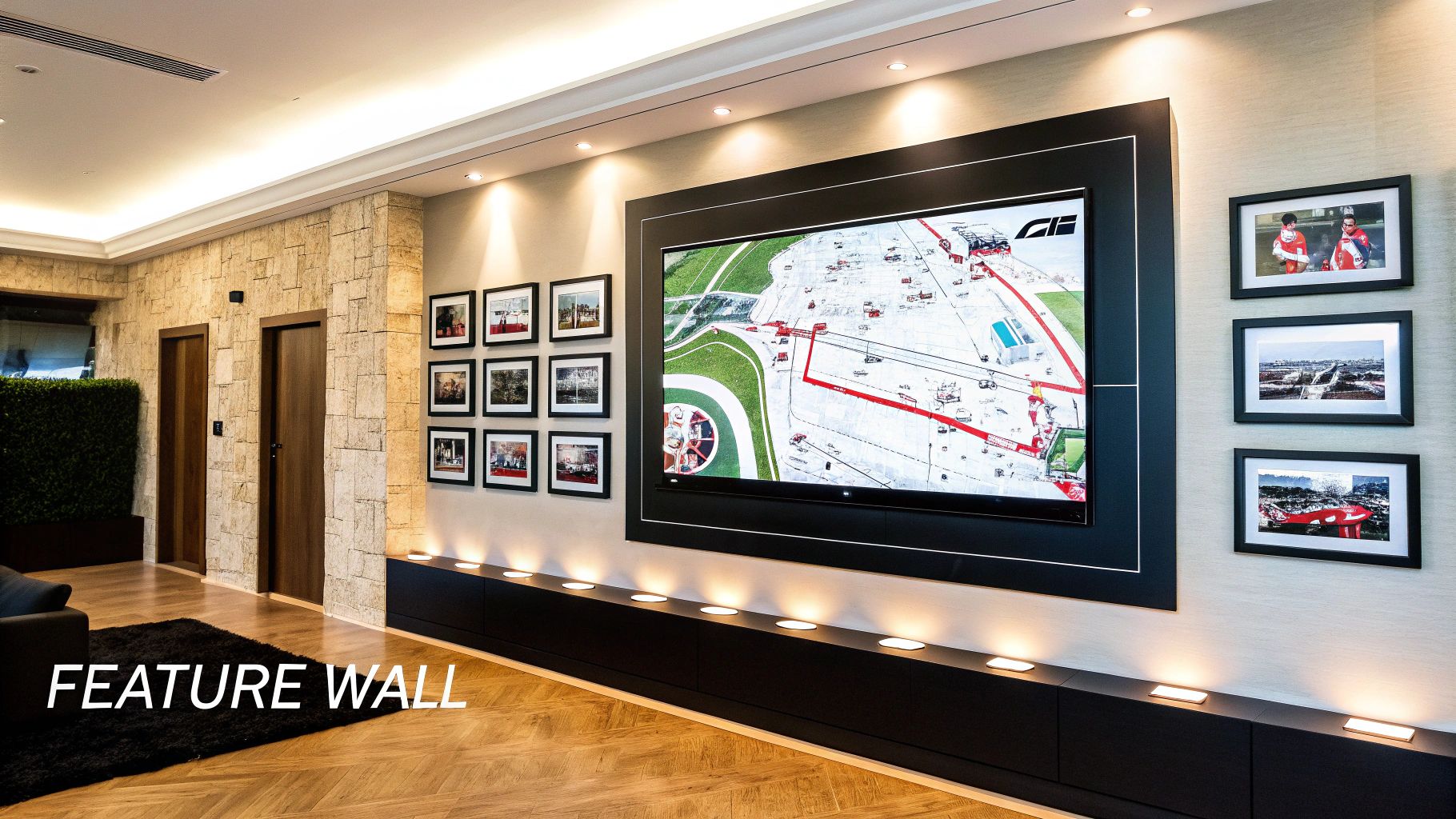
Instead of just hanging a single piece, think bigger. Consider creating a dedicated feature wall. This approach lets you build a visual story around your favourite team, driver, or a specific era in Formula 1 history. It’s all about curating a collection that truly says something.
Curate a Themed Collection
One of the best ways to create real impact is by grouping prints with a common theme. This method turns individual pieces into a powerful, cohesive display that grabs attention and gets people talking.
- Championship Season Gallery: Relive a legendary championship-winning year. Display a map of every circuit from that season’s calendar to create a visual timeline of a historic title fight.
- Team Tribute Wall: Go all-in for your favourite team. Pair a large map of their home circuit (like Monza for Ferrari) with smaller framed photos of their most iconic cars and victorious race moments.
- Driver-Focused Display: Celebrate your hero's career by showcasing maps of the tracks where they took their most memorable wins. This makes the collection personal and properly honours their legacy.
Good display is about more than just hanging a picture; it's about creating an experience. Your wall should feel like a curated exhibit, inviting people to explore the stories behind the art.
Perfecting Placement and Lighting
Once you've got your collection sorted, placement and lighting are the finishing touches that will make it shine. Always position your main circuit map at eye level—that’s around 145cm from the floor to its centre—to make sure it’s the natural focal point.
When it comes to lighting, use spotlights or adjustable track lighting to highlight the artwork. This draws the eye straight to your display and stops the colours from looking flat or washed out. By getting these details right, you’ll transform your motorsport art from simple decoration into a true statement piece that screams passion for F1.
A Few Common Questions About F1 Circuit Maps
Jumping into the world of motorsport art can bring up a few questions, especially when you're trying to find that perfect piece. We get it. Below are some straight-up answers to the most common things fans ask us about an F1 circuits map.
Think of this as your quick guide to choosing your art with confidence, making sure it’s the right fit for your space and your passion for F1. Whether you’re buying for yourself or gifting it to a fellow fan, getting these details right makes all the difference.
Are the Track Layouts on the Maps Up to Date?
Absolutely. Most of the high-quality circuit maps you'll find, including ours, use the most current, officially recognised layout for any given track. This means you're getting a true-to-life representation of the circuits you see screamed around on race weekends.
Of course, historical maps are a different story. They're deliberately designed to show a circuit's layout from a specific past era, celebrating how it's evolved over time. Just be sure to check the product description to know if you're buying a contemporary design or a cool vintage piece that honours a track's rich history.
What Is the Best F1 Circuit Map for a Gift?
Honestly, the best map really comes down to the person you're buying for. If they're a die-hard fan, an annotated map of their favourite driver's most successful circuit is a brilliant choice because it’s packed with details that mean something to them.
For someone who just loves clean, modern design, a minimalist schematic layout is a super stylish option that looks great in any home or office. A great tip? Think about their favourite track, driver, or even a race they went to. That personal touch is what makes a gift truly special.
A thoughtful gift connects with a passion. Choosing a map of a circuit that holds special meaning for a fan—like their first attended Grand Prix or their hero's greatest victory—turns a piece of art into a treasured memory.
How Do I Care for My Framed Canvas or Print?
Looking after your new piece of motorsport art is actually pretty simple. For both framed prints and canvases, the biggest rule is to avoid hanging them in direct sunlight. This will stop those vibrant colours from fading over the years.
To keep it clean, just give it a gentle dust with a soft, dry cloth every now and then. And here's the crucial bit: never use chemical cleaners or water. This stuff can easily damage the print surface or the canvas itself. With the right spot on the wall and a tiny bit of care, your art will stay looking incredible for a long, long time.
At TrackNation, we craft premium motorsport wall art that brings the racetrack into your home. Explore our collections to find the perfect F1 circuit map for your space at https://tracknation.au.