

Discover formula one models: The Ultimate Collector's Guide
Welcome to the electrifying world of Formula One models, a hobby that puts motorsport history right in the palm of your hand. This guide is your ultimate starting grid, helping you navigate a passion that goes way beyond simple toys—from rugged diecast metal cars to incredibly detailed resin replicas.
Think of yourself as the curator of your very own F1 museum.
Your Journey into Collecting Formula One Models
Diving into the world of Formula One models gives you a completely new lens through which to see the sport you love. You're no longer just a spectator; you become a collector, a historian, and an admirer of the incredible engineering and design that have defined generations of racing.
This hobby is all about celebrating the artistry, speed, and stories that make F1 the pinnacle of motorsport. Each model connects you to legendary drivers, unforgettable liveries, and the championship-winning beasts that have carved their names into the history books. It’s a tangible piece of the F1 story, whether it’s a team's dominant era or a single, breathtaking moment of on-track brilliance.
More Than Just a Hobby
This is a passion for everyone, from the casual fan wanting a cool desk ornament to the dedicated collector building an entire grid of miniature masterpieces. The community is buzzing, fuelled by a shared love for the sport that’s felt all around the globe. And that excitement is absolutely off the charts in places with a deep-rooted racing culture.
Just look at the Australian Grand Prix at Melbourne's Albert Park Circuit. It's become a massive event on the F1 calendar, showing just how popular the sport is Down Under. In 2024, the event completely sold out for the first time ever, drawing a mind-blowing 452,055 fans over the weekend—the biggest crowd the circuit has ever seen. That kind of passion flows directly into the collecting world, firing up a huge market for formula one models that celebrate local heroes and iconic Aussie races. You can read more about the incredible turnout at the 2024 Australian Grand Prix on Wikipedia.
Collecting isn't just about owning things; it's about preserving moments. Each model is a frozen snapshot of engineering, design, and pure human achievement, letting you own a piece of Formula 1's amazing legacy.
Consider this guide your personal race engineer. We'll start by exploring the foundational concepts every new collector needs to get a handle on, making sure you can kick off your collection with total confidence.
- Understanding Scale: We’ll break down what numbers like 1:18 and 1:43 really mean, so you can picture the size and level of detail you’re getting.
- Choosing Materials: You’ll learn the key differences between tough diecast metal and the beautifully delicate detail of resin models.
- Recognising Authenticity: We’ll show you what separates a true collectible from a simple toy, from official licensing to historical accuracy.
By the time you're done, you won't just know what to look for in a model. You'll have a much deeper appreciation for the connection they offer to the fast, furious, and ever-evolving story of Formula 1.
Understanding the Different Types of F1 Models
Diving into the world of Formula One models for the first time can feel a bit like walking into a busy pit lane – there's a lot going on, and everything has a specific purpose. To figure out what’s right for you, it helps to know the main players. Each type of model offers something completely different, kind of like how different tyre compounds deliver unique performance on the track.
Let's break down the main contenders: the physical diecast models, the artistic resin replicas, and the digital blueprints that start it all.
This diagram shows how the passion for collecting branches out into these different physical and digital forms.

As you can see, every path, whether it leads to a physical model on your shelf or a digital file on your computer, starts from a shared love for the sport's incredible engineering and history.
Diecast Models: The Sturdy Workhorses
Think of diecast models as the tough, reliable workhorses of the collecting world. Crafted mostly from metal, they have a satisfying weight to them that just feels solid in your hands. This construction makes them super durable and ready to withstand a bit of handling.
They’re often the perfect entry point for new collectors and frequently come with interactive features like wheels that turn or removable engine covers. Their robustness means they’re not just for looking at on a shelf; you can actually pick them up and admire the mechanics up close.
Resin Models: The High-Definition Art Pieces
If diecast models are the workhorses, then resin models are the high-definition art pieces. These are built for collectors who crave flawless detail and pinpoint accuracy above all else. The resin material allows for much finer, more delicate components than you can get with metal.
What you get is breathtakingly sharp detail, from the impossibly thin front wing elements to the perfect paint finish. But that level of precision comes at a price – resin models are more fragile and are strictly meant for display. They are static sculptures, designed to capture a car at a perfect moment in time. For a closer look at these stunning miniatures, our guide to mini Formula 1 cars has more to see.
Resin models are the pinnacle of miniature replication. They don't just represent the car; they capture its essence with a level of precision that can make you feel like you're looking at the real thing through a shrinking ray.
Digital Models: The Modern Blueprints
Finally, we have the invisible foundation behind every single F1 car and its replica: the digital model. These are the 3D and CAD (Computer-Aided Design) files that serve as the master blueprint. Long before any metal is cast or resin is poured, the car exists as an incredibly complex design on a computer.
For collectors, this is a fascinating and growing niche. Digital models allow fans to 3D print their own cars or dive deep into the car's engineering in a virtual space. They represent the modern edge of the hobby, bridging the gap between physical collecting and the raw technology that drives modern Formula 1. Every physical Formula One model you can buy started its life right here.
Comparing Formula One Model Types
To make things a bit clearer, here’s a quick-reference table that lays out the key differences between the main types of F1 models.
| Model Type | Primary Material | Typical Detail Level | Durability | Average Price Range |
|---|---|---|---|---|
| Diecast | Metal Alloy | Good to Very Good | High | $ - $$ |
| Resin | Polyurethane Resin | Exceptional | Low | $$ - $$$$ |
| Digital | N/A (File) | Perfect (Blueprint) | N/A | Variable |
Understanding these distinctions is the first step toward building a collection that truly means something to you. Whether you value durability for hands-on appreciation, intricate detail for a display case, or the tech behind it all, there's a perfect type of F1 model out there for you.
Choosing the Right Scale and Material
When you first dive into collecting formula one models, two of the biggest decisions you'll make are about scale and material. Get these right, and you'll build a collection you absolutely love. Getting it wrong is like a team choosing the wrong tyre compound for the race—it just won’t feel right.
Think of it this way: scale dictates the model's physical presence, while the material defines its feel, durability, and the sharpness of its detail. Let's break down what really matters so you can pick the perfect models for your space and your budget.
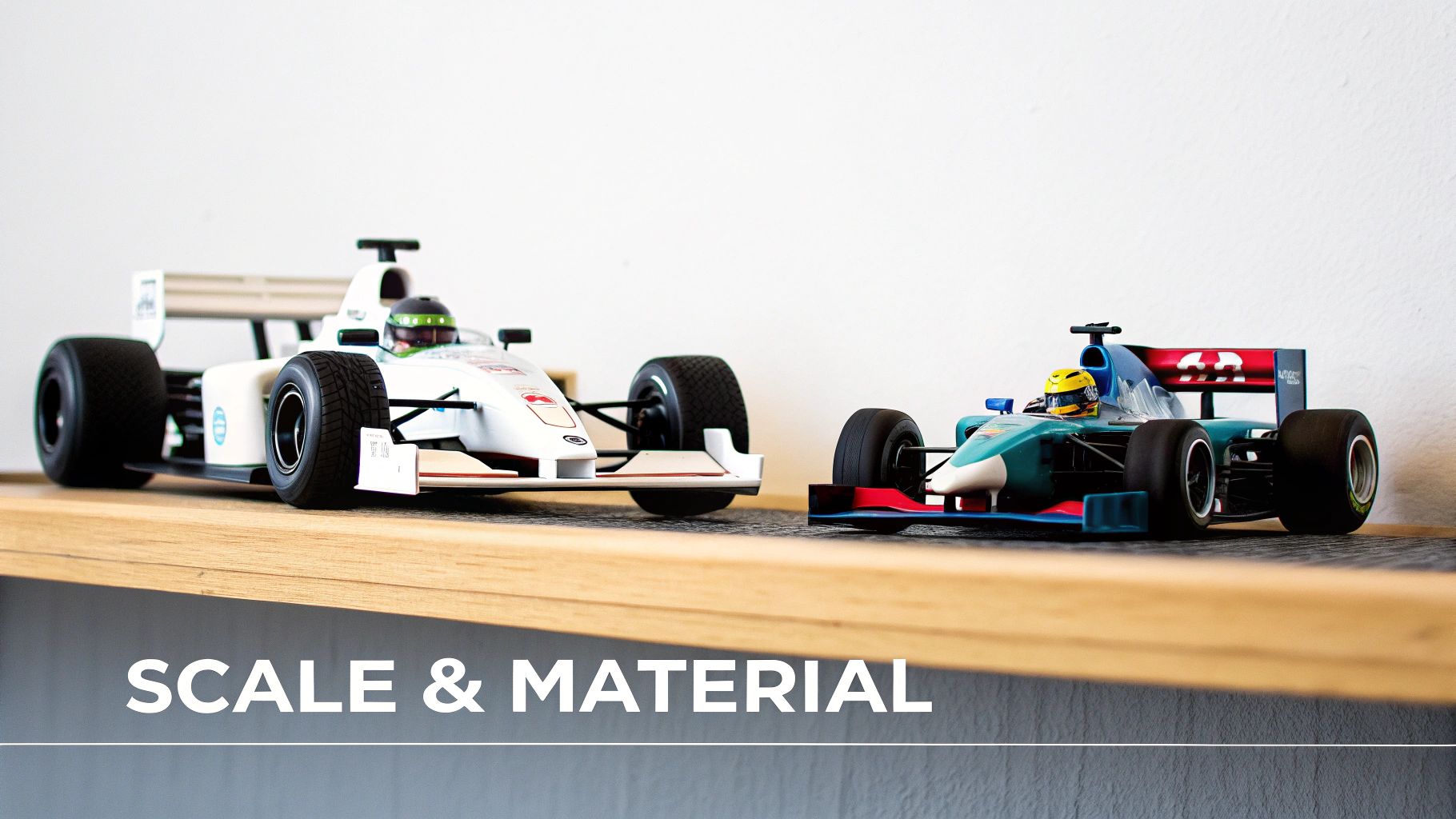
Cracking the Code on F1 Model Scales
The scale is just a simple ratio that tells you how many times smaller the model is compared to the real F1 car. For example, a 1:18 scale model means that for every 18 centimetres on the actual car, you get 1 centimetre on the model. It's the blueprint that determines its size.
In the world of formula one models, two scales dominate the grid: 1:18 and 1:43. Each offers a totally different experience.
-
1:18 Scale: The Centrepiece – This is the heavyweight champion. A 1:18 model is a serious statement piece, big enough to command attention on any desk or shelf. Its size allows manufacturers to go all-out on the details, from a fully kitted-out cockpit to intricate suspension and engine parts. If you want one incredible model that captures every last nuance of an iconic car, 1:18 is your champion.
-
1:43 Scale: The Collector's Choice – This is the sweet spot for anyone wanting to build a diverse collection. A 1:43 model is the perfect size for a bookshelf, letting you display an entire grid's worth of cars without needing a new room. Don't let the smaller size fool you; high-quality 1:43 models still pack a punch with impressive detail and accuracy. They’re ideal for showcasing a team's evolution or a driver's entire career.
Think of it like this: a 1:18 scale model is the Blu-ray director's cut, showing every detail in stunning high-definition. A 1:43 scale model is the perfectly curated photo album, capturing all the key highlights of an entire season.
Selecting the Perfect Material
Once you've locked in a scale, the next call is the material. This really boils down to what you value most: a solid, weighty feel, or the absolute pinnacle of precision detail. The two main contenders, diecast and resin, couldn't be more different.
Diecast: The Substantial Classic
Made from a metal alloy, diecast models are the traditional backbone of the collecting world. They have a satisfying heft and a solid, durable feel that so many collectors love. That robustness also makes them a bit more forgiving to handle.
A great diecast model can still feature fantastic detail, often with opening parts like engine covers that let you peek at the beautifully replicated power unit inside. They’re the perfect choice for anyone who appreciates that tactile connection and wants a car that feels as solid as it looks.
Resin: The Detail Purist
Resin models are crafted for one thing: unmatched accuracy. The material allows for sharper, finer details than diecast metal could ever achieve. This means delicate aero flicks, razor-thin wing edges, and flawless paint finishes are captured with breathtaking precision.
Because they are more fragile and usually have no moving parts, resin models are pure display pieces—think of them as miniature sculptures. They are built to be the most faithful representation of a real F1 car possible, making them the ultimate choice for purists who crave detail above all else. Their intricate nature also pairs beautifully with minimalist art, like the clean lines found in high-quality Formula 1 posters.
This passion for detail connects deeply with the sport's heritage, especially in nations with a rich motorsport history. Australia's contribution to Formula 1 is a perfect example, with homegrown talent creating moments worth immortalising. As of the 2025 season start, Australian drivers have racked up an impressive 45 victories, 35 pole positions, and 140 podiums, all powered by four world championships.
What Makes an F1 Model Truly Collectible
So, what separates a simple miniature car from a treasured piece of motorsport history? It's a fine line, but one drawn with a few key ingredients: authenticity, scarcity, and the story the car tells. Getting a feel for these factors is how you start to see beyond the price tag and build a collection with real, lasting value.
First and foremost, it all comes down to authenticity. A truly collectible model must be an officially licensed product. This is your guarantee that every sponsor decal, every aerodynamic flick, and every shade of paint is meticulously accurate and signed off by the Formula 1 team itself. You might find unlicensed models that look the part from a distance, but they'll always be missing that hardcore precision collectors live for.
That accuracy is everything because it anchors the model to a specific moment in F1 history. Think about a legendary circuit like Albert Park, home of the Australian Grand Prix. It's hosted 28 races since 1996, and its 5.303km layout has been conquered by icons like Michael Schumacher. A model of his 2004 Ferrari isn't just a toy car; it’s a tiny tribute to that specific era of dominance. To see more stats on this iconic track, check out the Australian Grand Prix's rich history on F1 Stat Blog.
The Power of Scarcity
Once you've ticked the authenticity box, scarcity is what really drives a model's desirability through the roof. Manufacturers know this, which is why they produce limited edition runs to celebrate a driver's first win, a team's championship, or another milestone.
These models are often individually numbered, creating a fixed supply that lights a fire under collector demand. A standard model from any given season might be easy to find, but a special release of just 500 units worldwide? That becomes an instant must-have. Knowing only a few hundred other people on the planet own that exact piece adds a huge amount of appeal and, frankly, long-term value.
A collectible F1 model is more than a replica; it's a time capsule. It captures the engineering, the branding, and the human story of a specific race or season, preserving a fleeting moment from the fastest sport on Earth.
The Story Behind the Machine
Ultimately, the most sought-after formula one models are the ones with a powerful story. A car driven by a legend like Ayrton Senna or Lewis Hamilton carries an emotional weight that a regular mid-field car just can't touch. That connection to a hero transforms the model from a piece of machinery into a piece of a legacy.
This 'narrative value' also comes from special achievements and unique one-offs.
- Championship Winners: It’s a no-brainer. Models of cars that sealed the World Constructors' or Drivers' Championship are always hot property because they represent the absolute pinnacle of F1 success.
- Special One-Off Liveries: Did a team run a unique colour scheme for a single race? Models of that car are gold dust to collectors, prized for their rarity and standout looks.
- Race-Specific Versions: Some high-end models replicate a car exactly as it crossed the finish line of a famous race—scuffs, tyre marbles, dirt, and all. These "dirty" versions are incredible snapshots of history.
By learning to spot these qualities, you can move from just buying models to curating a collection that's not only stunning to look at but is also packed with historical and emotional weight. And if you're looking to celebrate the sport beyond models, our guide to Formula One memorabilia is full of other great ideas.
How to Display and Preserve Your Collection
Your collection of formula one models deserves better than being tucked away in boxes. These aren't just toys; they're pieces of motorsport art, each one telling a story of speed, engineering, and passion. Turning your models into a stunning display doesn't just showcase your hobby—it protects your investment for years to come and transforms individual cars into an exhibit that truly impresses.
The trick is finding that sweet spot between visibility, protection, and style. You want to highlight the incredible detail of each car while keeping them safe from the everyday enemies of a prized collection.

Creative Display Solutions
Moving beyond a simple shelf is what separates a hobbyist from a true curator. Think about options that add a touch of professionalism and narrative flair to your space.
- Dedicated Display Cases: Let's be honest, an enclosed glass or acrylic case is the top-tier solution. It keeps dust completely at bay and, with some built-in LED lighting, makes every livery and aerodynamic detail pop.
- Wall-Mounted Shelves: For a more dynamic, "floating" look, individual wall-mounted shelves are fantastic. They let you arrange cars in formation, creating a sense of motion that draws the eye across the wall.
- Themed Arrangements: Don't just line them up—tell a story! Group your models by team to show their evolution, arrange them by a specific driver's career, or even recreate the starting grid of a famous race.
A great display does more than just hold your models; it provides context. It turns a collection of cars into a visual history of Formula 1, making each piece more meaningful and engaging for anyone who sees it.
And remember, your display doesn't have to exist in a vacuum. It can be beautifully complemented by other art forms that capture the on-track drama your static models represent. For some inspiration, check out our article on stunning Formula 1 photography to see how visual art can elevate your entire setup.
Essential Preservation Techniques
Looking after your formula one models is crucial for maintaining their condition and value. Over time, exposure to the elements can cause irreversible damage, turning a pristine replica into a faded, brittle shadow of its former self.
The two biggest culprits? Dust and sunlight. Dust works its way into tiny crevices, dulling the finish and obscuring all those fine details you paid for. Sunlight is even worse—it will bleach the vibrant colours of a car's livery and can make delicate resin or plastic parts brittle.
Cleaning Your Models Safely
Cleaning requires a gentle touch. Keep in mind that a durable diecast car can handle a bit more than a fragile, hand-built resin model.
- Start with Air: Use a can of compressed air (held at a safe distance!) or a soft puffer brush. This is your first line of defence to blow away any loose dust from the bodywork, wings, and wheels.
- Use a Soft Brush: For anything more stubborn, a super-soft makeup or artist's brush is perfect. It can gently sweep away particles from delicate areas without leaving a single scratch on the paint.
- Microfibre for Surfaces: A clean, dry microfibre cloth is great for wiping down the base and the outside of an acrylic case. Just avoid rubbing the model itself, as you could easily snag and damage tiny decals.
By investing just a little time in a proper display and regular, careful maintenance, you're ensuring your collection not only looks incredible but also preserves the history and craftsmanship of each piece for generations to enjoy.
Bringing Your F1 Passion to Life with Wall Art
While detailed formula one models are brilliant at capturing the three-dimensional engineering of the cars, high-quality wall art captures the soul of the sport. It’s the final touch that elevates your space from a simple collection into a proper fan experience. This is how you add emotion and context to your display, creating an environment that truly celebrates Formula 1.
Think about it. Imagine pairing a gleaming 1:18 scale model of a classic Ferrari with a minimalist, framed print of the Monza circuit. All of a sudden, you're not just showing off the car; you’re telling its story. You’ve placed it in its natural habitat, the legendary "Temple of Speed," and you can almost hear the roar of the Tifosi. That combination turns a static display into a real conversation starter.
More Than Just Decoration
The right piece of wall art gives your models the historical and geographical context they deserve. It anchors your collection, connecting the miniature machine on your shelf to the iconic locations where legends were made. It’s a stylish, curated way to express your F1 passion that looks great in any room, office, or fan cave.
Complementing your models with beautifully framed canvas prints of iconic circuits creates a complete narrative. A model of Senna's McLaren becomes even more powerful when it’s displayed next to an artistic take on Monaco's twisting streets. A modern Red Bull model somehow feels even more dominant when paired with a bold print of the Suzuka esses.
Wall art gives a model its home. It’s the backdrop that transforms a piece of engineering into a piece of history, reminding us that these incredible machines belong to legendary tracks, thrilling moments, and unforgettable eras.
Creating a Cohesive F1 Environment
The trick is to think like a curator. Select pieces that harmonise with both your models and your personal style. Whether you prefer retro Grand Prix posters that evoke a golden age of racing or modern, clean track maps, the goal is the same: to build an environment that reflects your deep appreciation for the sport.
Consider a few popular ways to bring it all together:
- Circuit Celebrations: Display models alongside art of the tracks where they took famous victories.
- Team Tributes: Group models from a single constructor with wall art that features the team's iconic colours or historical logos.
- Driver Shrines: Create a dedicated space for your favourite driver, combining models of their cars with portraits or artistic prints celebrating their career.
This layered approach offers a much richer and more personal connection to the world of Formula 1. It’s about moving beyond just owning formula one models and into the realm of true motorsport curation. For anyone looking to blend these elements, our guide to Formula 1 wall art is packed with inspiration for creating a space that truly shows off your passion. By thoughtfully combining physical models with stunning visual art, you can design a display that is both deeply personal and undeniably sophisticated.
Got Questions About Formula One Models?
Diving into the world of formula one models can feel a bit like trying to understand race strategy for the first time. Whether you're just starting your collection or you've been a die-hard fan for years, a few questions always pop up. This section cuts through the noise with clear, straight answers to help you collect with confidence.
Think of us as your personal race engineer, giving you the quick insights you need to make the right call on your next piece.
Are the Expensive F1 Models Really Worth It?
This is the big one, isn't it? The short answer: it really depends on what you're looking for. A higher price tag on a formula one model isn't just a number; it usually points to a few key things that make it a more desirable, long-term piece.
A premium resin model, for instance, might cost a fair bit more than a standard diecast car. You're not just paying for the name. You're paying for incredible hand-finished detail, pinpoint-accurate liveries, and often, the rarity of a limited production run. These high-end models are crafted for collectors who see them as miniature works of art.
It’s a bit like buying a watch. A standard one tells the time perfectly well, but a luxury Swiss watch brings a level of craftsmanship, heritage, and precision that turns it into a collectible investment. The same idea applies to F1 models.
What’s the Best Scale for a Beginner to Start With?
If you're just getting into collecting, the 1:43 scale is almost always the perfect starting grid. These models hit that sweet spot of great detail, affordability, and size, making them super easy to display without needing a dedicated room.
- Easy on Space: You can build an impressive grid of cars on a single bookshelf.
- Endless Variety: The 1:43 scale offers the widest range of cars out there, from modern-day contenders to obscure classics you’ve half-forgotten.
- Friendly on the Wallet: It’s a lower-cost way to get into the hobby and figure out what you truly love.
Starting with 1:43 lets you explore different teams, drivers, and eras without a massive financial commitment. It’s the best way to discover which parts of F1’s incredible history really get your engine running.
How Can I Tell if a Model Is Officially Licensed?
In the collecting game, authenticity is everything. Spotting an officially licensed product is key. Always check the packaging or the model’s base for a few tell-tale signs. Official models will almost always have the Formula 1 team's logo, the proper F1 hologram, and the manufacturer's branding displayed clearly.
Unlicensed models might look the part at first glance, but they often have slightly off sponsor decals or generic branding. Buying official products is your guarantee that the model is an accurate, team-approved replica of the real car—and that's what gives it real collectible value.
At TrackNation, we reckon your passion for motorsport deserves to be seen. Beyond the models on your shelf, why not bring the excitement of the track to your walls with our premium canvas prints and framed art? Check out the collection and find the perfect piece to complete your fan cave.