

History of F1: history of f1 legends and milestones
Long before the lights went out for the very first official Formula 1 race in 1950, the sport's heart was already beating in the wild, thrilling European Grand Prix motor racing of the early 20th century. This untamed pre-war era was the crucible that forged the need for a unified 'formula'—a single set of rules that would eventually give birth to the World Championship, kicking off at the legendary Silverstone circuit in the UK.
From Grand Prix Roots to a World Championship
Forget the polished, high-tech spectacle we see today. Grand Prix racing in the 1920s and ‘30s was raw, unpredictable, and breathtakingly dangerous. Races were standalone events, each with its own loose set of rules, creating a high-stakes playground for pioneering car makers and unbelievably brave drivers.
This was the age of titans. Names like Alfa Romeo, Bugatti, and the dominant, state-backed German teams of Mercedes-Benz and Auto Union commanded the scene. Their cars were absolute monsters—hulking, front-engine beasts that thundered down public roads protected by little more than a few hay bales. It was this thrilling, almost reckless environment that made it clear a bit of order was needed.
The Call for a "Formula"
So, where does the name "Formula One" actually come from? It's simple, really. It refers to the push for a single "formula"—one set of rules that every team and driver had to follow. The idea was to level the playing field by regulating everything from the size of the engine to the weight of the car. After the massive disruption of World War II, the leaders of motorsport regrouped with a clear goal: create a structured, international championship.
This ambition led directly to the formation of the FIA Formula One World Championship. The new series would finally unite Europe's most prestigious Grands Prix into one cohesive season, giving drivers the chance to fight for the ultimate prize: the title of World Champion.
The timeline below charts the key steps that turned a collection of scattered races into the global sport we know and love today.
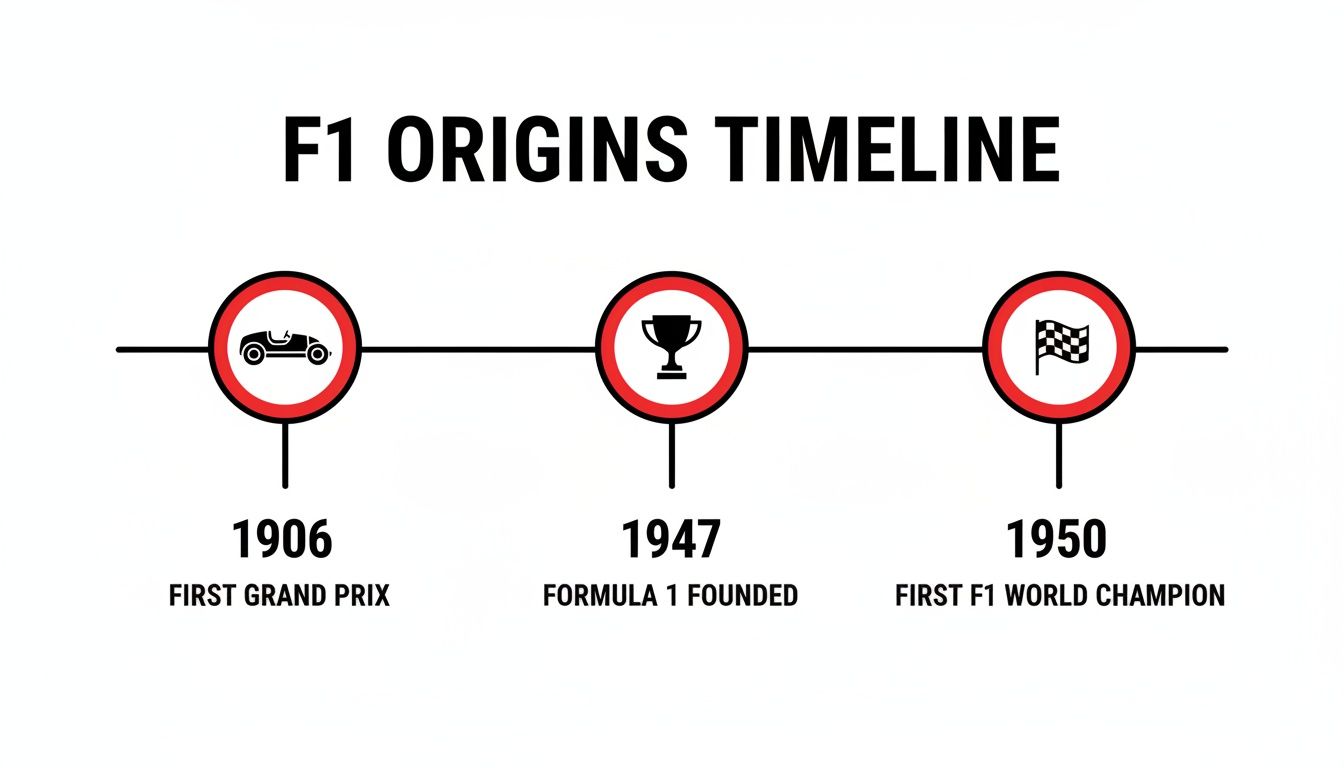
As you can see, the path from that first Grand Prix in 1906 to the inaugural F1 championship in 1950 was a long one, packed with over four decades of incredible—and often perilous—automotive innovation.
The Dawn of a New Era at Silverstone
It all began for real on a former RAF airfield in Northamptonshire. The date was 13 May 1950, and Silverstone was about to host the first-ever race of the brand-new FIA Formula One World Championship. The event was huge, drawing a massive crowd that even included members of the British Royal Family. You can explore more about this iconic track's history in our deep dive on the Silverstone Grand Prix.
That first race was completely dominated by the Alfa Romeo team. Their "Alfetta" 158 cars, originally designed before the war, were still miles ahead of the competition. An Italian driver, Giuseppe "Nino" Farina, carved his name into the history books by winning not just the race, but by going on to become the sport's first-ever World Champion.
Key Milestones of F1's Inaugural Decade
The 1950s were a foundational period, setting the tone for decades of competition and innovation. The table below highlights some of the key moments that defined the very first decade of the Formula One World Championship.
| Year | Key Event or Milestone | Notable Champion / Team |
|---|---|---|
| 1950 | First-ever F1 World Championship race held at Silverstone | Giuseppe "Nino" Farina (Alfa Romeo) |
| 1951 | Juan Manuel Fangio wins his first of five world titles | Juan Manuel Fangio (Alfa Romeo) |
| 1952 | Championship switches to F2 regulations due to a lack of F1 cars | Alberto Ascari (Ferrari) |
| 1954 | F1 returns with new 2.5-litre engine regulations; Mercedes-Benz debuts | Juan Manuel Fangio (Mercedes) |
| 1955 | Stirling Moss claims his first victory at the British GP | Juan Manuel Fangio (Mercedes) |
| 1957 | Fangio secures his fifth and final title, a record that stood for 46 years | Juan Manuel Fangio (Maserati) |
| 1958 | First Constructors' Championship is awarded to Vanwall | Mike Hawthorn (Ferrari) |
These early years were about more than just rules and races; they were about the heroes who risked it all and the machines that carried them, laying the groundwork for the legends to come.
The First Legends: Fangio and Farina
While Farina took home the first championship crown, it was his teammate, the Argentine maestro Juan Manuel Fangio, who would become the sport's first true global superstar. Known for his incredible car control and tactical brilliance, Fangio went on to win five World Championships in the 1950s—a stunning record that wouldn't be broken for nearly half a century.
These early champions were a different breed, piloting cars that were pure mechanical beasts. There were no seatbelts, no aerodynamic wings, and the tyres were impossibly skinny. Driving was a brutal physical battle against raw power and primitive handling. It demanded a unique blend of raw courage and delicate finesse that came to define the sport's heroic first decade, setting the stage for all the incredible innovation that was yet to come.
The Constant Push for Engineering Supremacy
The story of Formula 1 is really a story about the relentless pursuit of an unfair advantage. It’s a battle fought in wind tunnels and workshops, where a single breakthrough can turn the entire sport on its head. The 1960s was the first time we saw this happen in a massive way, thanks to a bunch of small, clever British teams nicknamed the "garagistes."

Before them, F1 cars were big, front-engined brutes. But teams like Cooper and, most famously, Lotus—led by the brilliant Colin Chapman—decided to flip the entire concept around. They put the engine behind the driver, a simple move that completely transformed the car's balance and how it handled corners.
This was just the start. Chapman’s next big idea was the monocoque chassis, which debuted on the legendary Lotus 25. Instead of a clunky tubular frame with a body bolted on, the monocoque used the car's skin as its skeleton, just like an aeroplane. It made the car lighter, stronger, and incredibly rigid, giving drivers a huge confidence boost through the corners.
Mastering the Invisible Force of Ground Effect
As we rolled into the 1970s, the battleground shifted from mechanical grip to something you couldn't even see: aerodynamics. Wings had been around since the late ‘60s, but it was Lotus, once again, that unlocked a powerful secret called ground effect.
Think about how a plane’s wing works—curved on top, flat on the bottom. Air rushes faster over the curve, creating low pressure and lifting the plane up. Ground effect cars simply flipped that idea upside down.
By shaping the entire floor of the car like an inverted wing, teams created a massive low-pressure zone between the car and the road. This invisible force literally sucked the car to the tarmac, generating insane amounts of grip without the drag from massive wings.
This discovery led to mind-bending cornering speeds that were simply unimaginable before. The Lotus 79, with its perfectly sculpted underbody and sliding "skirts" that sealed the airflow, was almost untouchable. Suddenly, every other team was desperately trying to copy the design. This was a defining moment in the history of F1, marking the shift from raw power to aerodynamic witchcraft. To dive deeper into these game-changing eras, check out our complete overview of the F1 history.
The Brutal Power of the Turbo Era
Just as everyone got a handle on ground effect, the rule-makers decided it was too fast and dangerous, banning it for the 1980s. So, engineers went looking for speed somewhere else and found it in the form of tiny 1.5-litre engines strapped to enormous turbochargers.
These things were absolute monsters. In qualifying spec, engines from BMW, Renault, and Honda were rumoured to be pushing out over 1,400 horsepower—a number that’s still wild to think about today. That was more than double the power of the naturally aspirated engines they replaced.
But taming that beast was a nightmare. The turbos had crippling "lag"—a huge delay between the driver hitting the throttle and the power actually kicking in. It made the cars incredibly twitchy and difficult to drive, demanding superhuman skill and bravery to handle the explosive, unpredictable surge of acceleration. The Turbo Era was all about raw, untamed power.
The Rise of the Electronic Age
The desperate need to control that turbo power led directly to the next great leap in the 1990s: electronic driver aids. With turbos banned again, teams switched to naturally aspirated V10s and V12s and turned to clever electronics to find an advantage.
This was the era that brought us a whole suite of now-famous tech:
- Active Suspension: A computer-controlled system that kept the car perfectly flat through corners, optimising its aerodynamic platform second by second.
- Traction Control: The car's brain would stop the wheels from spinning, letting drivers get on the power much earlier and more aggressively.
- Launch Control: Perfect, automated starts every single time, managing the clutch and throttle to get off the line as fast as humanly possible.
- Anti-lock Brakes (ABS): Allowed drivers to brake later and harder without locking the wheels, making overtaking much easier.
These systems made the cars ridiculously fast and consistent, but they also triggered a huge debate: was this racing, or was it a science experiment? The FIA was constantly playing cat-and-mouse, banning one system only for engineers to invent a new one. That constant tug-of-war between raw driver talent and engineering genius is still at the very heart of Formula 1.
The Relentless Pursuit of Driver Safety
For much of its early history, Formula 1 existed with a grim acceptance of danger. The same engineering brilliance that pushed cars to impossible speeds also made them incredibly fragile. For the drivers, stepping into the cockpit was an act of profound bravery, as safety measures were minimal and tragedy was an all-too-common part of a race weekend.
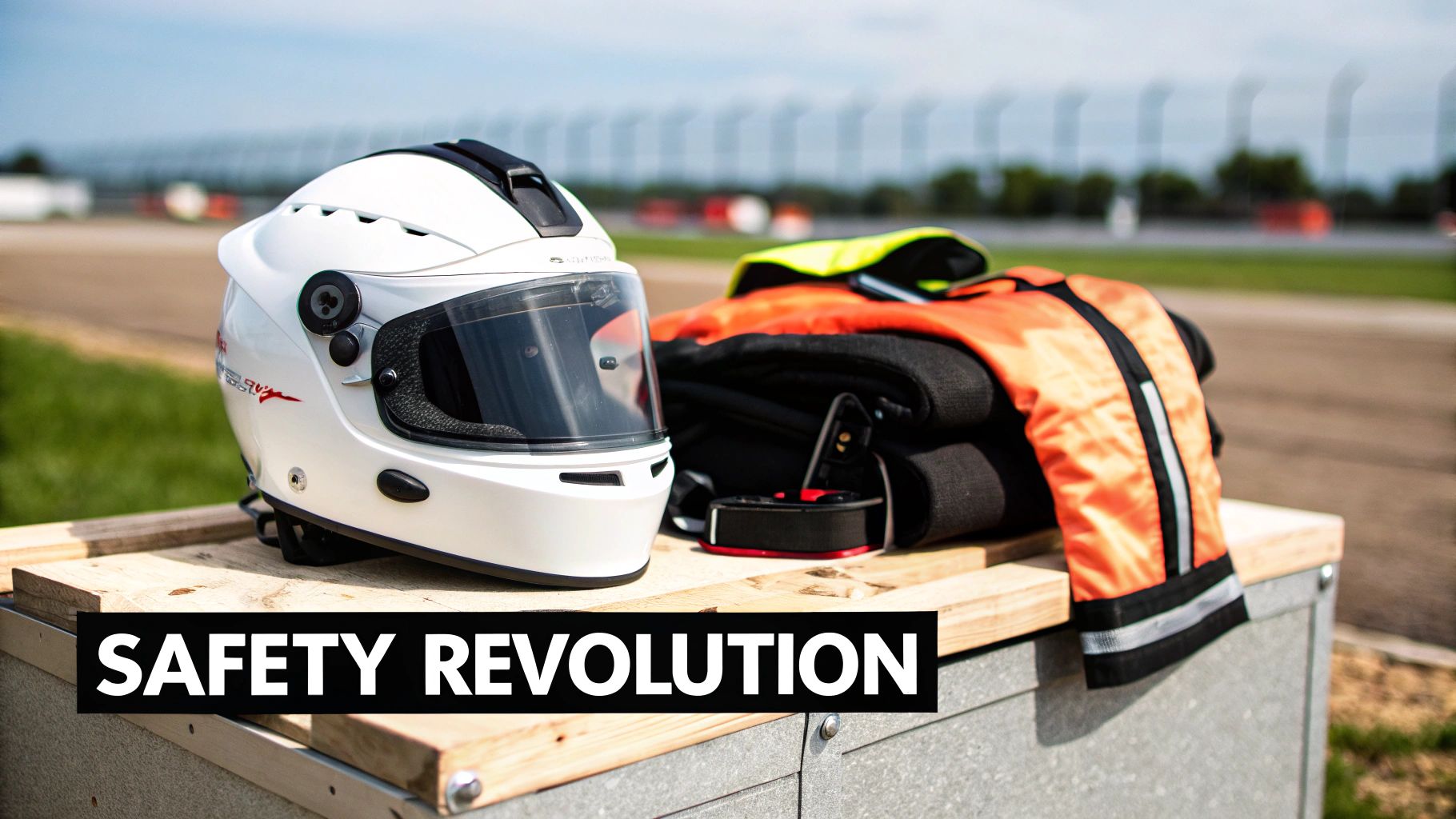
This all started to change thanks to the tireless campaigning of drivers who had seen too many friends and rivals perish. Three-time world champion Sir Jackie Stewart became one of the most powerful voices, demanding better circuit safety, improved medical facilities, and cars designed to protect their occupants, not just go fast. His advocacy kickstarted a slow but steady shift in the sport's entire culture.
Initial progress was fundamental but life-saving. Simple innovations like fire-retardant race suits replaced the shockingly flammable cotton overalls of the past, and the introduction of full-face helmets offered far greater protection than the open-faced designs of the 1950s. These were crucial first steps on a very long journey.
From Survival Cells to Safer Circuits
The 1980s brought one of the most important developments in the history of F1 safety: the survival cell. Engineers developed ultra-strong carbon fibre monocoques designed to be an almost indestructible cocoon around the driver.
The idea was brilliant in its simplicity: while the rest of the car—wheels, wings, engine—was designed to break away and absorb the enormous energy of an impact, the survival cell would remain intact, shielding the driver from harm. This principle remains the bedrock of F1 car design to this day.
Think of it like a modern passenger car's crumple zones. The front and rear of the car are designed to collapse and absorb impact energy, while the reinforced passenger compartment stays rigid to protect the people inside.
The Imola 1994 Turning Point
Despite these advances, the sport received its most brutal wake-up call during the 1994 San Marino Grand Prix at Imola. The weekend was utterly devastating, marred by the tragic deaths of both rookie Roland Ratzenberger and the legendary Ayrton Senna in separate accidents.
The loss of two drivers, especially a figure as globally beloved as Senna, sent a shockwave through the motorsport world and forced the FIA to act decisively. This dark weekend became the catalyst for the most significant safety revolution F1 had ever seen, with sweeping and immediate changes.
- Circuit Redesigns: High-speed corners like Imola's lethal Tamburello were reprofiled with chicanes to slash speeds. Gravel traps and runoff areas were expanded across the calendar.
- Engine Power Reduction: Regulations were changed overnight to slow the cars down, giving drivers more reaction time and reducing the severity of impacts.
- Enhanced Crash Testing: Cars were suddenly subjected to much stricter and more rigorous crash tests to guarantee the integrity of the survival cell.
That tragic weekend, forever linked to the circuit's challenging layout, remains a poignant chapter in motorsport history. Fans often commemorate these moments with art, like this stunning framed canvas print of the Imola circuit, which serves as a powerful tribute to the track.
The Modern Era of Protection
The hard lessons learned from Imola paved the way for a new generation of safety devices. Two innovations in particular have proven to be absolute life-savers, preventing serious injury and death on numerous occasions.
The HANS (Head and Neck Support) device, made mandatory in 2003, is a carbon fibre shoulder collar connected to the driver's helmet. During a frontal impact, it prevents the violent whiplash that can cause catastrophic neck and skull fractures. It’s a game-changer.
More recently, the Halo was introduced in 2018. This titanium structure mounted above the cockpit was initially met with resistance for its looks, but it has since been credited with saving multiple drivers from severe head injuries—most notably protecting Romain Grosjean in his terrifying, fiery 2020 Bahrain crash. Every lesson, often learned the hardest way imaginable, has led to an engineering solution that has made F1 a benchmark for safety.
Legendary Drivers, Teams, and Unforgettable Rivalries
The engineering and aerodynamics might be the brains of Formula 1, but the human drama is its heart and soul. Ultimately, the history of F1 is a story about people—of iconic teams, legendary drivers, and the unforgettable rivalries that forged motorsport's most immortal moments. Without these personalities, the cars are just machines. With them, they become vessels of ambition, passion, and raw conflict.

Certain teams are woven into the very fabric of the sport. You simply can't talk about Formula 1 without mentioning Ferrari. As the only constructor to have raced in every single World Championship season since 1950, the Scuderia is more than just a team; it's an institution, defined by its iconic red livery and its passionate global fanbase, the Tifosi.
But their legacy is matched by British innovators like McLaren and Williams, teams born from humble, garage-based beginnings that rose to challenge and often defeat the established giants. More recently, the modern era has been defined by the clinical dominance of Mercedes, who completely rewrote the record books during the hybrid power unit era.
The Prost vs. Senna Era
No rivalry in motorsport history burns brighter than the bitter feud between Alain Prost and Ayrton Senna. It was a perfect clash of styles and personalities that captivated the entire world in the late 1980s and early 1990s.
Prost, nicknamed "The Professor," was a calculating, smooth, and tactical genius. He always played the long game, preserving his car and collecting points with a ruthless, almost frustrating, efficiency. Senna, on the other hand, was pure, raw passion. He drove with an almost spiritual intensity, pushing himself and his car to the absolute jagged edge on every single lap, especially in qualifying.
Their battle went nuclear when they became teammates at McLaren in 1988. What followed was a dramatic saga of controversial collisions, heated accusations, and championship deciders that are still debated fiercely today.
Their collision at the 1989 Japanese Grand Prix, which handed Prost the title, and Senna's seemingly deliberate retaliation at the very same corner a year later to claim his own championship—this was the dramatic peak of their conflict. It was a rivalry that went far beyond sport, becoming a fascinating psychological war fought at over 320 km/h.
The Schumacher Dynasty at Ferrari
After the emotional turmoil of the Prost-Senna years, the sport entered an era defined by one man's relentless pursuit of perfection. Michael Schumacher joined a struggling Ferrari team in 1996 and, alongside a masterful technical team, began the meticulous process of rebuilding the legendary Scuderia from the ground up.
The result was the most dominant chapter in F1 history. From 2000 to 2004, Schumacher and Ferrari were simply unbeatable, winning five consecutive Drivers' and Constructors' Championships. He didn't just win; he redefined what it meant to be a modern F1 driver with his unmatched work ethic, physical fitness, and deep technical understanding.
Schumacher's reign set incredible new benchmarks:
- Seven World Championships: A record that stood for years and has only been matched once.
- 91 Grand Prix Victories: A staggering number that many people thought would never be surpassed.
Modern Champions and Enduring Legacies
Schumacher’s records seemed untouchable—until the arrival of a new generation of superstars. This modern period has been overwhelmingly shaped by two figures who have etched their own names into the highest echelons of the sport.
First, Sebastian Vettel carried on the legacy of German excellence with Red Bull Racing, securing four consecutive world titles between 2010 and 2013. His finger-wagging celebration became an iconic symbol of a new dynasty.
Following Vettel's reign, the sport witnessed the rise of Lewis Hamilton. Paired with the dominant Mercedes team, Hamilton embarked on a record-shattering journey, matching and then exceeding many of Schumacher's incredible statistics. To get a better sense of his place among the greats, you can learn more about the legacy of Lewis Hamilton in our detailed driver profile. His success has defined the hybrid era, creating a new benchmark for future generations to chase.
How Legendary Circuits Became Theatres of Speed
While the cars and drivers grab the headlines, the circuits are the stages where Formula 1 legends are truly forged. These hallowed grounds are far more than just strips of asphalt; they are temples of speed, each with its own soul, its own set of challenges, and a history soaked in triumph and drama. In the early days, these "stages" were often just public roads lined with trees and ditches, offering practically nothing in the way of safety.
Take the original Nürburgring Nordschleife in Germany, famously nicknamed "The Green Hell." It was a terrifying test of pure nerve and endurance. This sprawling, 22.8-kilometre monster was a winding ribbon of tarmac snaking through the forest, a perfect symbol of the raw, untamed spirit of early Grand Prix racing. But as the sport matured, it became clear that purpose-built tracks were needed—ones that put safety first without losing the unique character that made racing so thrilling.
The Crown Jewels of the F1 Calendar
Some tracks have become completely synonymous with the history of f1, their names echoing through motorsport folklore for decades. They are the undisputed crown jewels on the calendar, each bringing a distinct personality to the table that pushes drivers and engineers to their absolute limits.
- Monza: Affectionately known as the "Temple of Speed," this Italian circuit is all about raw, straight-line grunt. Its long straights and blisteringly fast corners demand a low-downforce setup, creating a unique engineering puzzle and some of the most exciting wheel-to-wheel action you'll ever see.
- Silverstone: As the host of the very first World Championship race back in 1950, Silverstone is a high-speed, flowing circuit that drivers adore. Its famous Maggots and Becketts complex is one of the ultimate tests of a car's aerodynamic balance and a driver's courage.
- Monaco: Maybe the most famous of them all, the Monaco Grand Prix is a dazzling spectacle of glamour and pin-point precision. The tight, twisting street circuit leaves absolutely zero room for error, demanding immense concentration and skill. Dive deeper into what makes this race so iconic in our guide to the Formula One Monaco Grand Prix.
These legendary venues have had to adapt constantly over the years. Safety improvements have seen many corners reprofiled and runoff areas added, but their essential character has always been carefully preserved, making sure they remain the ultimate proving grounds for the best in the world.
Global Expansion and New Challenges
As Formula 1’s popularity exploded, so did its global footprint. The sport soon expanded beyond its European heartland, bringing new cultures and fresh challenges into the mix. This growth introduced a new generation of state-of-the-art circuits designed by architects like Hermann Tilke, who brought a modern philosophy to track layout and safety.
This global journey has also built incredibly passionate fanbases in new regions, like right here in Australia. The Australian Grand Prix, held at Melbourne’s Albert Park since 1996, has become a cornerstone of the F1 calendar. Over its 5.278-kilometre layout, the race has seen 13 different winners, with Ferrari standing as the most successful constructor. The event's phenomenal popularity is clear in its attendance figures, which have grown consistently and hit a remarkable 465,000 spectators in 2025 after a massive post-pandemic resurgence.
The evolution of circuits really just mirrors the evolution of the sport itself—it's a constant balancing act between preserving history, pushing technology, and, most importantly, keeping the drivers safe.
From treacherous public roads to meticulously designed modern arenas, every single track tells a part of the grand Formula 1 story. They are the battlegrounds where championships are won and lost, and where those unforgettable moments of motorsport magic are made.
A Few Burning Questions About F1 History
Diving into the rich tapestry of Formula 1’s past always stirs up some great debates. Who was the ultimate champion? Which car was simply untouchable? Here are our thoughts on some of the most common questions that pop up when you start exploring the history of F1.
Who Is the Greatest F1 Driver of All Time?
Ah, the big one. This is motorsport's most passionate and enduring debate, and there’s no easy answer.
If you’re looking at pure numbers, Lewis Hamilton holds the record for the most Grand Prix wins, and he’s tied with the legendary Michael Schumacher on seven world titles each. It's a staggering achievement.
But stats don't tell the whole story. Many purists will argue for Juan Manuel Fangio, whose five championships in the brutally dangerous 1950s came at a time when driver skill was everything. Others will point to Ayrton Senna, a man whose raw, almost mystical, speed and feel for a car has never been matched.
Ultimately, the "greatest" is subjective. It really depends on what you value most—be it sheer numbers, adaptability across different eras, or the profound impact a driver had on the sport itself.
What Was the Most Dominant Car in F1 History?
Every now and then, a team builds a car that is so far ahead of the competition, it’s practically in a different race.
The 1988 McLaren MP4/4 is the textbook example, famously winning 15 of the 16 races in the hands of Senna and Prost. It’s still the benchmark for single-season dominance.
Jump forward a bit, and you have Ferrari’s F2004, another absolute beast of a machine. It carried Michael Schumacher to his final title with 15 wins from 18 races. More recently, the Mercedes W07 Hybrid from 2016 simply crushed the competition, winning an astounding 19 out of 21 races and cementing its place as one of the most statistically successful cars ever built.
Why Is Ferrari So Important to Formula 1?
Ferrari’s place in Formula 1 goes way beyond its impressive trophy cabinet. They are the only team to have raced in every single Formula One World Championship season since it all began back in 1950. Their story is the story of F1.
Founded by the formidable Enzo Ferrari, the 'Scuderia' has cultivated a passionate, almost religious, global fanbase known as the 'Tifosi'. Their iconic rosso corsa (racing red) cars have become a universal symbol of speed, passion, and motorsport prestige.
For millions around the world, Ferrari is Formula 1. This unique legacy and unwavering presence have made them a foundational pillar of the championship, a direct link to the sport's heroic origins and its glamorous, high-stakes present. The name is simply synonymous with the soul of Grand Prix racing.
Celebrate these legendary moments and bring the thrill of motorsport history into your home. At TrackNation, we offer premium framed prints and art that capture the essence of iconic circuits, legendary drivers, and unforgettable eras. Explore our collection today at https://tracknation.au.