

Lewis Hamilton The Unrivaled Legacy of an F1 Icon
When you hear the name Lewis Hamilton in Formula 1, you're not just talking about another driver. You're talking about a seven-time World Champion whose sheer talent, record-breaking career, and massive influence have well and truly reshaped the sport. His story, from a determined kid karting in Stevenage to a global icon, is a masterclass in breaking down barriers and redefining what success looks like, both on and off the track.
Who Is Lewis Hamilton? The Man Behind The Helmet
To really get who Lewis Hamilton is, you have to look past the mind-boggling stats—the 103 race wins, the seven titles, and the countless records he's smashed. His story didn’t start on the podium. It started on the go-kart tracks of the UK, with his dad, Anthony, working multiple jobs just to keep his son’s dream alive. That foundation of pure sacrifice and grit is the real engine behind his entire career.
This was never just a weekend hobby; it was a mission. From a very young age, Hamilton had a natural flair that was simply impossible to ignore. His aggressive yet incredibly smooth driving style, mixed with a white-hot competitive fire, made him stand out and put him on the radar of motorsport’s biggest names long before he ever climbed into an F1 car.
From Prodigy To Champion
That incredible journey from karting prodigy to Formula 1 legend was built on a few key things that define the man behind the visor:
- Unshakeable Self-Belief: When he was just ten years old, Hamilton walked up to McLaren's team boss, Ron Dennis, and told him he'd one day race for his team. That wasn't just a kid's boast; it was a declaration of intent that he later made a reality.
- Raw, Instinctive Talent: Hamilton just feels a race car. He has this innate ability to find the absolute limit of grip and speed in a way very few drivers ever can. You really see this shine through in tricky, wet-weather races, where he’s widely considered a modern-day master.
- Resilience Under Pressure: Throughout his career, he's faced down intense rivalries, public scrutiny, and the immense pressure of being the sport’s first and only Black driver. His ability to take all of that and turn it into fuel for on-track performance is the mark of his incredible mental strength.
Lewis Hamilton's rise is proof that greatness isn't just something you're born with; it's forged through thousands of hours of dedication, overcoming obstacles, and an unshakeable will to win against all odds.
A Legacy Beyond Lap Times
While his achievements on the circuit have earned him a spot among the racing gods, his impact goes so much further than the chequered flag. He has become a powerful voice for change, using his global platform to champion diversity, equality, and environmental issues.
He completely shattered the old-school mould of a racing driver, embracing fashion, music, and activism to become a true cultural force. Understanding the full scope of F1 history really puts into context just how massive his barrier-breaking career has been. He didn't just join the sport; he changed it forever.
Forging a Champion: The Early Years and Karting Dominance
Every legend has an origin story, and for Lewis Hamilton, it all started with a radio-controlled car. His dad, Anthony, bought him one when he was just five, and it didn't take long for everyone to see he had a special knack for it. By six, he was in his first go-kart, a Christmas gift that would unknowingly map out the rest of his life.
This wasn't just a weekend hobby; it became a full-blown family mission. Anthony recognised his son's raw talent and poured everything he had into it, becoming his number one fan, manager, and mechanic. The financial strain was immense. He famously worked up to four jobs at a time—everything from IT to selling double glazing—just to keep the karting dream alive. That incredible sacrifice built the foundation for Lewis's fierce work ethic and steely determination.
That family belief was the real engine behind his early wins. It's a familiar story in motorsport, where rising stars often lean on massive family support to get started. Just look at Australia's own F1 driver, Oscar Piastri, whose career was also forged by early dedication and backing from his family.
From Karting Tracks to McLaren's Radar
By the time he was ten, Lewis wasn't just winning; he was in a league of his own. He bagged his first British Karting Championship in 1995, a victory that led to a now-famous encounter. At an awards night, a supremely confident ten-year-old Hamilton walked straight up to McLaren's team boss, Ron Dennis, and told him, "One day I want to be racing for you."
Impressed by the kid's sheer audacity, Dennis signed an autograph and told him to give him a call in nine years. It was more than just a cute story; it was a glimpse into the future. Only three years later, in 1998, McLaren and Mercedes-Benz officially signed Hamilton to their Young Driver Support Programme.
This was a game-changer. At just 13 years old, Lewis Hamilton had secured the backing of a top-tier Formula 1 team. It was a completely unprecedented move that basically screamed to the world: this kid is a once-in-a-generation talent.
Conquering the Junior Formulas
With McLaren's support behind him, Hamilton’s climb through the junior motorsport ranks was nothing short of meteoric. He capped off his karting career by becoming European Champion in 2000, famously beating his future F1 rival, Nico Rosberg, along the way. His move into single-seater cars was flawless, showing a level of maturity and racecraft well beyond his years.
His journey up the ladder was a checklist of domination:
- 2003 British Formula Renault Championship: He completely owned the series, wrapping up the title with two races to spare.
- 2005 Formula 3 Euro Series: Driving for the powerhouse ASM team, he won a staggering 15 out of 20 races, leaving a highly competitive field in his dust.
- 2006 GP2 Series Championship: In his rookie season in F1's main feeder series, he snatched the title after a dramatic, season-long fight, proving he was more than ready for the big leagues.
Each championship wasn't just another trophy for the cabinet; it was a statement. Lewis Hamilton wasn't just another promising driver on the grid. He was an unstoppable force, forged by sacrifice and ready to take on the world of Formula 1.
A Career Forged in Conquest: His Formula 1 Journey
The jump from junior formulas to Formula 1 is one of the toughest transitions in any sport. For Lewis Hamilton, it was just the next box to tick. When he landed a seat with the McLaren-Mercedes team for the 2007 season, he wasn't just another rookie; he was partnered with the reigning double World Champion, Fernando Alonso. The expectation was simple: learn the ropes, support the team, and maybe, just maybe, snag a few points.
Hamilton had other ideas.
He exploded onto the scene at the 2007 Australian Grand Prix, finishing on the podium in his very first race. That electrifying performance at Albert Park set the tone for a rookie season that was nothing short of extraordinary. He wasn't just there to compete—he went toe-to-toe with the best in the business. Over his career, Hamilton has collected an incredible 10 podium finishes at this iconic Melbourne street circuit, a testament to his lasting brilliance.
He followed that debut with a stunning string of nine consecutive podiums, securing his first pole position and maiden victory at the Canadian Grand Prix. The rookie wasn't just fast; he was a phenomenon. It sparked a fierce and often fiery rivalry with his teammate Alonso that became the story of the season.
This timeline shows just how calculated his path to F1 stardom really was.
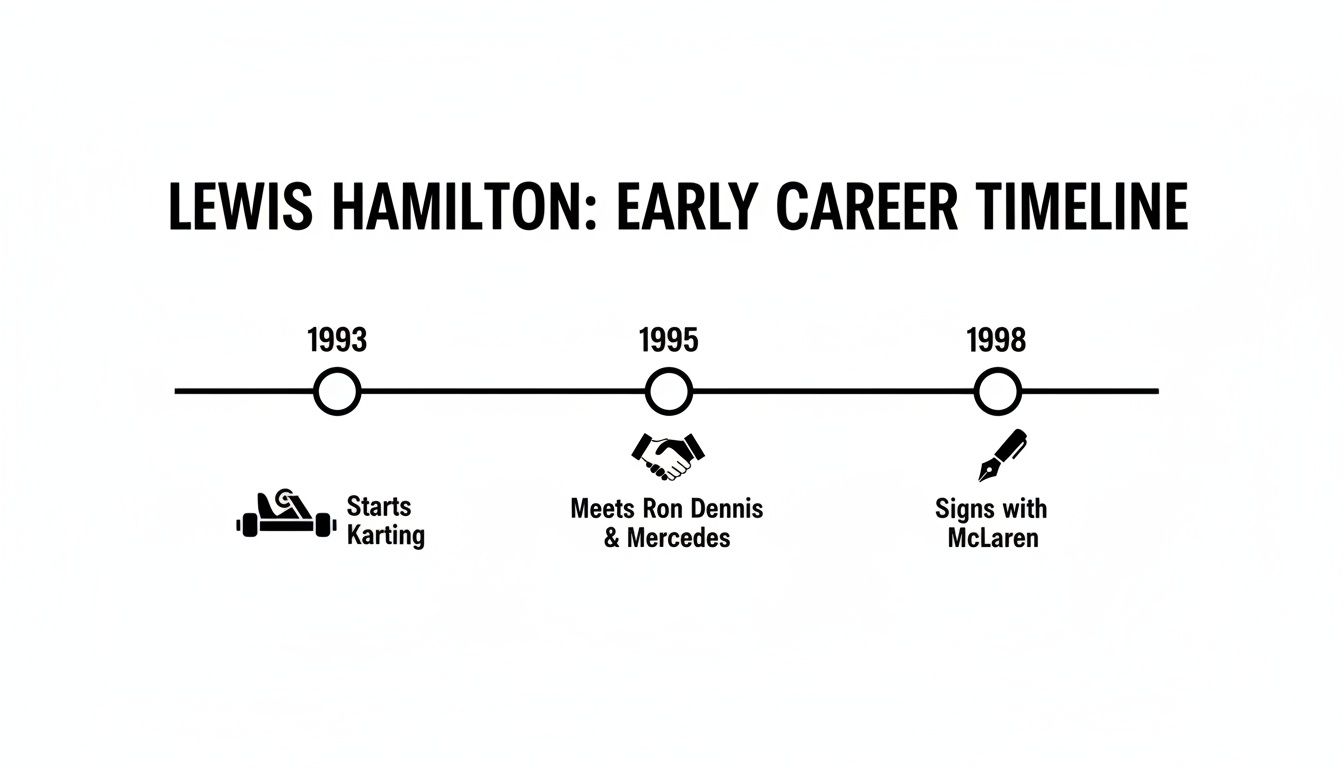
From his first time in a go-kart to inking a deal with an F1 giant, every step was a deliberate move toward greatness.
Claiming the First Crown
After missing out on the championship in his debut year by a single, agonising point, Hamilton came back in 2008 with a score to settle. The season was a rollercoaster, building to one of the most nail-biting, down-to-the-wire finishes in F1 history at the final race in Brazil.
Needing a fifth-place finish to seal the title, Hamilton found himself down in sixth as rain began to fall on the very last lap. In a heart-stopping moment that fans will never forget, he overtook Timo Glock on the final corner, grabbing the fifth position he needed to become the youngest-ever Formula 1 World Champion at the time. It was a victory pulled from the jaws of chaos, proving his now-legendary ability to deliver under insane pressure.
His epic win at the British Grand Prix that year, where he lapped almost the entire field in torrential rain, was a masterclass in car control. This race at Silverstone remains a fan favourite and a perfect example of his genius in wet conditions. For a deeper dive into the history and magic of this iconic track, check out our guide on the Silverstone Grand Prix.
The Bold Move to Mercedes
After the high of his 2008 triumph, Hamilton’s following years with McLaren were tough. He still racked up plenty of wins, but the car often lacked the raw pace to mount a serious, season-long championship fight. At the end of 2012, he made a career-defining decision that many in the paddock saw as a massive gamble: he left the established powerhouse of McLaren for the then-midfield Mercedes team.
At the time, it looked like a strange move. Mercedes had only managed a single victory since returning as a full works team in 2010. But Hamilton saw the long-term potential. He trusted the team's vision as the sport prepared for the massive shift to a new hybrid engine era in 2014.
This single decision would ignite the most successful driver-team partnership in Formula 1 history. It wasn't just a change of scenery; it was the beginning of an era of sheer dominance that would see Lewis Hamilton rewrite the F1 record books.
An Era of Unprecedented Dominance
The 2014 regulation changes, centred on V6 turbo-hybrid power units, played perfectly into Mercedes' hands. The team built a car that was lightyears ahead of everyone else, and Hamilton didn't waste the opportunity. He fought a fierce, season-long battle with his childhood rival and teammate, Nico Rosberg, ultimately claiming his second World Championship.
That victory opened the floodgates.
From 2014 to 2020, Hamilton and Mercedes were an unstoppable force, creating a dynasty that rivalled any in motorsport history. He added six more titles to his name during this period, cementing his legacy as one of the all-time greats.
This table gives you a snapshot of Hamilton's seven world titles, showcasing the stats behind each championship-winning season.
Lewis Hamilton's Formula 1 World Championships
| Championship Year | Team | Wins | Podiums | Poles | Key Rival |
|---|---|---|---|---|---|
| 2008 | McLaren-Mercedes | 5 | 10 | 7 | Felipe Massa |
| 2014 | Mercedes | 11 | 16 | 7 | Nico Rosberg |
| 2015 | Mercedes | 10 | 17 | 11 | Nico Rosberg |
| 2017 | Mercedes | 9 | 13 | 11 | Sebastian Vettel |
| 2018 | Mercedes | 11 | 17 | 11 | Sebastian Vettel |
| 2019 | Mercedes | 11 | 17 | 5 | Valtteri Bottas |
| 2020 | Mercedes | 11 | 14 | 10 | Valtteri Bottas |
This period wasn't just about having the fastest car. It was about relentless execution, clever strategy, and a driver operating at the absolute peak of his powers. Here’s a quick rundown of that golden era:
- 2015: A truly dominant season where he wrapped up the title with three races still to go.
- 2017 & 2018: Two intense, hard-fought championship battles against Ferrari's Sebastian Vettel, where Hamilton's consistency and near-flawless driving made the difference.
- 2019 & 2020: Two of his most commanding seasons ever. He shattered Michael Schumacher's long-standing record for the most race wins and equalled his incredible record of seven World Championships.
This incredible run solidified Lewis Hamilton’s place not just as a champion, but as a true icon of the sport.
The Hamilton Effect: A Deep Dive Into His Driving Style
What separates a truly great Formula 1 driver from a legend like Lewis Hamilton? It’s not just about having a fast car. It’s an almost supernatural connection between the driver and the machine—a rare blend of raw aggression, silky smoothness, and tactical genius that few can ever hope to master. This unique combination is what many call ‘The Hamilton Effect,’ an uncanny ability to wring performance out of a car that seems to defy physics.
Think of an F1 car as a finely tuned instrument. While plenty of drivers can play it well, Hamilton makes it sing. His driving style is a masterclass in adaptability, allowing him to be ruthlessly aggressive on the attack one moment and incredibly gentle to preserve his tyres the next. It’s this incredible dynamic range that has become the hallmark of his on-track brilliance.
The Art of Late Braking
One of Hamilton’s most formidable weapons is his braking. He has an almost freakish ability to brake later and harder than his rivals yet still carry mind-boggling speed through the corner’s apex. This isn't just about raw courage; it's about a deep, intuitive feel for grip, downforce, and weight transfer.
Imagine two drivers hurtling towards a tight corner. Most will hit the brakes at a predictable point to ensure they make the turn. Hamilton, on the other hand, consistently pushes that braking zone deeper, trusting his feel for the car to find grip where others believe there is none. This is the secret behind so many of his breathtaking overtakes and what helps him shave off those crucial tenths on a qualifying lap.
Lewis Hamilton’s true genius lies in his ability to dance on the very edge of adhesion. His control in the braking zone is less about mechanics and more about a sixth sense for what the tyres are doing at any given millisecond.
This incredible feel for the car is something that simply can’t be taught. It’s been honed over thousands of hours, right from his karting days, and is a key reason why he is so phenomenally difficult to defend against in wheel-to-wheel racing. Capturing these high-speed moments is an art in itself, something we explore in our feature on Formula 1 photography.
Masterful Tyre Management
In modern Formula 1, just being fast isn’t enough—you have to be smart. Race strategy often lives and dies by tyre life, and this is another area where Hamilton operates on another level. He possesses a remarkably smooth driving style that is incredibly kind to his tyres, allowing him to extend his stints on track and open up strategic possibilities his rivals just don't have.
His technique is all about minimising harsh inputs. He’s exceptionally gentle on the throttle and uses tiny steering movements, which reduces the heat and stress being punished into the rubber. This delicate touch has won him countless races where he appeared to be on a weaker strategy, only to make his tyres last far longer than anyone thought possible.
- Smooth Inputs: He avoids aggressive, jerky movements, which helps prevent overheating the surface of the tyre.
- Throttle Control: His ability to apply power progressively on corner exit reduces wheelspin, a major cause of tyre wear.
- Car Rotation: He uses subtle braking and throttle inputs to help rotate the car, rather than relying solely on aggressive steering angles.
The Undisputed Rain Master
When the heavens open and the track gets soaked, the truly great drivers shine. Hamilton is, without a doubt, the finest wet-weather driver of his generation. Racing in the rain neutralises a car's aerodynamic advantage and puts the focus squarely back on pure driver skill and feel.
His masterclass at the 2008 British Grand Prix, where he lapped almost the entire field in treacherous conditions, is the stuff of legend. More recently, his victory at the 2020 Turkish Grand Prix—on a wet and impossibly slippery track—saw him clinch his seventh world title in a supreme display of car control. In these conditions, Lewis Hamilton is simply in a class of his own.
More Than a Driver: His Impact Beyond The Track
When you're as dominant as Lewis Hamilton, it's easy for the on-track achievements to tell the whole story. But his real legacy is being built far from the pit wall and the chequered flag. Over the years, he’s evolved from a racing megastar into a genuine cultural force, using his massive platform to fight for real-world change.
He's not just another driver. He's a trailblazer who forced a traditionally closed-off world like motorsport to take a hard look in the mirror. He has consistently championed greater diversity and inclusion, becoming a powerful voice for underrepresented groups in a sport where he was, for so long, the only person of colour on the grid.
Championing Diversity and Inclusion
Hamilton's drive for a more equitable sport isn't just talk; it's action. He put his money where his mouth is by launching The Hamilton Commission with the Royal Academy of Engineering. This was a groundbreaking move designed to figure out what’s stopping young Black people from getting into UK motorsport and, crucially, to come up with real solutions.
The commission’s report was a wake-up call, highlighting the systemic hurdles in place, but more importantly, it laid out a roadmap for change. Hamilton continues this work through his personal foundation, Mission 44, which is all about supporting and empowering young people from underserved communities.
"For a long time, I was the only person of colour on the grid. It’s my responsibility to ensure that the next generation has a different experience."
That one quote says it all. He isn’t just opening a few doors; he’s trying to build entirely new pathways for the next generation, making sure the sport eventually reflects the diverse world it entertains.
A Voice for Global Issues
Hamilton's influence doesn't stop at the circuit gates. He has used his voice to back wider social movements, becoming an outspoken advocate for racial justice and actively supporting the Black Lives Matter movement to raise awareness about systemic inequality. His stance sparked important, and sometimes uncomfortable, conversations in the F1 paddock and among its global fanbase.
He’s also leaned into environmentalism, switching to a plant-based diet and pushing his followers—and the sport itself—to think about their environmental footprint. By shining a light on these issues, he’s challenging the old-school image of a racing driver and connecting with a new, more socially conscious audience.
The Paddock as a Runway
Hamilton's reach also stretches deep into high fashion, where he has completely rewritten the rulebook for what a driver can be. He famously turned the F1 paddock—once a sea of team polo shirts and caps—into his personal catwalk. Showing up to race weekends in bold, often custom-made outfits from the world’s top designers, he has become a legitimate fashion icon.
His style is more than just clothes; it’s a statement. By championing emerging and Black designers, he uses his fashion choices to elevate new talent and break conventions. This blend of sport and high fashion has made him a regular on the front row at major fashion weeks and even a co-chair of the prestigious Met Gala, bridging the gap between two very different worlds.
Naturally, this cultural impact has ignited a massive demand for items connected to his career. For fans wanting to celebrate his journey, collecting unique pieces of Formula One memorabilia is a fantastic way to own a tangible piece of his groundbreaking story.
Your Top Lewis Hamilton Questions, Answered
When you’re talking about a driver who has rewritten the Formula 1 record books, a few questions are bound to pop up. Whether you're a seasoned fan or just getting into the sport, here are the answers to the big ones about the seven-time World Champ.
How Many Championships Has Lewis Hamilton Won?
Lewis Hamilton has an incredible seven Formula 1 World Drivers' Championships to his name, putting him on equal footing with the legendary Michael Schumacher.
He clinched his first title in dramatic fashion with McLaren back in 2008. After moving to the Mercedes-AMG Petronas F1 Team, he added six more to his collection in 2014, 2015, 2017, 2018, 2019, and 2020. It's a run of dominance that truly defines him as one of the greatest to ever get behind the wheel.
What Are His Most Important F1 Records?
Beyond the seven titles, Hamilton’s name is all over the F1 record books. His stats paint a picture of extraordinary consistency and a career spent at the absolute peak of motorsport.
- Most Race Wins: He’s the only driver in history to smash through the 100 victories barrier.
- Most Pole Positions: Likewise, he’s taken pole position over 100 times, more than anyone else.
- Most Podium Finishes: No other driver has stood on the podium more often than Hamilton.
These aren't just numbers on a page; they represent an entire era of the sport. His relentless ability to deliver weekend after weekend is a cornerstone of his legacy.
Which Teams Has Lewis Hamilton Raced For?
Throughout his long and storied Formula 1 career, Lewis Hamilton has only ever driven for two teams.
He burst onto the scene with McLaren in 2007, staying with the Woking-based team until the end of the 2012 season. Then, in 2013, he made the game-changing switch to the Mercedes-AMG Petronas F1 Team. That partnership would go on to create one of the most dominant dynasties motorsport has ever seen.
What Is The Hamilton Commission?
The Hamilton Commission is a powerful initiative Lewis co-founded with the Royal Academy of Engineering. Its core mission is to get to the bottom of why Black people are so underrepresented in UK motorsport and to fix it.
The commission digs into the barriers that block entry and stop progression in the industry. From there, it provides real, actionable recommendations to help build a more diverse and inclusive sport for the generations to come.
Celebrate the legacy of a true icon. Bring the speed, precision, and passion of TrackNation into your home with our premium collection of motorsport wall art. Explore our curated Lewis Hamilton inspired pieces today.