

A Guide to the Monaco Grand Prix Track for F1 Fans
Ask any motorsport fan to name the most iconic track in the world, and nine times out of ten, they’ll say Monaco. The Monaco Grand Prix track, known officially as the Circuit de Monaco, isn't just a race circuit; it's a legend. Snaking its way through the tight, glamorous streets of Monte Carlo and La Condamine, it offers absolutely zero room for error.
The Crown Jewel of Formula 1
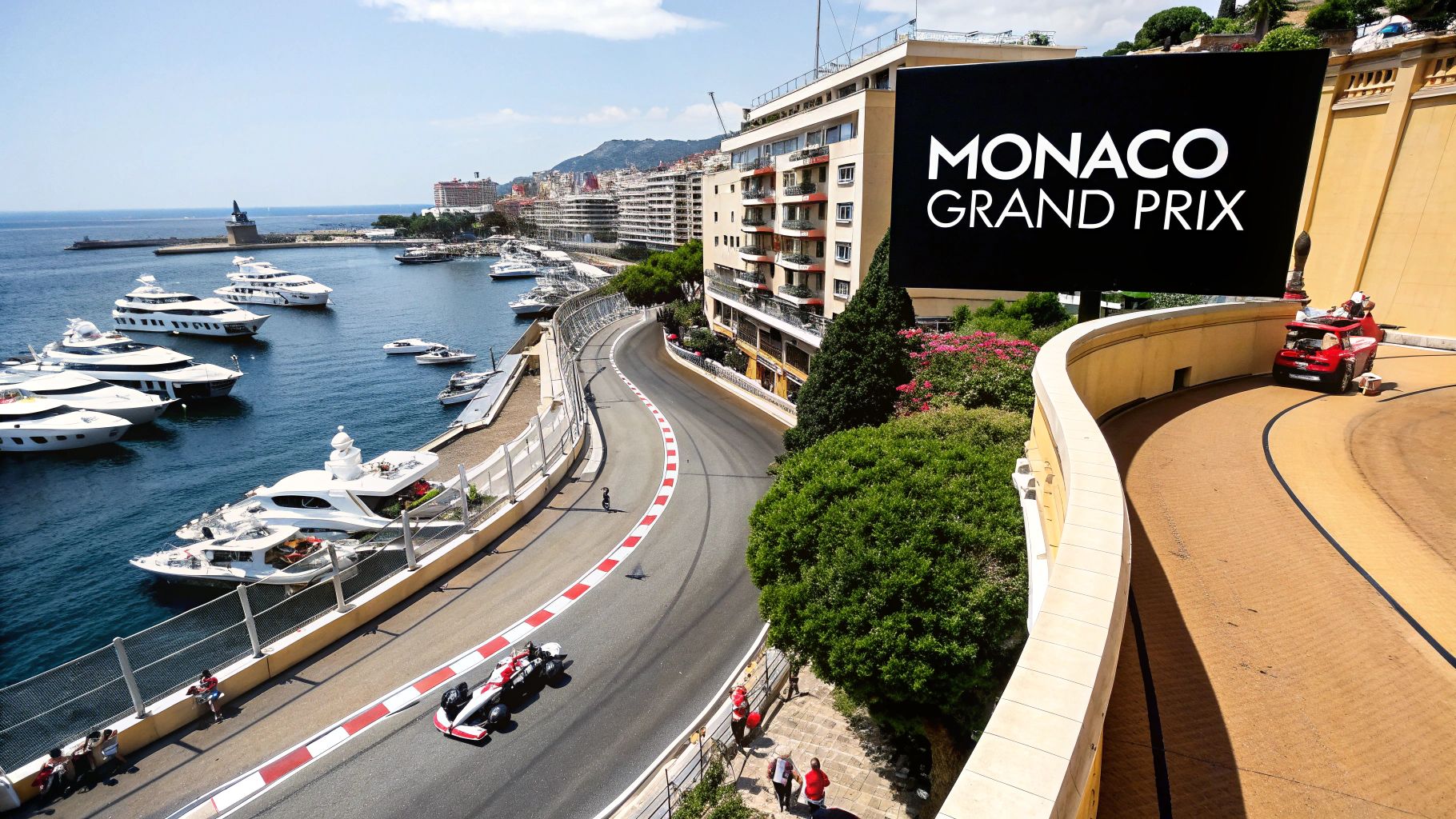
There’s simply nothing else like it on the calendar. The Monaco Grand Prix transcends motorsport. It's a spectacular collision of high-speed precision, immense danger, and almost unbelievable opulence. Unlike modern, purpose-built racetracks with acres of runoff, the Circuit de Monaco is a temporary beast, built from public roads.
For one weekend a year, the very streets locals use for their daily commute morph into a high-stakes arena. Here, the world's greatest drivers thread multi-million dollar machines through impossibly narrow gaps. The barriers are unforgiving, the corners are household names, and a single mistake almost guarantees the end of a driver's race.
A Test of Pure Skill
Winning at Monaco is one of the highest honours in a driver's career. It’s one-third of the unofficial Triple Crown of Motorsport, alongside the Indianapolis 500 and the 24 Hours of Le Mans. The track’s unique layout puts a massive premium on pure driver skill, often trumping the outright performance of the car.
"Winning at Monaco feels as good as winning the world championship." - Nelson Piquet, three-time Formula 1 World Champion.
You'll hear that sentiment repeated up and down the paddock. The sheer mental focus needed to navigate 78 laps here is the stuff of legend. Drivers often describe it as a mental marathon, where even a split-second lapse in concentration means an intimate meeting with the Armco barriers.
Why Monaco Captivates Fans
The magic of Monaco lies in its raw, unfiltered challenge. It’s a glorious throwback to a bygone era of racing, where the danger was real and the drivers were heroes in the truest sense. For us fans, especially those in Australia waking up at an ungodly hour to watch, the race is a must-see spectacle of skill and chaos.
What makes this track a global icon? It boils down to a few key things:
- Unmatched Prestige: A win here carries more weight than almost any other. It instantly cements a driver's name in the history books.
- Intense Spectacle: The cars screaming past just metres from spectators, engines echoing off the buildings, and the backdrop of superyachts create an atmosphere you can’t find anywhere else.
- Driver-Centric Challenge: The slow, technical nature of the track helps level the playing field, neutralising some of the car's aerodynamic advantages and allowing a truly exceptional driver to shine.
This guide will take you on a lap through every historic corner and chicane of the Monaco Grand Prix track. We'll dive into its rich history, break down what makes a perfect lap so fiendishly difficult, and celebrate the legends who have tamed its treacherous streets. Get ready to understand why this circuit is, and always will be, the crown jewel of Formula 1.
A Rich History Carved into Monte Carlo's Streets
Long before it became the glittering heart of the Formula 1 calendar, the idea for a race through Monaco's streets was sparked by a simple need for recognition. Back in the late 1920s, Antony Noghès, the man in charge of the Automobile Club de Monaco, was determined to put the principality on the global motorsport map. His plan was audacious: turn the city's tight, everyday roads into a genuine racing circuit.
This wasn't some purpose-built track out in the countryside; it was a vision carved directly into the very fabric of Monte Carlo. The first-ever Monaco Grand Prix roared to life on 14th April 1929, a spectacle of raw bravery that instantly captured the public's imagination. Early racing heroes threaded their basic machines through the same streets we see today, setting a standard for precision driving that has defined the event ever since.
When the official Formula 1 World Championship kicked off in 1950, Monaco was rightly there from the start. Its inclusion cemented its reputation as a circuit that demands far more than just raw speed—it requires courage, finesse, and an almost intuitive connection between the driver and their car.
Evolving with the Sport
Remarkably, the Monaco track of today is incredibly similar to its original 1929 layout, a true testament to its timeless, challenging design. Over the decades, however, it has seen subtle but critical changes to cope with the ever-increasing speed of F1 cars and to improve safety in what is an inherently dangerous place to race.
A few key changes have shaped the modern-day challenge:
- The Swimming Pool Section: What was once a straight blast along the harbour was transformed in 1973 with the addition of the fast chicane complex, creating one of the track's most iconic and demanding sequences.
- Nouvelle Chicane: The chicane at the exit of the tunnel was re-profiled to scrub off speed after what is the fastest part of the entire circuit.
- La Rascasse: The final corners were also reconfigured, creating the tight, technical entry into the start-finish straight that so often produces last-gasp drama.
These tweaks weren't just about changing the layout; they were about preserving the circuit's formidable character while adapting to new eras of motorsport. To get a better feel for the sport's origins, you can dive deeper into the rich F1 history that shaped legendary tracks like this one.
A Legacy of Attrition
The punishing nature of the Monaco Grand Prix is written all over its grim statistics. It holds the unwanted record for the fewest finishers in an F1 race—a mere three cars crossed the finish line in 1996, and only four managed it in 1966. With zero runoff and barriers hugging every single corner, crashes are a constant threat. Drivers navigate 19 braking zones per lap, spending a massive 27% of their time on the brakes. This relentless demand on both car and driver is exactly what thrills Aussie fans who love the controlled chaos of this 3.337 km beast. For a closer look at these extreme braking demands, you can learn more about Monaco's unique challenges from braking specialists at Brembo.com.
The circuit's evolution reflects a constant balancing act: maintaining its historic, unforgiving soul while meeting the demands of modern Formula 1. Each modification has added another layer to its legendary story.
From its humble beginnings as a local spectacle to its current status as the most prestigious race on the planet, the history of the Monaco Grand Prix is etched into every kerb and barrier. It’s a living museum of motorsport, a place where the ghosts of past champions race alongside today’s heroes, continuing a tradition of excellence that defines Formula 1.
Navigating the Legendary Corners of Monaco
To truly get your head around the Monaco Grand Prix, you have to mentally walk the circuit, corner by treacherous corner. This isn't your average racetrack; it's a relentless series of iconic turns, each with its own story, its own personality, and its own special way of punishing the tiniest of mistakes.
Forget the wide-open, forgiving circuits of the modern era. Monaco is a tightrope walk between unforgiving Armco barriers, a place where the driver is both an artist and a daredevil.
The lap kicks off not with a gentle roar, but with a sudden, violent blast of acceleration down the short start-finish straight. Drivers hustle past the pit lane and brace for the first big test: Sainte Dévote. This tight right-hander, named for Monaco's patron saint, is pure chaos on the first lap as the entire grid tries to squeeze through its narrow apex. Get it wrong here, and your race is over before it's even started.
The Climb to Casino Square
From Sainte Dévote, the cars launch themselves up the Beau Rivage hill. It’s a sweeping, blind left-hander taken at incredible speed, where the car feels light and skittish. Here, drivers are literally threading a needle between the barriers as they climb towards the most glamorous and recognisable backdrop in all of motorsport.
Next up is the left-hander of Massenet, which flows directly into the legendary Casino Square. This is where the sheer spectacle of Monaco hits you. The drivers flick the car right, directly in front of the magnificent Casino de Monte-Carlo. It's a section that demands unbelievable precision, as the car crests a small rise and momentarily loses grip.
From its earliest days as a high-society rally to its current iconic status, the evolution of the Monaco track is a story in itself. This visual map traces its incredible journey.

The image really drives home how the circuit’s core challenge—a driver’s ultimate test—has stayed the same, even as the sport around it has changed completely.
The Descent and the Hairpin
After the glitz of Casino Square comes the sharp, bumpy descent. The track plunges downhill through the two Mirabeau corners—first the tight Mirabeau Haute, then the slightly faster Mirabeau Bas. These are tricky, off-camber turns where locking a brake is terrifyingly easy.
This sequence funnels drivers directly into what is arguably the most famous corner in motorsport: the Fairmont Hairpin. Formerly known as the Loews Hairpin, it's the slowest corner in Formula 1, taken at a crawling 50 km/h. Drivers have to apply full steering lock, almost as if they're parallel parking a multi-million-dollar rocket.
From there, it’s a quick squirt of power into the right-hand Portier corner. This turn is deceptively important; a clean exit is everything for building speed into the fastest part of the track. It's also the very spot where Ayrton Senna famously crashed out while leading in 1988, a moment forever burned into F1 history.
Through the Tunnel and Harbourfront
Portier leads straight into the iconic Tunnel. Plunging from bright sunlight into relative darkness, the drivers go flat-out, hitting speeds of nearly 300 km/h through this curved section. The rapid change in light is completely disorienting, and the car’s aerodynamics are briefly disturbed by the enclosed space.
"You're coming out of the tunnel and into the light. The first time you do it, you're not ready for how quickly the barrier comes up. It’s a real moment of commitment." - Mark Webber, former F1 driver and Monaco Grand Prix winner.
Emerging from the darkness, drivers slam on the brakes for the Nouvelle Chicane, a tight left-right flick that is the track's best—and some would say only—real overtaking spot. It’s a high-risk, high-reward move that has decided the fate of many races.
The lap continues with a short straight leading to the left-hand Tabac corner, taken at high speed with the harbour's incredible superyachts providing a stunning backdrop. For a deeper dive into how this layout compares to others, you can explore our full collection of F1 circuits on our map collection.
The most famous corners of the Circuit de Monaco aren't just turns; they are legendary landmarks in motorsport history. Each one presents a unique challenge that has tested the world's greatest drivers for decades.
Key Corners of the Circuit de Monaco
| Corner Name | Turn Number | Key Challenge | Historical Significance |
|---|---|---|---|
| Sainte Dévote | 1 | A tight right-hander known for first-lap pile-ups. | Named after Monaco's patron saint; a make-or-break start to the race. |
| Casino Square | 4 | A fast, cresting right-hander requiring immense precision. | The most glamorous and photographed section of any F1 track. |
| Fairmont Hairpin | 6 | The slowest corner in F1, requiring full steering lock. | An iconic, surreal pivot point that defines the track's unique character. |
| The Tunnel | 9 | A high-speed, curved section with dramatic light changes. | The fastest part of the circuit and a unique aerodynamic challenge. |
| Swimming Pool | 15 & 16 | A fast left followed by a tight right-left chicane. | Demands millimetre-perfect accuracy; the walls are incredibly close. |
| La Rascasse | 18 | A tight, technical right-hander before the final corner. | Named after the famous bar; a common spot for late-race drama. |
Navigating these corners successfully is what separates the good from the great in Formula 1. Each one is a chapter in the story of a Monaco lap.
The Final Challenge: The Swimming Pool and Rascasse
What comes next is one of the most demanding sequences on any circuit in the world: the Swimming Pool complex (Piscine). It starts with a lightning-fast left-hander, followed immediately by a tight right-left chicane that requires aggressive use of the kerbs. Drivers have to be perfect here; the walls close in, and any error is punished instantly and brutally.
After wrestling the car through the Piscine, only two crucial corners remain. First is La Rascasse, a tight right-hander named after the famous bar on the inside of the turn. It's another slow, technical corner that often sees drama, especially on worn tyres late in the race.
Finally, a sharp right-hander named Antony Noghès slingshots the drivers back onto the main straight to complete a punishing, exhilarating lap of Monaco.
Why a Perfect Lap in Monaco Is Nearly Impossible
Nailing a single lap of the Monaco Grand Prix is often called the greatest challenge in all of motorsport. It’s so much more than just driving fast; it’s a high-wire act where millimetres separate glory from a disastrous meeting with the barriers. For 78 laps, drivers have to maintain absolute, flawless concentration in an arena designed to punish the tiniest mistake.
Imagine trying to fly a fighter jet through a living room. That's the kind of mental load we're talking about. There are no proper straights to catch your breath, no runoff areas to forgive a slip-up. Every corner, every kerb, and every gear change demands total perfection, lap after relentless lap. It’s the ultimate test of mental and physical endurance.
This incredible intensity is exactly why qualifying on Saturday is arguably more important than the race itself. With overtaking notoriously difficult on these narrow streets, track position is everything. Starting at the front isn't just a leg-up; it's pretty much essential for victory.
Qualifying Is King in Monte Carlo
Nowhere else on the Formula 1 calendar does your starting spot matter more. The Monaco Grand Prix, a legendary 3.337 km street circuit winding through glamorous Monte Carlo, has been a cornerstone of F1 since 1950. For Aussie F1 fans, it's a bucket-list event, with local heroes like Jack Brabham etching their names into its history.
Over its 70+ races, the track has crowned 37 different winners. But here’s the killer stat: a staggering 32 of those victories—a whopping 86% success rate—came from pole position. This single number proves why qualifying truly is king on this unforgiving layout.
This statistic completely shapes the entire race weekend. Teams and drivers pour everything they have into that one perfect qualifying lap, knowing it could seal their fate for Sunday.
A pole position at Monaco is worth more than a pole position anywhere else in the world, by a long way. It’s almost 90% of the job done.
This laser focus on a single lap turns Saturday's session into a breathtaking spectacle. You see drivers push their cars right to the absolute edge, often kissing the barriers in a display of controlled aggression that is just mesmerising to watch. The gap between pole and second can be just thousandths of a second. If you're curious how Monaco stacks up against other tracks, check out our deep dive into rating all the Formula 1 Grand Prix tracks.
Strategic Chaos and Car Setup
If qualifying doesn't go to plan, a driver's only real hope often lies in a clever strategy and the high chance of a Safety Car. With the barriers so close, incidents are common, and a well-timed Safety Car can completely flip the race on its head.
This turns pit stop timing into a high-stakes game of chance. Pitting under a Safety Car can save a driver around 10-12 seconds compared to a stop under normal green flag conditions. A lucky break can launch a midfield runner into podium contention, while an unlucky one can completely ruin a race leader's day.
To even be in the running, teams have to set up their cars specifically for Monaco's unique demands. The philosophy here is totally different from any other circuit on the calendar.
- Maximum Downforce: Teams bolt on their biggest, most aggressive wings to generate as much aerodynamic grip as possible for the slow-speed corners.
- Softest Tyres: Grip is everything, so the softest available tyre compounds are used to maximise traction on the slippery street surface.
- Specialised Suspension: The suspension is softened and the ride height is raised to cope with all the bumps, kerbs, and camber changes of the public roads.
This technical cocktail, combined with the immense mental pressure and strategic variables, is what makes a truly "perfect" lap a near-mythical idea. Winning here requires a special blend of raw speed, strategic genius, and a healthy dose of good fortune.
Celebrating the Legends Who Conquered Monaco
Winning at Monaco is more than just a notch on your belt; it’s your ticket to motorsport immortality. The circuit is so ferociously demanding that a victory here requires an almost supernatural blend of talent, raw nerve, and millimetre-perfect precision. Over the decades, an elite club of drivers has proven they have what it takes, but a select few have mastered Monaco so completely their names are forever etched into its history.
The unofficial title of ‘Mr. Monaco’ is reserved for those who truly tamed this beast of a track. For years, that honour belonged to British hero Graham Hill, who owned the streets in the 1960s with an incredible five victories. His masterful car control and tactical smarts set the gold standard for what it took to win around Monte Carlo.
But for a whole generation of fans, one name eclipses all others.
The Reign of Ayrton Senna
The undisputed king of Monaco is Ayrton Senna. The Brazilian maestro’s record of six victories is still the benchmark—a feat that feels almost superhuman on a circuit that punishes the smallest mistake. His connection with the track was something else entirely; it was pure, intuitive genius that left rivals, and everyone watching, completely spellbound.
For Australian F1 fans, Senna's dominance at Monaco is legendary. His six wins between 1987 and 1993, including a staggering five in a row, fuelled a massive surge in passion for the sport down under. Many of us can still remember packing into pubs in Melbourne to watch his defensive masterclass in 1992, where he somehow held off Nigel Mansell's much faster Williams to win by just 0.21 seconds. Senna also snatched five pole positions here, a record that really drives home just how critical one-lap magic is at this circuit. If you want a deeper dive, you can find more insights about Senna's Monaco achievements on Formula1.com.
Senna’s uncanny ability to push right to the absolute limit, lap after lap, without ever stepping over it, was what made him untouchable here. His 1988 qualifying lap, nearly one and a half seconds faster than his teammate Alain Prost, is still talked about as perhaps the single greatest lap in F1 history.
The Hall of Fame
While Senna’s record is extraordinary, other titans of the sport have also cemented their legacies on the streets of Monte Carlo. Icons like Michael Schumacher and Alain Prost each took home five wins, showcasing their own unique brands of genius on these hallowed streets. Modern greats have also added their names to the list of multi-time winners; you can get a feel for the driving style of champions like Lewis Hamilton, who has mastered this circuit three times.
For Aussie fans, Monaco holds a special place in our hearts thanks to our own heroes who have triumphed here. The great Sir Jack Brabham scored a famous victory way back in 1959, blazing a trail for future generations. Decades later, Mark Webber muscled his Red Bull to two incredible wins, and who could forget Daniel Ricciardo’s emotional 2018 victory? Nursing a wounded car to the finish line, that win remains one of the most celebrated moments in recent Aussie motorsport history.
Bringing the Monaco Grand Prix Track into Your Home
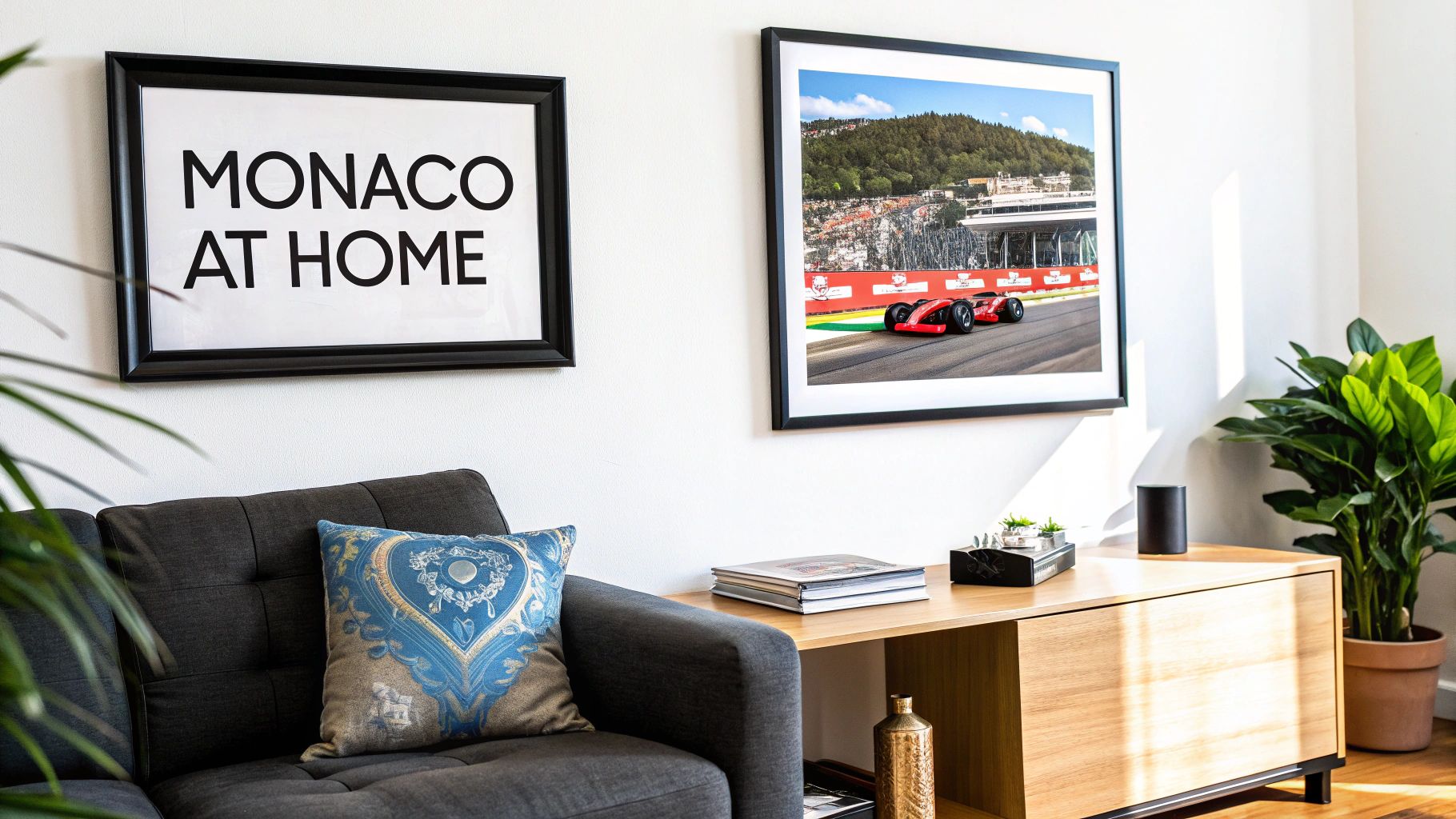
The legend of Monaco stretches far beyond the TV screen on a Sunday afternoon. For a true fan, the passion for this iconic circuit is part of who you are. The good news? You don’t need a superyacht moored in Port Hercule to celebrate its legacy. You can bring that unique blend of glamour and raw precision right into your own home.
Turning the energy of Monte Carlo's streets into stylish home decor is all about creating a space that feels both personal and sophisticated. This is about more than just sticking a poster on the wall; it’s about crafting an atmosphere that captures the essence of what makes this race so special. A well-chosen piece of wall art can become a stunning focal point in any room, whether it’s your home office, living area, or the garage.
Curating Your Personal Grid
A motorsport-themed gallery wall is a brilliant way to put your passion on display. Think of it like assembling a team—each piece should complement the others while telling its own story. Your centrepiece could be a minimalist outline of the Monaco circuit, its famous twists and turns captured in clean, modern lines.
From there, you can build out your collection:
- Historic Photography: Black and white prints of legends like Senna or Hill wrestling their cars through the hairpin add a timeless, classic feel.
- Vibrant Car Art: A high-quality canvas print of a classic F1 car, like a scarlet Ferrari or a striking McLaren, gives you a dynamic splash of colour.
- Themed Memorabilia: Round out your wall art with smaller framed items like old ticket stubs or postcards from the principality.
This approach creates a real narrative on your wall, celebrating not just the track itself but the entire culture surrounding the Monaco Grand Prix.
Choosing the right art is about finding a piece that speaks to your connection with the sport. It should evoke the thrill of the tunnel, the glamour of Casino Square, and the raw skill on display at every single corner.
Matching Style with Substance
Monaco’s aesthetic is all about refined elegance, and your decor should reflect that. A minimalist, black-framed canvas of the circuit layout is incredibly versatile and fits right in with most modern interiors. It's a subtle nod to your passion that feels more like genuine art than simple fan merchandise.
For an even bigger statement, a meticulously detailed Circuit de Monaco framed canvas print can completely transform a wall. Pair your main artwork with complementary textures and materials to really complete the look. Think brushed metal photo frames, carbon-fibre-inspired coasters, or even a bookshelf stacked with biographies of Monaco's greatest champions. By combining these elements, you create a space that celebrates the Monaco Grand Prix in a way that’s both stylish and deeply personal.
Your Monaco Grand Prix Questions, Answered
The Monaco Grand Prix is a race that captures the imagination like no other, and its unique nature always sparks a ton of questions. What’s it really like to race there? Why is it so famously difficult? Can you actually walk on the track?
We get it. The mystique is real. So, we’ve put together some quick, straightforward answers to the most common questions we hear from fans.
Why Is Overtaking So Hard at Monaco?
It all comes down to the circuit’s unforgiving layout. The track is incredibly narrow, there are almost no long straights, and the corners are ridiculously tight. With steel barriers kissing the edges of the tarmac and absolutely zero runoff area, there’s simply nowhere to go.
Any attempt to pass is a massive risk. The one real, albeit risky, opportunity is to out-brake someone into the Nouvelle Chicane after hurtling through the tunnel. This is exactly why a good qualifying position at the Monaco Grand Prix is more important than at any other race on the Formula 1 calendar. A front-row start is half the battle won.
What’s the Fastest Lap Around the Circuit?
The official race lap record on the current 3.337 km circuit is a mind-bending 1:12.909, set by Lewis Hamilton back in 2021. It’s a stunning reminder of just how fast modern F1 cars are, even when navigating these tight, historic streets.
But that’s not the whole story. The fastest unofficial lap ever recorded belongs to Valtteri Bottas, who scorched around in 1:10.252 during qualifying in 2019. Qualifying laps are always faster—the cars are running on low fuel with fresh tyres, pushing everything to the absolute limit for that all-important starting spot.
Can You Actually Walk the Monaco Grand Prix Track?
Yes, you absolutely can! This is one of the coolest things about Monaco. For most of the year, the circuit is just a collection of public roads. Outside of the race weekend, you can walk, drive, or even cycle the entire legendary layout.
This incredible access means you can experience the track on a deeply personal level.
- Stand on the start-finish straight where champions are made.
- Try and navigate the impossibly tight Fairmont Hairpin.
- Drive through that world-famous tunnel.
It’s an amazing way to connect with the history and feel the sheer challenge of the world’s most iconic street circuit for yourself.
Celebrate the world's most prestigious circuit with a piece of art that captures its elegance and intensity. Explore the full collection of motorsport-inspired designs at TrackNation and bring the legend of Monaco into your home. Discover your perfect piece at https://tracknation.au.