

Williams F1 The Enduring Legacy of a Formula 1 Dynasty
Williams F1 isn't just another name on the grid; it's one of the most storied and resilient teams in Formula 1 history. Their journey is a testament to independent spirit and championship glory, starting from the humblest of beginnings in a carpet warehouse under the leadership of Sir Frank Williams and Patrick Head.
An Unbreakable Formula 1 Spirit
In the high-stakes, high-glamour world of Formula 1, very few names carry the same weight as Williams F1. For decades, this legendary British team has been the embodiment of true grit, consistently punching well above its weight to take on, and often beat, the manufacturing goliaths of the sport. The team’s history is a powerful story of pure passion, ingenious innovation, and an unshakeable will to win against all odds.
This isn’t just the story of a racing team; it’s the story of a family’s singular vision. Sir Frank Williams built his team from nothing, creating a culture where engineering brilliance and a deep-seated love for motorsport were the only things that mattered. This unique atmosphere became a magnet for some of the greatest talents in both driving and design, paving the way for an era of dominance that is forever etched into F1 folklore.
The Heart of a Privateer
Unlike many of their rivals who were bankrolled by major car manufacturers, Williams has always been a true "privateer" at its core. This means their incredible success was earned through clever engineering and resourcefulness, not just deep pockets. This fierce independence is a fundamental part of their identity.
Williams represents the quintessential underdog spirit of Formula 1. Their journey from a small British operation to a nine-time Constructors' Champion showcases what is possible when passion and ingenuity are the driving forces.
It's this foundational spirit that connects so deeply with fans all over the world. Every victory felt earned, and every championship was a monumental triumph for the independent competitor.
Why Williams Matters Today
Even through the tough seasons of the modern era, that legacy lives on. The team's history is a crucial part of the sport's very fabric, a constant reminder of a time when private teams could rise to the absolute pinnacle of motorsport. To truly appreciate the rich tapestry of racing, it’s essential to understand their journey—a topic you can explore further in our detailed look at the history of F1 teams.
Through thick and thin, their story continues to inspire a fiercely loyal global fanbase that celebrates resilience just as much as victory.
The Golden Era of Williams F1 Dominance
Every legendary team has its golden era, and for Williams, the 1980s and 1990s were pure gold. This wasn't just a string of good years; it was an absolute masterclass in Formula 1 dominance that fundamentally reshaped the sport. The driving force behind it all was the formidable partnership of Sir Frank Williams and Patrick Head, whose technical genius consistently outsmarted and out-engineered the competition.
This period was all about bold engineering moves that left other teams playing catch-up. Williams wasn't just building faster cars; they were pioneering technologies that became the stuff of legend. By mastering aerodynamics and embracing groundbreaking systems others shied away from, they created machines that were, for long stretches, simply untouchable.
Engineering Mastery on Display
The team's brilliance truly shone through in their technical advancements. They had a fearless willingness to experiment, which led to some of the most sophisticated and effective cars the sport had ever seen. This audacious approach to design was the bedrock of their success, turning complex theories into devastating on-track performance.
Some of their most famous innovations included:
- Active Suspension: A game-changing, computer-controlled system that constantly adjusted the car's ride height. This delivered a massive aerodynamic advantage and unbelievable stability through corners.
- Semi-Automatic Gearbox: This allowed for lightning-fast gear changes, giving Williams drivers a crucial edge over every single lap.
- Superior Aerodynamics: Patrick Head and his design team, which included the legendary Adrian Newey, sculpted cars that manipulated airflow with surgical precision to generate incredible downforce.
When these technologies came together in cars like the FW14B and FW15C, the performance gap was just staggering. They didn't just win races—they completely controlled them from lights out to chequered flag.
This timeline beautifully captures the key phases of the team’s incredible journey, from its humble beginnings to its era of total dominance and lasting legacy.
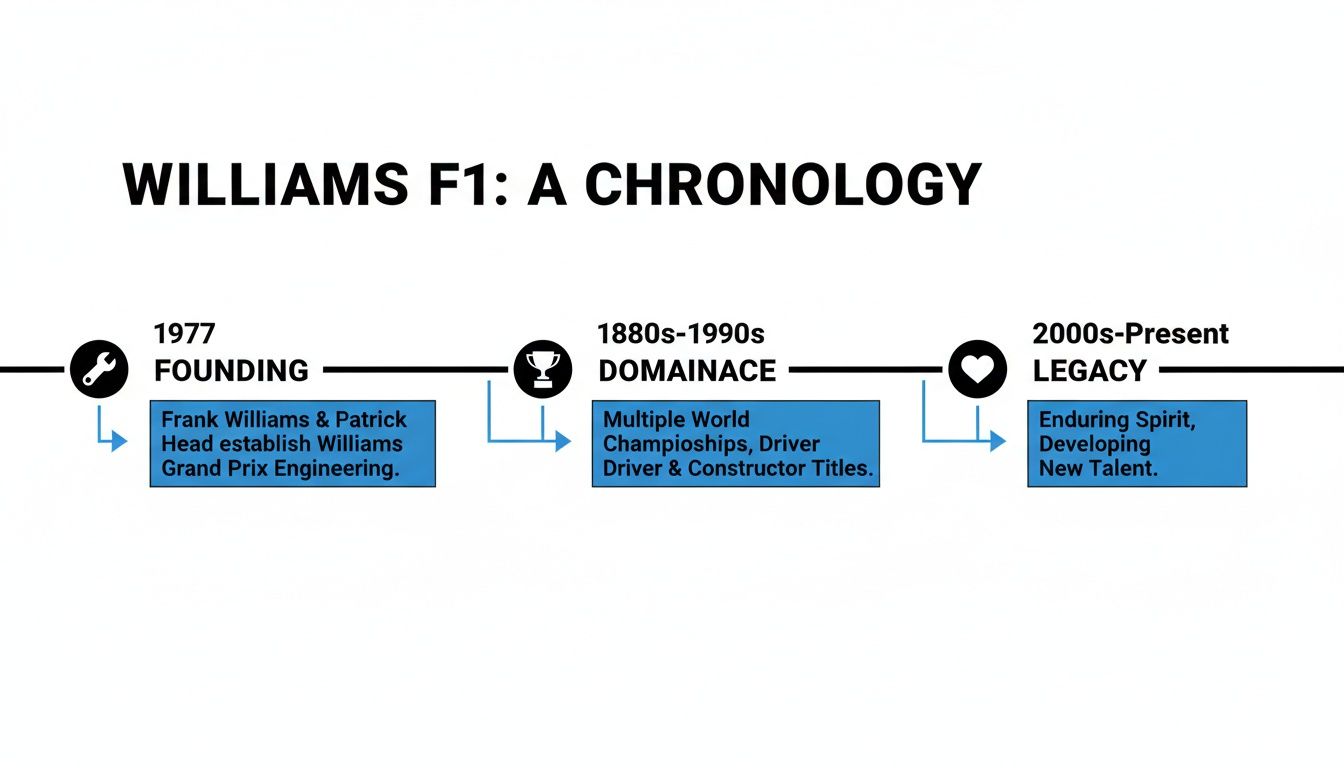
As the graphic shows, the hard graft of the late '70s laid the perfect foundation for the trophy-filled decades that were just around the corner.
The Champions Who Piloted Perfection
Of course, even the most perfect car needs a masterful driver at the wheel. During this era, Williams became the destination for the world's top talent, attracting a who's who of legends who would go on to win world championships with the team. Drivers like Nigel Mansell, Alain Prost, and Damon Hill became household names piloting these incredible machines.
Their success was a global affair, including a particularly strong record down under in Australia. Williams kicked off its Aussie legacy with a triumphant win at the very first Adelaide Grand Prix in 1985, with Keke Rosberg taking the top step. This was just the start, as the team went on to secure a stunning five race victories in Adelaide before the GP moved to Melbourne, where Damon Hill won the final two.
This incredible run of form cemented Williams F1 as one of the sport's all-time greats. Here’s a quick look at the championship titles they racked up during this period.
Williams F1 Championship Victories
| Year | Championship Won | Winning Driver(s) |
|---|---|---|
| 1980 | Constructors' & Drivers' | Alan Jones |
| 1981 | Constructors' | Alan Jones, Carlos Reutemann |
| 1982 | Drivers' | Keke Rosberg |
| 1986 | Constructors' | Nigel Mansell, Nelson Piquet |
| 1987 | Constructors' & Drivers' | Nelson Piquet |
| 1992 | Constructors' & Drivers' | Nigel Mansell |
| 1993 | Constructors' & Drivers' | Alain Prost |
| 1994 | Constructors' | Damon Hill, David Coulthard, Nigel Mansell |
| 1996 | Constructors' & Drivers' | Damon Hill |
| 1997 | Constructors' & Drivers' | Jacques Villeneuve |
All told, their golden era delivered seven Drivers' Championships and nine Constructors' Championships. This wasn't just a winning streak; it was a powerful demonstration of what happens when brilliant engineering, visionary leadership, and fearless drivers come together.
To see how their story fits into the bigger picture, check out our guide covering the history of F1 teams.
Iconic Cars That Defined an Era
A great team is often defined by its machines, and Williams F1 created some of the most legendary cars in the history of F1. These weren’t just fast cars; they were engineering masterpieces that carried the team to glory and captured the imaginations of fans across the globe.
Their designs were the perfect marriage of raw speed and pure aesthetic brilliance, turning them into instant icons. And it wasn't just the performance that made them famous—it was their unforgettable liveries. From the bold yellow of Canon to the classic Rothmans blue and white, these colour schemes became synonymous with success on the track. They captured the spirit of their time, creating a visual legacy just as powerful as their race wins.
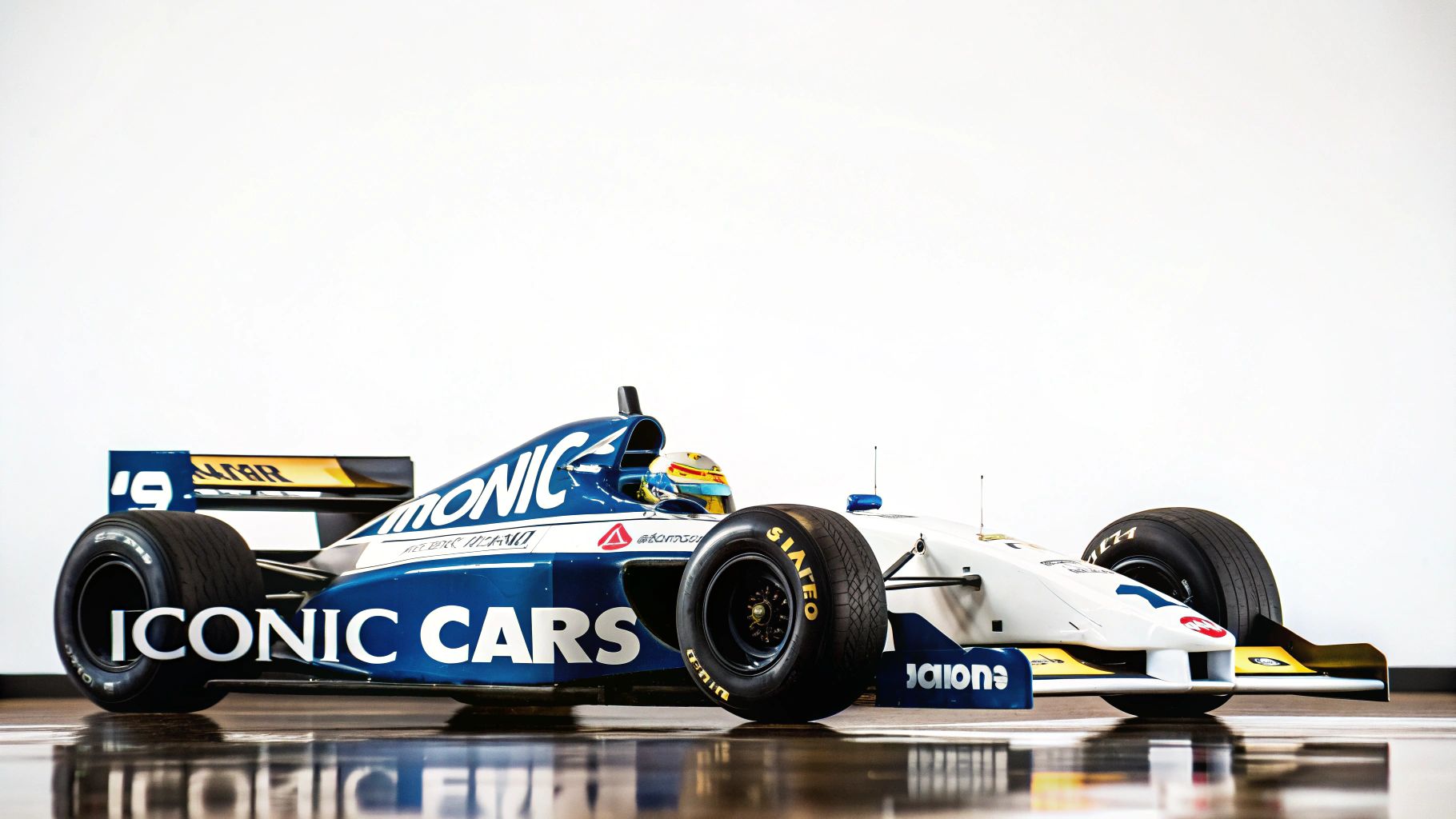
The FW14B: The Active Suspension King
Ask any F1 fan about dominant Williams cars, and the FW14B is usually the first name that comes up. When it hit the track for the 1992 season, this car was so far ahead of its time it felt like it was in a different category altogether. Its secret weapon? A computer-controlled active suspension system.
This clever system constantly adjusted the car's ride height to maintain the perfect aerodynamic platform, giving it incredible grip and stability through the corners. Nigel Mansell piloted the FW14B, and he was simply unbeatable. He stormed to the Drivers' Championship with nine wins, sealing the title in August—one of the earliest championship victories in F1 history. This machine wasn't just fast; it was a huge technological leap forward for the sport.
The FW15C: A Technological Tour De Force
Just when rivals thought they might have caught up, Williams unleashed the FW15C for the 1993 season. It took every groundbreaking concept from the FW14B and polished it to near perfection. The car was an absolute powerhouse of electronic aids, so effective that many of them would be banned in the years that followed.
The FW15C was arguably the most technologically advanced Formula 1 car ever built at that point. It featured not only active suspension but also traction control, a semi-automatic gearbox, and even anti-lock brakes, making it unbelievably quick and consistent.
Alain Prost was lured out of retirement to drive this masterpiece, and the result was another crushing championship win for the Williams F1 team. The FW15C cemented Williams' reputation as the undisputed kings of engineering in the 1990s.
The legacy of these cars is immense. They represent a golden era when Williams pushed the boundaries of what was possible in motorsport. For fans, owning a piece of this history, like a stylised print of the iconic Rothmans livery, is more than just decor—it’s a timeless tribute to an age of pure dominance and engineering genius.
The Legendary Drivers of Williams F1
A great car is nothing without a great driver, and Williams has been home to some of the absolute titans of Formula 1. These weren't just skilled pilots; they were gladiators who embodied the team's fighting spirit, turning engineering marvels into championship-winning machines. Their unique driving styles and career-defining moments are completely woven into the fabric of the Williams F1 story.
From the raw, bulldog determination of Nigel Mansell to the aggressive flair of Juan Pablo Montoya, the Williams cockpit has seen an incredible array of talent. Each driver brought their own personality and fire to the team, creating memories that still give fans goosebumps decades later. Their legacies are a huge part of why memorabilia celebrating these motorsport icons remains so powerful.
Nigel Mansell: The British Bulldog
Few drivers have ever captured the hearts of fans quite like Nigel Mansell. The passionate Italian Tifosi nicknamed him 'Il Leone' (The Lion) for his fearless, all-or-nothing approach to racing, and it was the perfect fit. Mansell was the epitome of grit. His on-track battles were the stuff of legend, often pushing his car to the absolute limit and far, far beyond.
His defining moment finally came in 1992 when he stormed to his long-awaited World Championship at the wheel of the all-conquering FW14B. It was a victory celebrated by an entire nation, a massive reward for his relentless perseverance with the Williams team.
From Prost to Hill: A Dynasty of Champions
After Mansell’s triumph, Williams didn't slow down, continuing its incredible run with a series of world-class drivers. The legendary Alain Prost, 'The Professor', joined for the 1993 season. With his famously calculated and intelligent approach, he expertly piloted the FW15C to his fourth and final title.
Then came Damon Hill, son of double World Champion Graham Hill. Damon's journey was one of pure resilience, having to step up and lead the team through its most difficult and tragic period. His emotional championship victory in 1996 was a hugely popular win that cemented the Hill family name forever in F1 history. You can learn more about the paths of modern champions in our article on Lewis Hamilton's remarkable career.
The ability of Williams to attract and nurture championship-winning talent was central to their golden era. It wasn't just about building the best car; it was about pairing it with drivers who had the skill and mentality to extract every last tenth of a second from it.
A New Generation of Talent
The team continued to be a launchpad for future stars. Valtteri Bottas, a former Williams ace, made his debut at Albert Park in 2013, exactly six years before his dominant 2019 win with Mercedes—a nice nod to his Williams roots. While Williams has a strong Australian history with five triumphs in Adelaide, the modern Melbourne circuit has often tested the team's mettle, with drivers like Alex Albon now fighting tooth and nail for every single point.
Navigating the Modern F1 Challenge
The road back to the top is never a straight line, and for Williams F1, the modern era has been a gauntlet of hurdles. From massive regulation shake-ups to the introduction of a budget cap designed to level the playing field, the challenges have been immense.
After some tough years at the back of the grid, the team is now on a very public and determined path to redemption. This isn’t just about finding a few tenths of a second on the track; it’s a root-and-branch rebuild of the entire organisation.
That classic Williams resilience has become its greatest asset, a quality that keeps its die-hard fanbase behind them through thick and thin. Every point scored now feels like a victory in a much larger battle for revival.
A New Vision Under New Leadership
A huge part of this new chapter was the arrival of Team Principal James Vowles. He brought with him a long-term strategic vision, shifting the focus from short-term fixes to building a rock-solid foundation for future success.
"At its core, this partnership is built on a shared belief that technical excellence and high-performance systems in service of the mission are the keys to success." - James Vowles
That quote, made while discussing a team partnership, perfectly sums up the new philosophy brewing in Grove. It's all about getting the fundamentals right—upgrading factory machinery, modernising processes, and fostering a culture that can compete at the sharp end again.
On track, that fighting spirit is personified by drivers like Alex Albon, whose gritty, tenacious performances have often squeezed more out of the car than seemed possible, single-handedly dragging the team into the points.
The Fight on Track
You can see that fighting spirit play out every race weekend. Take the Australian Grand Prix, for instance, which saw a mind-blowing 465,498 spectators pack into the circuit, making it the biggest sporting event in Melbourne’s history.
Amid that chaos, the Williams drivers battled with everything they had. The race itself, with a record three red flags, was a perfect mirror for the team’s own journey—challenging, unpredictable, but defined by resilience. The drama on track, detailed in reports from the iconic Albert Park event, is what F1 is all about.
The story of modern Williams F1 is one of pure, unwavering grit. It’s a narrative that reminds fans exactly why they fell in love with the team in the first place: not just for the championships of the past, but for the relentless spirit that’s fuelling their fight for the future.
Bring the Williams F1 Legacy Home
Being a Williams F1 fan is about more than just race Sundays. It’s about appreciating a story of grit, ingenuity, and pure racing spirit. Bringing a piece of that history into your home is the perfect way to keep that legacy alive, turning your passion into a stylish statement.
Think about dedicating a corner of your office or living room to the team's golden era. This isn't about creating clutter; it's about making a sophisticated nod to what makes Williams so special. A single, well-chosen piece can completely transform a room, sparking conversations with fellow fans and giving you a hit of inspiration every single day.
Curating Your Champions Wall
One of the best ways to show your support is by creating a personal gallery—a 'Champions Wall' that pays tribute to the cars and drivers that defined an era.
- Iconic Car Prints: A minimalist print of the legendary FW14B or FW15C is a slick tribute to the team's engineering dominance. These artworks look fantastic in a modern office or study.
- Driver Tributes: You can’t tell the Williams story without its heroes. Artwork featuring legends like Nigel Mansell or Damon Hill captures the raw emotion behind their famous victories. Look for dynamic shots that bottle the intensity of their championship seasons.
- Retro Circuit Maps: Why not celebrate Williams' most famous wins with stylised maps of classic tracks like Silverstone or Adelaide? These add a great touch of motorsport history and look brilliant arranged as a set.
The key is to find a piece that connects with a moment in Williams' history that means something to you. Whether it’s Mansell’s 1992 triumph or the sheer genius of the FW15C, your decor should tell the story you love to tell.
More Than Just Art
It doesn't have to stop at wall art. You can subtly weave the Williams legacy into your space in other ways, too. Think about coasters featuring classic liveries or a mug printed with a memorable radio message. Each item is a small but powerful reminder of the team's incredible journey.
Exploring different kinds of Formula One memorabilia can open up even more ideas for turning your appreciation for Williams F1 into a stylish, personal statement that’s uniquely you.
Your Williams F1 Questions, Answered
Got a few questions about Williams? You're not alone. Let's run through some of the most common queries fans have about one of F1's most historic teams.
This is your go-to reference for brushing up on the key facts, whether you're a new supporter getting up to speed or a long-time fan wanting a quick refresher.
How Many Championships Has Williams F1 Won?
Williams is true Formula 1 royalty. The team has clinched an incredible nine Constructors' Championships and seven Drivers' Championships, placing them firmly in the elite tier of the sport's most successful outfits.
These titles were hard-won by some of the absolute legends of the sport, including Alan Jones, Keke Rosberg, Nelson Piquet, Nigel Mansell, Alain Prost, Damon Hill, and Jacques Villeneuve. That record alone speaks volumes about their historical dominance.
Who Owns The Williams F1 Team Now?
Since 2020, the team has been under the ownership of Dorilton Capital, a private investment firm based in the United States.
This move signalled a major shift, as it marked the end of the Williams family's direct involvement after Sir Frank Williams and his daughter Claire stepped down. It kicked off a fresh era of investment, with a clear focus on rebuilding the team and clawing its way back to the front of the grid.
The change in ownership was a huge moment. It brought much-needed resources and stability, allowing the team to finally start a proper long-term project to regain its competitiveness.
What Was The Most Dominant Williams F1 Car?
Hands down, the 1992 Williams FW14B is the stuff of legend. Many still see it as one of the most technologically brilliant and utterly dominant cars in the history of Formula 1. It was packed with tech like a revolutionary active suspension system and advanced traction control that left rivals for dead.
Nigel Mansell piloted it to a crushing World Championship victory, wrapping up the title as early as August. The FW14B didn't just win; it rewrote the rulebook on F1 engineering and forced every other team back to the drawing board.
Celebrate the incredible legacy of TrackNation with premium wall art that brings the stories of these championship-winning cars and drivers to life. Find your perfect piece at tracknation.au and honour one of F1's most iconic teams.